

Visit the Missouri Department of Conservation (MDC) educational page on falcons! You will find fact sheets, classroom activities and lesson plans to help students in all grades learn about the Peregrine falcon activities.
Materials were developed in partnership with the World Bird Sanctuary, St. Louis, Mo. Other material adapted from the MDC's Discover Nature Schools program. You can also check out questions and answers on the falcons from Jeff Meshach, deputy director of World Bird Sanctuary.
Ameren Missouri, the Missouri Department of Conservation and the World Bird Sanctuary are working together to use their diverse resources to protect and preserve the wildlife of the heartland. The Peregrine falcon project is the latest result of these efforts. Learn more about the installation of the nesting box and camera at the Ameren Missouri Labadie Energy Center.
- Ameren Missouri
Ameren Missouri, in conjunction with the Missouri Department of Conservation and the World Bird Sanctuary, is providing a nesting box for Peregrine falcons in Franklin County. The project is part of Ameren Missouri's ongoing commitment to being responsible stewards of the environment. - Missouri Department of Conservation
The Missouri Department of Conservation (MDC) protects and manages the fish, forest and wildlife of Missouri. The MDC provides information on resource management and numerous activities for enjoying and learning more about nature. - World Bird Sanctuary
The World Bird Sanctuary provides education, propagation, field studies and rehabilitation of threatened bird species in their natural environment. "The Peregrine falcon has made an incredible comeback from the brink of extinction," Jeff Meshach, director of the World Bird Sanctuary, said. "Our camera will provide a window into the nesting life of the world's fastest creature, and I personally will find it hard to get any desk work done as I watch my favorite of the world's bird species."
Ask Jeff 12 – June 17, 2026
Season Finale
Hello everyone! I am writing to you on Wednesday, June 17. I’m sure everyone is now aware that the camera was turned off early Saturday morning, June 13. We turned it off because the last chick (Meramec, band black/blue, W/36) left the box sometime late Friday afternoon. She jumped to the grating the nest box sits on, joining her three sisters who were already there.
Meramec’s siblings left the box last Wednesday, June 10, during the 5 a.m. hour. They were in and out of the box over the next three days, with all of them spending Thursday night into Friday morning in the box. Late Friday morning, I switched to the camera on my computer just in time to see one of the parents feeding Meramec. She was at the front-left corner of the box, looking down and making plenty of beak movement (meaning she was calling out). Then a parent’s head came into view in that same corner as it reached up to give her food. The parent was on the grating, tearing apart a prey item and passing pieces up to her. It gave Meramec about a dozen pieces before the feeding stopped.
On Monday afternoon, June 15, I got a call from a worker at Ameren Missouri’s Labadie Energy Center (where the nest box is located). He told me one of the chicks was on the ground. To refresh your memory, the first flights of Peregrine chicks usually result in them landing below the level of the nest box. I liken their first flights to a human baby’s first steps – clumsy at best. However, both learn very quickly, and usually a Peregrine’s second flight is much better.
When I arrived, the chick had made it onto the roof of a small vehicle, but it wasn’t in an ideal spot for a young falcon. When I tried to catch the chick from the vehicle, it flew to the ground, and I was then able to catch it easily. The chick was Lou (band black/blue, W/37). When Lou flew from the vehicle, I could see she was flapping her wings very well. When I caught her, she aggressively footed my glove. When raptors defend themselves, they use their strong feet. Since both her wings and feet were working well, I determined there was nothing wrong with her.
Using an elevator, we took Lou back up to the level of the nest box. I placed her on the grating, keeping my hand lightly on her back, wished her the best, and quickly returned to the elevator. I didn’t want to linger and risk causing her to fly again before she was ready.
It was so impressive to have Lou in my hands one last time. It was obvious her parents had been feeding her well – she felt heavy as I carried her. Her flight feathers (wing and tail) were nearly fully grown, though she still had some down on the top of her head. It’s rare to hold one of the chicks again after banding, but as amazing as it was, I knew I needed to get her back to her high-in-the-sky realm as quickly as possible.
The parents will continue feeding the chicks for the next three to six weeks as they learn to fly efficiently and eventually catch prey on their own. Peregrine parents have been observed bringing in live prey, likely to teach their young how to hunt. With the strength in their feet, Peregrines typically make the kill by biting their prey at the neck.
Long ago, I read an account of a parent transferring a live bird to its chick mid-flight. Upon feeling the prey struggle, the young bird dropped it. The parent easily caught it again, and the lesson continued. Even after fledging, Peregrine parents continue to care for their chicks, since catching another bird in flight is a complex skill.
Now to your questions. Some of you asked about occasionally seeing a white film on the chicks’ eyes. This is a great observation, as it appears only for a split second. The “white film” is actually a third eyelid called the nictitating membrane. Because birds move so quickly, even a normal blink could cause them to miss prey – or become prey themselves. The nictitating membrane is transparent, allowing them to blink, clear dust, and keep their eyes moist without losing sight of what’s happening around them.
Many of you also asked about my fledging prediction being off. I mentioned that Peregrine chicks usually fledge between 40 and 50 days old. Late Friday morning, I went to the energy center to check the grating beneath the nest box, since we can’t see the chicks on camera once they leave. I didn’t want to approach too closely and risk scaring them into flight, so I observed from a nearby rooftop.
From there, I realized that a kickplate on the grating could hide the chicks if they were lying flat. Fortunately, the adult female, Thor, flew by and called out at my presence. All three chicks that had left the box stood up, while Meramec remained inside, so I was able to confirm all four. As they grow stronger, young raptors often “branch,” moving onto nearby supports rather than flying outright. Our chicks did this by jumping to the grating beneath the box. Technically, they didn’t fly from the box, so my prediction may have been closer than it first appeared.
Unfortunately, it’s time for me to sign off until next year. It’s hard to describe how much I enjoy writing about the Peregrines we’ve come to know so well. Their behaviors, from the time the parents arrive through the chicks’ departure, never fail to captivate me. The icing on the cake is getting to answer your questions, which show just how committed you are to this Peregrine family.
As I leave you until next year, I have one request: If you aren’t already, consider becoming a member of an organization that supports wildlife. There are many in our area and across the country. Your support, through donations or volunteer time, helps protect wildlife and the habitats they depend on.
Folks, it has truly been a pleasure, and I can’t wait until next March when we connect again. Have a great rest of your 2026 and beyond!
Ask Jeff Supplemental – June 11, 2026
Hello everyone! I’m writing this supplemental ASK JEFF on Thursday, June 11. There is a lot going on with our Peregrine chicks. On the morning of June 10 at 5:17 a.m., 5:43 a.m., and 5:45 a.m., three of the chicks jumped to the grating just out of the camera’s view outside of the nesting box. If you were able to view this on the 24-hour stream, then you would have seen the chicks doing a lot of mouth-moving and turning their heads in synchronization, as if they were watching a tennis match. The action they were watching and screaming about was at least one parent flying by the box, probably with prey in its feet. Peregrine parents have been known to lure their chicks into fledging by flying by the nest so the chicks can see the food they have. In ASK JEFF 11, I wrote about the motivational power of hunger.
After the first chick jumps to the grating, all the others look and stare to their right as they watch to see what the chick that jumped is doing. The other two chicks that went to the grating left the box, one right after the other. They may have quickly left the box because one of the parents brought prey to the first chick that left. I believe the reason the fourth chick, Meramec, didn’t leave is because it’s the youngest. If you were able to watch the footage before the first chick leaves the box, you would have seen that one of the chicks has a little more down on it than the others. The chicks grow so fast that even if it’s several hours younger, the last chick that is still in the box isn’t ready to make the jump yet.
Later in the afternoon of the 11th, one of the chicks that left the box was back in the box. I didn’t check the footage, but one of the parents could have brought food to the box, and one of the three on the grating saw the parent come back in and scrambled back into the box for the food. If the chicks continue to stay on the grating and the youngest remains in the box, there could be more to see. But eventually, the chicks will start to fly after the parents when they see a parent fly by with food. Whether we continue to see them on camera or not, I will write to you all early next week.
Ask Jeff 11 – June 8, 2026
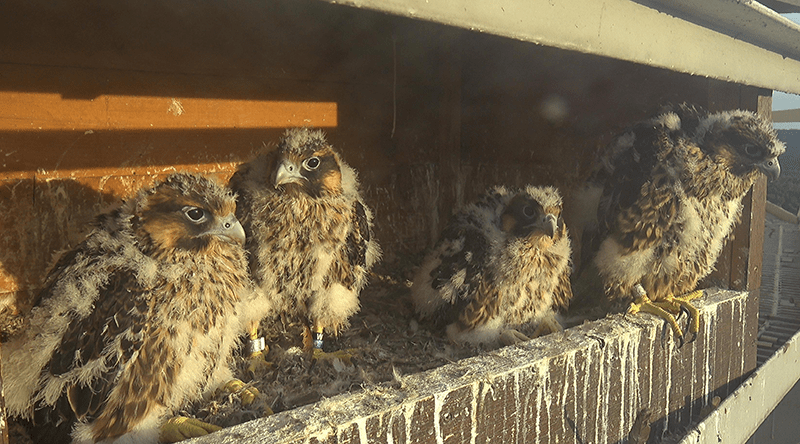
Most of the fluffy white down is gone, being replaced by the juvenile
colored contour, wing and tail feathers.
Good day, folks! I’m writing to you on Monday, June 8. I just took a peek at the Falcon Cam, and our girls are really starting to look like Peregrine falcons now. Most of the down is gone, showing us all the incoming juvenile plumage. They will keep their juvenile plumage until next February or so, when they will start to molt into their adult plumage. By the time May 2027 rolls around, they will look mostly like their parents.
How about the change in how well they can balance? When I looked, all four were standing on the front edge of the box, preening away. I haven’t seen it myself, but I know by now the parents are just dropping off prey items. Whichever youngster gets the prey first will immediately grab it with their feet, hold it on the box floor directly under their body weight, and tear off bite-size pieces with their beak. When I banded the chicks at 19 days of age, they had virtually no strength in their feet. At 36 days old now, they have plenty of strength in their feet.
Now for your questions. There were several good ones over the last week. A couple of you asked if the chicks would return to the nest after they fledge. The short answer: probably not. The parents still feed the chicks for as many as six weeks after fledging. When the parents are flying around with food, the chicks will just follow them, so there is really no need for the chicks to go back to the nest. The chicks don’t necessarily fledge at the same time, though. If there is still a chick or two in the nest, the parents might take food there. If the fledged chicks see this, they may fly back to the nest to try to get the prey item. As well as the parents feed the chicks, they are still always hungry. When a bird is growing its first full set of feathers, its body needs a fairly constant supply of food. Hunger is a big motivator for all wildlife. Even if a chick has fledged and ends up on the ground, it can almost always still see the parents flying around with food. This sight will make the young Peregrines want to fly after the parent to try to get the prey item. Hunger is the biggest motivating factor that helps the chicks become better and better fliers.
The next question was, “When the chicks move their beaks, are they always making sound?” In ASK JEFF 9, I wrote about the chicks panting, which in birds is called gular flutter. Gular flutter is how birds keep themselves cool on a warm day. When gular flutter is happening, their beaks will move. When a parent brings a prey item to the nest and you see chick beaks moving, they are definitely making sound. In past ASK JEFF entries, I have said that Peregrines have a huge set of lungs relative to their body size. When they make noise, you might need hearing protection because they are so loud. With all the chicks yelling at once because they see food coming – and if you happened to be a few feet from the nest – you would need earmuffs.
The last question is in regard to distinguishing between Peregrine males and females when you have no size reference. To refresh, with most birds of prey, the female is larger than the male. With Peregrines, the size difference is usually quite significant. Are there other ways to distinguish between males and females? Kind of, but only when the birds have adult plumage. The females sometimes have more barring on their breasts, and the males usually have a whiter breast with less barring. This difference is the norm but certainly not absolute. I have seen females with very white breasts and males with barring there. Ultimately, these plumage traits are passed down through genetics.
Folks, I love your questions! Because our kids may be fledging sometime within the next 10 days, time is running out to write to me. When the last chick fledges, we usually turn the camera off a couple of days later. I will write one final ASK JEFF after the camera goes off, so send in your questions as soon as you can. Have a great week!
Ask Jeff 10 – June 2, 2026
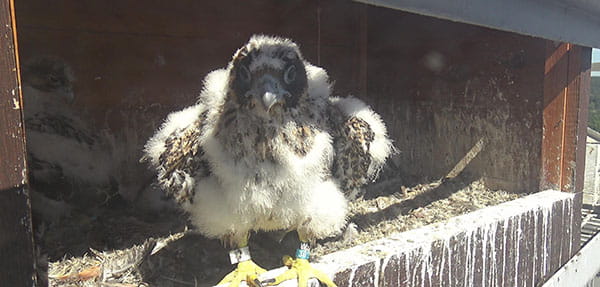
The darker feathers coming in from underneath the white down of Meramec
(W/36) are contour feathers.
I am writing to you on Tuesday, June 2. Today, our four girls, Meramec, Lou, Moe and Frankie, are 33 days old. As you can see, their fluffy down is being quickly replaced by contour feathers. Contour feathers are exactly what they are named for; they follow the contour of a bird’s body as they grow into place. While contour feathers help keep birds warm and dry, their primary purpose is likely to make birds aerodynamic. While all birds that can fly have traits that make them aerodynamic, Peregrines rely on those traits more than any other bird in the world. When chasing avian prey, they can dive at speeds well over 200 miles per hour. Extra-stiff feathers and the shape of their wings help them dive quickly and maintain maneuverability, but contour feathers play a large role in their lifestyle. It’s awesome that we get to watch them grow in. In about 12 days, our chicks will be slipping through the air on their own.
Another thing we can now see is how well they are balancing on their feet. Up to about 27 days old, when a chick moves around the box, it awkwardly crawls with its toes folded together. As it crawls, its balance is maintained with the toes and the tarsus. As a refresher, the tarsus is the bone just above where the toes come together. It’s the bone where I place the bands and is actually part of the foot. Now the chicks can spread their toes and balance on both their toes and the main foot pad, which is the underside of the foot where the toes meet. This is an important development in a raptor chick’s life because they can now pin prey down with their feet. This allows birds of prey to use their body weight to hold prey in place while tearing it with their beaks. I haven’t seen it yet, but any time now, the parents will likely drop off prey and let the chicks handle it themselves.
Now to your questions.
I will combine the first two questions, as they both involve banding. As you know, the auxiliary bands on the left foot help us gain knowledge about Peregrines from a distance. Someone asked if anyone has seen the chicks I banded last year. I have not heard any updates yet. However, the most recent Peregrine I banded that has been reported was at Ameren Missouri’s Rush Island Energy Center in 2023. I wrote about this bird in ASK JEFF 5. In February 2024, this bird was spotted about 600 miles away at a conservation area south of Dallas, Texas.
Our current family is at Ameren Missouri’s Labadie Energy Center, and someone asked how many Peregrine chicks I have banded there. Since 2009, I have banded 43 chicks at Labadie.
Another question was whether the chicks ever fight each other. If chicks were to fight, it would likely be over food. However, in all the live Peregrine cam footage I have watched, I have never seen chicks fight in the nest. In my experience, Peregrine parents consistently provide well for their broods. This same person also asked if Peregrine chicks return to the same area the following year. Peregrines are highly territorial, and as long as a pair is established at the Labadie Energy Center, they will not allow even their offspring to settle there.
The final question was whether I have ever known a chick to fall from its nest before it could glide safely to the ground. I saved this question for last for a reason. As secure as this family seems, life in nature can be difficult. Unpredictable events happen, such as severe storms that can blow chicks from their nest.
This actually happened at a nest I was monitoring in Clayton, Missouri. Overnight, a strong windstorm moved through and the next morning both chicks were on the ground below their nest on the 11th floor. The chicks were nowhere near ready to fly, yet one survived the fall with only minor injuries. After a few days at the World Bird Sanctuary’s wildlife hospital, I was able to return the chick to its nest, and the parents continued caring for it.
It’s important to remember how quickly things can change in nature. While it can seem harsh at times, the existence of nearly 10,000 bird species is a testament to their adaptability. There will always be challenges, but life finds a way.
I will write to you next week!
Ask Jeff 9 – May 27, 2026
Good day, everyone! I am writing to you on Wednesday, May 27. I just took a look at our four girls – Meramec, Lou, Moe, and Frankie. Even though I banded them only five days ago, it seems they are twice as big as they were the last time I had my hands on them. They are 24 days old today.
In a mere 20 or so days, they will be fledging, or taking their first flights from the nest box. It’s hard to believe they grow so fast, but this is true of almost all the world’s birds. The faster they grow and leave the nest, the less vulnerable they are, especially to ground predators.
Our peregrine family is about 270 feet above the ground, and I don’t know of a predator that could climb a vertical concrete wall that tall. In this location, they are quite safe from ground predators. And rest assured, mom and dad keep them well protected from aerial predators like bald eagles and red-tailed hawks. Even crows can quickly swoop in and kill very young peregrine chicks, but our more-than-half-grown chicks can probably cross crows off the predator list.
The first thing I noticed when I took a look was their panting. Birds don’t have sweat glands like humans and other mammals do. Sweat is produced in response to vigorous exercise and/or warm temperatures, and evaporation cools the body. When the liquid from our sweat evaporates from our skin, we cool down.
Birds use a process known as gular flutter. The gular region is the throat. When birds are warm, they rapidly move this region, pulsing quick bursts of air across the moist surfaces of their mouth and throat. As this moisture evaporates, it cools them.
Now to your questions. Someone asked about the chicks’ first flights and whether it’s as simple as stepping to the edge of the nest box and jumping off. Yes, it’s about that simple. Birds have an innate ability to fly. Even chicks raised without seeing their parents fly can still do so. As long as they have their flight feathers, they can fly.
Peregrine chicks often fledge before their flight feathers are fully grown. Their first flights are awkward and often take them to the ground or to surfaces lower than the nest height. However, they learn quickly. Within a couple of days, they begin gaining altitude and accurately landing on perches.
Another question was whether I bring the chicks to the ground to band them. I collect the chicks, place them in a pet carrier and take them to an air-conditioned room. I wasn’t timing myself precisely, but I believe I returned them to the nest box about an hour later. The mom returned quickly after I left. The disturbance to the nesting cycle is minimal, and as we could see, the family was back to normal within minutes.
Finally, someone asked whether there was video footage of Thor flying by while I was near the nest box. That footage will be available soon on Ameren Missouri’s social media pages. It’s quite spectacular to see both mom and dad flying by while I’m at the nest. They do not like my presence near their chicks, which is why I work efficiently when handling them.
Talk to you all next week!
Ask Jeff 8 – May 22, 2026
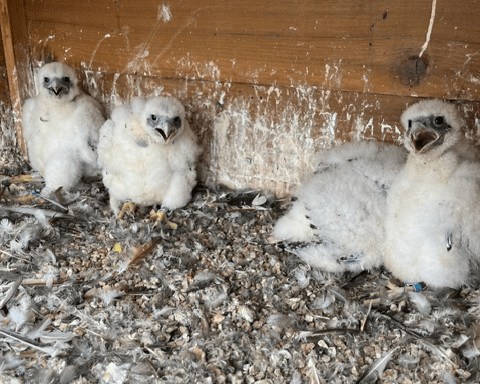
Hello everyone!
I am writing to you on Friday, May 22. I waited until this late in the week because of what happened today. This morning, I and a team of others, placed bands on our four healthy chicks. At about 9:30 a.m., I took a small elevator on the Ameren Energy Center’s middle stack to elevation 767, which is the number of feet above sea level. At that elevation is where the nest box is located. The box is about 270 feet off the ground, so those with a fear of heights wouldn’t want to be there. Today, the chicks are 19 days old, which is a great age to band Peregrine falcon chicks. With the world’s falcons, the female is considerably larger than the male. This means the chicks have to be old enough so I can see the difference between the males and females and place the correct size bands on each bird. To be sure, I use a measuring device (see the photo), where I place each chick’s right tarsus (the single bone above the toes, which I spoke about in ASK JEFF 4) within the denoted slots. With Peregrines, the females get a size 7A band, and the males take a size 6. Each bird’s right tarsus received a United States Geological Survey aluminum band, and each bird’s left tarsus received an auxiliary band, which allows citizen scientists to gather information on a bird if one is seen in months or years to come. As you can see, the auxiliary bands have large letters and numbers in each color field. If you remember, our adult female has bands, so we know exactly where she was hatched and raised (see ASK JEFF 1). These numbers, letters and colors can be seen with binoculars and spotting scopes. If any of you ever encounter a banded Peregrine and can record the auxiliary band information, you can report your sighting to the Bird Banding Lab’s (BBL) website. If I banded the bird you see, I will receive the information. No matter who banded the bird, you will receive a certificate from then BBL thanking you for the sighting.
This year, all our chicks are females, and for the first time in my many years of banding Peregrine falcon chicks, we named each chick. The chick that received the auxiliary band – black over blue, letter W over 36 (technically Blk/Blu, W/36) – was named Meramec. Blk/Blu, W/37 was named Lou, Blk/Blu, W/38 was named Moe and Blk/Blu, W/39 was named Frankie.
Now to your questions. A couple of you asked why the chicks lie down so much. I’ll start by saying that once a chick leaves the nest, it is rare that they ever lie down, unless they are incubating eggs or brooding young chicks. Until they are full size, the chicks lack the musculature to hold themselves in the standing position for very long. Someone observed that the chicks sometimes lie in crazy-looking positions. I can remember looking in on my kids as they slept and snickering at the crazy positions they sometimes slept in. Maybe animal kids the world over do the same.
Someone asked if a claw breaks, will it grow back? I am glad this person brought up the word “claw,” because in all birds, that is technically what the chitin at the end of each toe is called. Chitin is the same material that our fingernails and toenails are made of. With birds of prey, the claws are called talons. If a talon breaks, whether it grows back depends on how far up the talon the break occurs. If the break is too high, the talon will not grow back. If the back talon (called the hallux) is broken and doesn’t grow back, it would be hard for any bird of prey to survive without even one hallux. That talon opposes the other three, as our thumb does to our four fingers. Not having that gripping motion, even on one foot, could be a problem for a raptor. Even with all the work claws do, it is rare for a wild raptor to break one.
“Why do the adults sometimes stand on one foot?,” was another question. Especially when it is cold, tucking one foot into the belly feathers help birds keep warm. While one foot is tucked, the belly feathers also mostly cover the foot supporting the weight, helping to keep that foot warm, too. During warm weather, I am of the opinion that standing on one foot is a comfort issue.
The last question is: If the adult Peregrines wandered too far from the nest, would another raptor kill and eat the chicks? The short answer is yes. Any predator is almost always looking for an easy protein source. Unprotected chicks of any kind are fair game. Rest assured that Peregrine parents are never very far away from their chicks. Even bald eagles, which are considerably larger than a Peregrine, will be viciously attacked by both parents. The local bald eagles know exactly how far they must stay away from the nest because they don’t want a Peregrine dive-bombing them.
To help you see how fast the chicks grow, I suggest taking a screen shot every day. Comparing pictures just three days apart, you will see major differences in body size and feather length. Talk to you all nest week!
Ask Jeff 7 – May 12, 2026
Good day, everyone! I am writing to you on Tuesday, May 12. I just looked at the four chicks, and they were all sleeping. Neither of the parents were at the box, but with the chicks reaching at least nine days old and the afternoon being warm, they don’t need to be brooded (or kept warm) by either parent. In Ask Jeff 6, I wrote about when the chicks become large enough to retain their own body heat.
The parents usually don’t defecate in the box, especially during incubation and chick rearing. As you can already see, the chicks don’t follow this “rule.” The walls of the nest box were already stained white from last year’s chicks and will become even more “whitewashed” as the season progresses. If a chick happens to be in the way when another defecates – oh well. It’s quite interesting to me to see how the different groups of raptors are so different with nest cleanliness as far as defecation and food scraps are concerned. Falcon chicks the world over defecate in their nests. In fact, there are Gyrfalcon (the world’s largest falcon that lives in Arctic regions) nests that have been used by Gyrfalcons for 2,500 years. Researchers know this because of the feet of falcon guano that have accumulated over that time with very little biodegradation of the guano because of the cold, dry weather in the Arctic. Carbon dating the guano at the bottom of the pile is how researchers came to nest age estimation. Accipiter and Buteo (genera of birds like the Sharp-shinned Hawk and Red-tailed Hawk, respectively) chicks back their butts up to the edge of their stick nests and shoot the guano over the edge. Especially with the Accipiters, any little food scraps are quickly cleaned up by very mobile fly larva that live within the nest sticks. Bald eagles bring in very large food items, and if there are fly larva that eat the scraps, there’s too much scrap volume for the larva to keep up. Also, the chicks defecate wherever they want. Yes, it's safe to say the only eagle nest I have visited didn’t smell so great.
I got only one question over last week, but it’s a good one. Someone asked how the falcon chicks get water. The Arabian oryx, which is a mammal from desert regions in the Middle East, drinks very little water in its lifetime because its kidneys are so efficient; it gets all the water it needs from the dry grasses and seeds it eats. Bird kidneys are also very efficient at retaining water. Our Peregrine chicks get all the water they need from the food their parents bring to them.
We will band the chicks on Friday, May 22, when they are 19 days old. I’m already looking forward to writing Ask Jeff 8. Keep those questions coming!
Ask Jeff 6 – May 7, 2026
Hello, everyone! I am writing to you on Thursday evening, May 7. My apologies for being so tardy during such an important week. Last Sunday, May 3, we caught the first glimpse of a chick. I believe Thor may have had a chick hatch Saturday around 7:30 p.m., but I couldn’t get a visual. I believe she had a chick then because of how high she was sitting over her scrape. When Thor had eggs, she would hunker down so her back was not very far above the gravel level. On Saturday evening, her back was two or so inches higher over the gravel surface. Her bare belly and belly/breast contour feathers continued to give the chick(s) warmth, but she needed to also give them more space so they could breathe normally.
If you haven’t gotten the opportunity to count, our pair has four chicks. We have known Thor and her significant other for three seasons now, and they’ve yet to have an unhatched egg. They had five chicks in 2024, four last year, and, of course, four this year. The chicks seem to be developing normally, with mom and dad very attentive to their needs. Their needs are simple but important: food and warmth. Peregrine chicks need to be kept warm with parent body heat until they are about 10 days old. Then their bodies, aided by the fluffy downy feathers, are large enough to retain the body heat they need for all bodily functions. On cooler days, especially, mom may still brood them. Dad could try to brood, but with his body being so much smaller than the female’s, a chick or two could get too cold.
So we are officially calling May 3 the hatch date. I like to band the chicks when they are between 19 and 23 days old. As I mentioned above, males are significantly smaller than the females, which means females get a larger band size than males. Even at only 19 days old, their feet are already adult size, which allows me to get the right size bands on each sex. Our banding day will be Friday, May 22. I will go to the nest box, collect the chicks in an appropriate sized crate, then take them to an air-conditioned room to place the bands on. The whole process will take about 40 minutes. The parents won’t be happy with me, but they will return literally seconds after I place the chicks back in the box, and life will resume normality.
Now for your questions. Someone asked how many times a day Peregrine adults eat. This depends on temperature and activity. First, activity. Peregrines are very active birds with a higher metabolism than most other raptors of the world, which helps produce the energy needed for the extra activity. While they will perch – usually very high above an open expanse – and wait for prey to fly into the open expanse, Peregrines almost always catch their prey while both they and the prey are on the wing. Of course, the bird they are trying to catch is trying not to be caught, so Peregrines have to be incredibly maneuverable to catch the flying bird. Maneuverability requires energy. Also, Peregrines tend to hunt their prey while they perch quite far away from where they think prey will expose itself. With the Peregrine being the fastest creature in the world, they can afford to hunt from farther away from their prey because they can make up the distance they must cover so quickly, though at the expense of extra energy. It is estimated that most of the world’s birds of prey catch prey about once every 10 tries. If this is true, it means Peregrines must cover a lot more distance to reach their prey and, if they miss, return to their favorite place to hunt. All this activity probably makes Peregrines eat more per body weight than, for example, a Red-tailed Hawk that may fly 50 feet to try to catch a mouse and, if it misses, only needs to fly 50 feet back to its favorite hunting perch.
The second part to my answer is the temperature. The colder it is, the more Peregrines – and, for that matter, any creature – must eat. When the body is losing heat more quickly, it must expend more energy to keep all functions working. In conclusion, it’s hard to know how many times a Peregrine eats during the day, but I hope my explanation helps paint a picture.
Another question was whether adult Peregrines eat before feeding or while they are feeding the chicks. The answer is both. I hope everyone watching our Falcon Cam gets a chance to watch one of the adults bring food in and then tear the prey into small enough pieces for the chicks to easily swallow. First, you may notice that sometimes the prey the adults bring in is already missing meat. Second, you may see the parents sometimes swallow a piece while they are feeding the chicks.
The last question is in regard to Missouri wild Peregrines nesting in other places other than the boxes many organizations, like Ameren Missouri, provide for them. If humans weren’t on this earth, Peregrines would be nesting within the crevices on cliffsides; of course, many pairs still do. Cliffs are usually found along rivers, lakes and oceans, which the prey birds Peregrines hunt must fly across during their daily and/or migratory activities. Prey birds that must cross these open expanses give Peregrines more chances to catch prey, so living on cliffs makes total sense for Peregrines. The person who asked this question stated they know of several Peregrine pairs nesting on cliffs above the Missouri River as it passes through Missouri. I was not aware of any Peregrines nesting in natural places in Missouri, so a hardy thank you goes out to the person who made these observations. If you find yourself along any cliff in Missouri, keep an eye out for Peregrines.
I will talk to you all next week!
Ask Jeff 5 – April 29, 2026
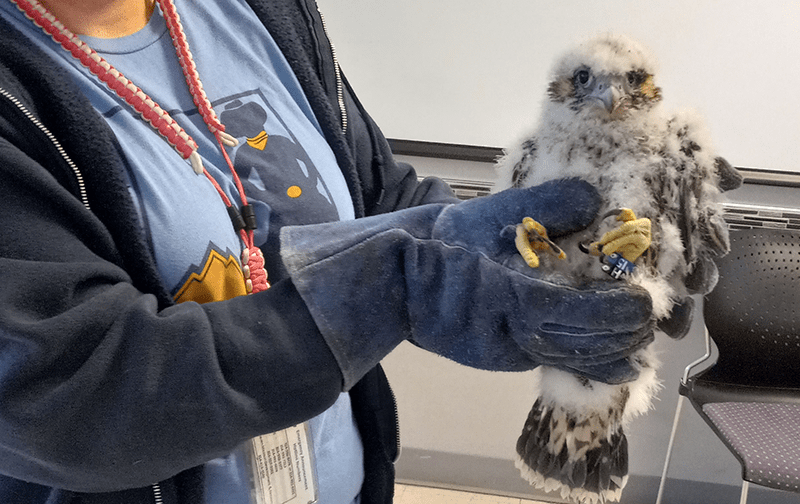
Ameren Missouri employee carefully holding a falcon chick
on a previous banding day.
Hello, everyone! I’m writing to you on Wednesday, April 29, and probably like all of you, I’m anxiously waiting for the eggs to hatch. As a refresher, the eggs are predicted to hatch on Friday, May 1. That’s a Jeff Meshach prediction, and I tried to take into consideration all the variables to come up with this date. I guess time will tell if my prediction is correct.
We had some really great questions over the last week, so I will get right to them. Someone asked how the incubating parents cushion themselves when they nestle down on the eggs. The parents do use their feet to help support their bodies, but they do apply some of their weight to the eggs. I talked quite a bit about bird eggs in ASK JEFF 3, and how strong they are to be able to take some of the weight of the incubating parents yet still be porous enough to allow gas exchange for the developing chick. Yes, to us it does seem like it would be uncomfortable spending so much time with such hard objects pressed against us, but birds around the world over have no issues with incubation.
Another great question is if the female consumes more or less food during the incubation period. It seems they would consume less, since they spend so much time not moving. Yet, we must remember how much calcium is taken from the female’s body to produce the eggs in her clutch. Birds that fly have air spaces within large bones like the thigh bone, or femur. Hollow, large bones are one of the many adaptations birds have to lighten the load and help keep them airborne. Females have small bone spurs that grow into these air spaces. The spurs are called the medullary bone. As the female’s body produces the egg, the medullary bone shortens to the point of disappearing but then grows back after her body is done producing the eggs. It seems plausible that the female’s appetite would increase as the medullary bone grows back. There are other factors that govern if it’s more or less food the mother bird consumes during incubation, so ultimately, it’s a tough question to give a definitive answer to.
Someone made the great observation that this year, our male doesn’t seem to be incubating as much as he did the last two years. I feel the same way, too. Based on pictures from 2024 and 2025, I am very sure we have the same male this year, but ultimately, I can’t be totally sure, since he’s not banded. If it’s a different male, we could have an answer. If it’s the same one, I can’t tell you why he isn’t incubating as much this year. Along these same lines, some asked how to tell if the male or female is incubating at any one time. With it being hard to judge the length/width of the incubating bird through the camera lens and only being able to see the back of the bird incubating, it’s hard to know which adult is which. As you gaze at the live feed, in the lower left corner there’s a symbol that looks like a piece of video tape. If you hover your curser over this, you will see that’s how to get to “archived views.” You have to play around with archived views to go back a few minutes/hours, but you can go back to the last time the male and female switched duties. Then I suggest lining up marks on the back wall with the head/tail to help you with judging the length of the bird incubating. Remember the female is considerably larger than the male.
Finally, someone asked how far away from its nest a Peregrine I banded as a chick has been observed. On May 8, 2023, I banded the chick featured in the photo of it being held by an Ameren Missouri employee on banding day at one of their energy centers about 45 miles south of St. Louis. In February 2024, this chick was observed at Richland Creek Wildlife Management Area, about 80 miles south of Dallas, TX (see photo from Ask Jeff 4). That’s about 630 miles from where I banded this bird. In each picture, you can see the black colorfield over the blue colorfield, with H in the black and 15 in the blue. Many thanks to Danny Pickens, the person who took the picture at Richland Creek WMA.
Lastly, I wanted to share that I will be on KMOV and FOX 2 this week alongside Dan Zarlenga with the Missouri Department of Conservation, followed by KSDK on Mother’s Day weekend. Please make sure to tune in and pass along any more questions these segments might inspire.
The next time I write to you we should have chicks in the nest box. I hope everyone has a great week!
Ask Jeff 4 – April 21, 2026
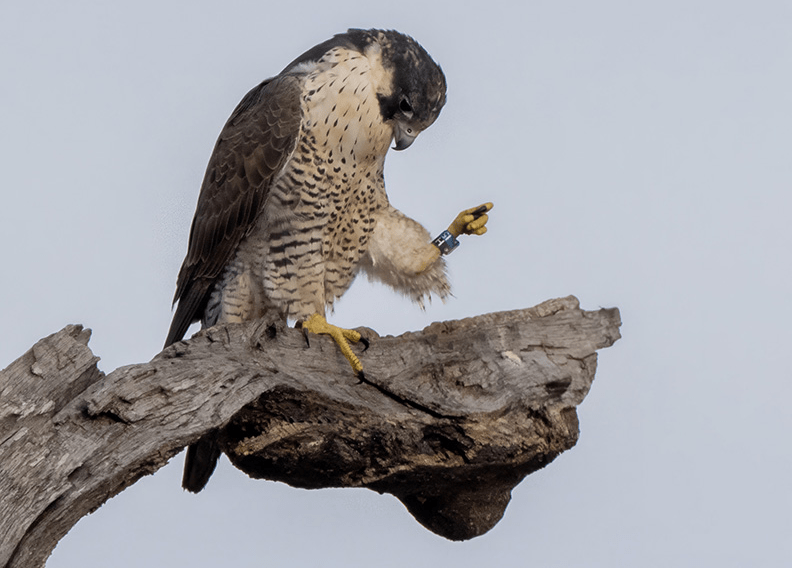
This band is on the tarsus, placed on this Peregrine falcon by Jeff Meshach,
in May of 2023. Photo by Danny Pickens.
HELLO, EVERYONE! I didn’t receive a single question over the last week, but I understand we are “watching paint dry” as our pair takes care of the boring, yet integral incubation of the eggs. At this point, the chicks are about seven days from being fully developed. A day or two before hatching, the chicks will start to peep and the female especially will peep at the eggs, which is thought to stimulate the chicks to start the “pip.” The pip is when the chick punches its first hole in the shell. All chicks are equipped with a tiny “egg tooth” near the end of their beaks, with its sole purpose being to help the chick get out of the egg. Chicks are not strong enough to just break the shell with body movement. Remember, the shell must be strong enough to handle the weight of the parents. Raptor chicks are helpless, or altricial, which means they need a lot of parental care before they leave the nest. Yet even a precocial chick (examples are chickens, turkeys and ducks), which is moving away from the nest just a few hours after hatching, still needs the “egg tooth” to break from the shell. With precocial chicks, the parents must still brood them, or keep them warm on cooler days, and lead them to safe areas and feeding spots, but precocial chicks will feed on their own. As you will see, our altricial Peregrine chicks must have their food torn into small pieces and fed to them by the parents, at least until the chicks gain foot strength and can hold down prey with their feet and tear with their beaks.
The chicks are predicted to hatch on May 1, 2026. I will place bands on their “legs” when they are about 20 days old. I have legs in quotations because the bird part I place the bands on is actually part of the foot. The tarsus is equivalent to our metatarsals, the bones that extend from the toes to the ankle joint. Through the evolution of the dinosaur group, which scientists are fairly certain developed into birds, the metatarsals fused into one bone, which we call the tarsus. For most birds and especially raptors, it’s the perfect part of a bird to place a band on. A band on the tarsus doesn’t interfere with any part of a bird’s life.
I will write to you all next week!
Ask Jeff 3 – April 14, 2026
Good day, everyone! I am writing to you on April 14. We are almost halfway to our predicted hatching day. I just looked at the box, and our female is faithfully incubating her clutch of four eggs. With the last egg being laid on March 30, the eggs will probably hatch around May 1. While I watched, Thor raised herself above the eggs, adjusted her body's position to probably get more comfortable, and moved at least two of the eggs to slightly different positions.
On a fairly regular basis, the female turns the eggs with her beak so that the same side isn’t always down or up. There are some theories on why females of most species consistently turn their eggs. One of the theories is to help maintain a consistent temperature. Most of the world’s female birds will pull feathers from their belly to expose their warm skin to the eggs. Remember, feathers are really great insulators. Pulling feathers keeps the warmth emanating from her body more directly on the eggs. Since there’s no heat coming from the substrate under the eggs, the eggs have a better chance of normal development if she turns them.
In Ask Jeff 1, I talked about the porous eggshell and how gases and water vapor are exchanged through it. If the eggs are turned on a regular basis, oxygen going into the egg for use by the developing chick and carbon dioxide coming out of the egg happens on a more even basis.
Everyone who likes to eat store-bought eggs knows about the egg white, or albumen. The albumen is made of proteins, and through its developing of arteries and veins, the chick absorbs the albumen and the yolk as it grows. While the albumen is viscous, or fairly thick, if the egg is not turned regularly, the developing chick’s weight could push through the albumen and the chick could become stuck to the inner membrane of the egg. Getting stuck to the inner membrane could hinder chick development or even kill the chick. Turning the eggs is considered an innate behavior just like flying is to birds that can fly.
Yes, we are about smack-dab in the middle of the doldrums of incubation, but if you are patient, you can still see the little things our Peregrine pair does to protect and keep the eggs developing normally. I will talk to you all next week.
Ask Jeff 2 – April 7, 2026
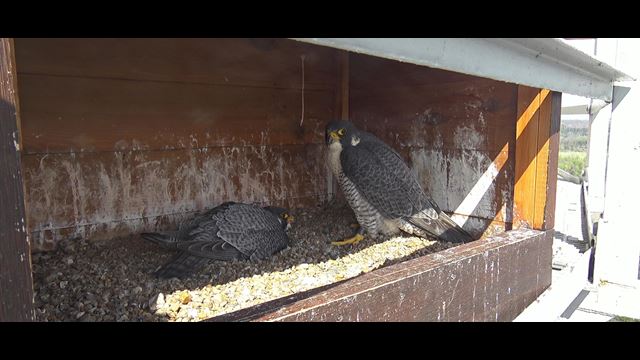
Usually when the female enters the nest after taking an incubation break, the male quickly
jumps off the eggs and leaves. Not so with our male.
HELLO, EVERYONE! I am writing to you on Tuesday, April 7, at 10:45 a.m. I am specific about the date and time because I just looked at the live feed, and this is what I saw. To refresh your memory, the male for the two-plus seasons we’ve provided the Ameren Missouri Falcon Cam is unlike any other male Peregrine falcon I’ve ever known. Usually, the male spends very little time incubating the eggs. I just observed the female perched on the front edge of the nest box, watching the male incubate the eggs. While I watched, it didn’t seem like the male was going to be budging from the eggs any time soon. Over the two previous seasons, many of us have seen this male take way more time incubating than normal. It seems chauvinistic to say, “It’s the female’s job to incubate the eggs,” but with most of the world’s birds, that’s the way it is. However, the male does perform very important jobs. He provides food for the female, gives her incubation breaks now and then during the day and provides almost all the territorial defense during incubation. Using the word “chauvinism” in this case is anthropomorphic, meaning giving human traits to animals. In the wildlife realm and especially in trying to figure out animal behavior, anthropomorphism should never be used. Still, I can understand how seeing what I just saw would make most of us say, “What a great dad!” Our “great dad” and mom are incubating four eggs, which is probably their full clutch for the season. The eggs should hatch around May 1, 2026.
We had some great questions come in over the last week, so I will get right to them. Someone observed Thor, the female, pulling pebbles with her beak toward the front edge of the nest as she incubated. As I mentioned in ASK JEFF 1 of 2026, there’s no falcon in the world that brings nesting material, such as sticks and grasses, to the nest. However, using their feet, falcons dig a depression in whatever substrate there is at the nest site. This depression helps keep the eggs from rolling around as they would on a more level place and allows the incubating falcon to settle her warm belly more easily on the eggs. While I don’t know the exact reason Thor was pulling the pea gravel closer to her, I would speculate she was building up the rim of her scrape to help keep the eggs in place.
In keeping with the topic of eggs, someone asked if a lower average incubation temperature helps dictate the sex of the chicks. This question really made me think and also ask colleagues some questions. There is very little research pertaining to this question, but there was research done on wood ducks (Aix sponsa). It was found that developing females still inside the egg died before hatching more frequently than males when the average temperature was lower than 104 degrees Fahrenheit (the average bird body temperature), which resulted in broods with more males than females. However, the lower temperature itself did not dictate whether an egg would hatch male or female. One hundred four degrees Fahrenheit is over five degrees more than the average human body temperature. A bird’s metabolism runs at a much higher rate than ours, which makes sense when you bring the ability to fly into the scenario. Many things contribute to birds being able to fly very efficiently, but a high metabolism is still needed to move the wings quickly enough to sustain wing-flapping flight. So, in order for the developing chick to grow correctly, the temperature the egg must stay at is probably just under 104 degrees F. Things like adults switching incubation duties, extra cold days during incubation, and situations where the female must leave the eggs to help the male defend the territory can contribute to a lower than 104-degree average temperature. If eggs are cooled for a short time, their development is slowed rather than stopped, but we don’t know if a Peregrine’s lower average incubation temperature could indicate an egg’s sex.
Finally, someone noticed a different camera angle on the nest box than what we have had the previous two seasons. The box had to be moved slightly for maintenance reasons, so yes, the box is a little closer to the camera than before. Good observation!
I hope you all have a great week and keep those questions flying at me.
Ask Jeff 1 – March 31, 2026
HELLO EVERYONE! It’s late March, and for those that like to look in on our peregrine falcon (Falco peregrinus) family at Ameren Missouri’s Labadie Energy Center in Franklin County, you have come to the right place. I can’t wait to start answering your questions about our Peregrines. This is our third season at Labadie, and the Falcon Cam team is so happy to continue bringing this experience to you. A big thanks goes out to all the Falcon Cam partners: Ameren Missouri, the Missouri Department of Conservation, World Bird Sanctuary and of course to all of you who watch the nesting season unfold.
I think we should go over the basics first. Thor, our female from the last two nesting seasons, has returned once again for the 2026 nesting season. She was hatched and banded on the American Century building in downtown Kansas City during the spring of 2017. When she is perched on the nestbox ledge, you will be able to see the black color field over blue color field band on her left leg. Within the black field is the number 69 and within the blue field is the letter C. The male is not banded, but comparing pictures from the last two nesting seasons, I believe he’s the same male as well.
A few of us on the Falcon Cam team have had the privilege of looking in on the nest since early March. Both Thor and the male showed up quite quickly, and as the month wore on, Thor started hanging at or in the box more and more. Both birds helped make the scrape, which is the depression in the gravel that keeps the eggs in one place. They dug the scrape with their feet, never in the box at the same time, but both were observed doing the digging. As a refresher, none of the world’s falcons bring any nesting material, like sticks or grasses, to the nest. A falcon nest is more “bare bones” than hawks, eagles and ospreys.
We had our first egg laid on Monday, March 23. As of March 30, we have four eggs. Last year, the pair had four eggs, and all hatched; the year before, five eggs, and all hatched. It’s anyone’s guess as to how many in total Thor will lay this season. Being in the prime of her life, I expect Thor to lay four or five eggs total. Of course, there’s another entity that has a lot of say in how many fertile eggs there will be: the male. Since we don’t know how old he is, we hope he holds up his end of the bargain. Old age in peregrines usually leads to less fertility.
You may have noticed that Thor isn’t yet tightly incubating the four eggs. Thor won’t start religiously incubating until the full clutch is laid. The theory behind this is so the chicks all hatch at about the same time. If Thor were to begin incubating at the first egg, that chick would have a two- to three-day head start on growth. This would mean the first chick or two could outmuscle the smaller, younger chicks when the female brings in food, thus decreasing the chance of all the chicks surviving to fledging. During the time before the full clutch is laid, the adults may sit on the eggs when the temperature falls below 50 degrees Fahrenheit or when it is raining. If rain is blowing in from the east (the box opening faces east), the eggs could get wet. The eggshell won’t let inner liquids escape, but there is always gas exchange occurring through the porous eggshell. When an egg is first laid, it is at its heaviest. Through gas exchange, the egg slowly loses weight as the chick develops. If the eggs get wet, the water could clog the pores that allow gas exchange and could suffocate the developing chick. Because of the nine chicks they have produced over the last two seasons, Thor and her mate have already proven they naturally follow “standard incubation protocols.
I’m already looking forward to writing to you next week!
Ask Jeff Archive
ASK JEFF 11 - June 20, 2025
Hello Everyone! My goodness, the 80 days between first egg laid and last fledgling chick at the box have flown by, like a Peregrine chasing a pigeon. If I could make an analogy to my life, I would have to say from the time of the first egg laid on March 26 to the last moment we saw a mostly grown chick at the box on June 16 is a very condensed version of the time I rocked my newborn son in my arms to the day I dropped him off at college. Yes, that time flew by too, but a whole lot of very great things happened in between.
Keeping with that analogy, at most dinner table discussions I asked my kids what they learned during the day that they did not know before the day started. I gladly let them turn the table on me, which always made me think through my day for the things I learned. So, here I go. “Jeff, what did you learn from the 2025 falcon nesting season?” When visiting the box on banding day, I like to sift through the prey feathers and other remains on the box floor. I can use these to try to figure out what prey the parents are bringing to the growing chicks. Most of the remains I find are wings, legs, feathers and heads of prey birds. Larger prey bird heads are usually not eaten, probably because the beak is hard to swallow and digest.
Even with the camera, most times you can’t tell what the prey is. I get to visit several Peregrine boxes during each nesting season, and over the last decade I found many Yellow-billed Cuckoo (Coccyzus americanus) feathers in the boxes. The Yellow-billed Cuckoo is a native species of usually deciduous forests, migrating to Central and South America for the winter. There have been some nests I visited where most feathers and remains were from the Yellow-billed Cuckoo.
I have never figured out exactly why Peregrines in the St. Louis area seemed to prefer Cuckoos, but over the past two seasons it seems this trend has stopped. At our nest box this season I found only one wing from a Yellow-billed Cuckoo. So, what I learned has spawned a new question: Why did our area’s Peregrines feeding mostly Yellow-billed Cuckoos to their chicks come to a stop? Why did it even start? Let me turn the table on you readers. If there is anyone that would like to theorize why Peregrines brought so many cuckoos to their nests and then stopped, I will continue to monitor your emailed questions for a few more weeks. Maybe we can figure it out together.
Let’s get to this season’s last set of questions. Someone asked, “Do Peregrines ever return to the same nest they hatched from?” The short answer is, “Not likely, but not out of the question either.” Peregrines are very territorial, as are most of the world’s birds that nest in a solitary way, and even a chick from the year before would not be welcome at a nest that is still occupied by mom and dad. If, say, a female chick from the year before returned and there was no female at the nest, a bachelor or widower male would probably accept the female, even if the female was one of his chicks from the year before. Peregrines and most other wild animals do not abide by human rules of marriage.
Another asked, “Do the fledglings ever return to the box?” Usually not. I addressed a similar question in one of this year’s ASK JEFF’s, but don’t at all mind answering this version. Food is the major reason chicks need parent birds. If there are no other chicks in or near the box, usually parents will fly to the first chick they see when bringing in food. Remember, fledgling chicks just out of the nest don’t yet have the flight skills to catch prey birds in midflight, so the parents continue to feed them. If a parent flies to a chick with prey, you can bet any other chick that sees this will fly right to the parent with the food. As the chicks gain their flight skills, the parents will bring in prey and just drop it, sometimes from very high in the sky. The first chick to the prey will catch it in midflight, and the other chicks will chase and even fight the lucky chick for the food.
Last question. One of you watched one of the chicks throw up what looked like food, and asked what was going on with that chick. What you probably saw was a chick regurgitating a pellet. When any Peregrine eats a bird, it will end up swallowing a lot of feathers during the meal. Feathers cannot be digested, so about once a day the bird will regurgitate a compact pellet of feathers, sometimes scales from bird legs and even bird beaks, if they are small enough to be swallowed. Flesh and bones are digested and their remains come out the other end.
Folks, I can’t tell you how happy I am. Yes, we are at the end for this season, but what a season it was! Watching the parents hatch and raise four healthy chicks is quite the beautiful thing, and answering your questions helps me continue to learn about this incredible species. I am grateful to Ameren Missouri, the Missouri Department of Conservation, and my employer, World Bird Sanctuary, for providing all the working parts that brought you the Falcon Cam. I am already looking forward to the 2026 season, and I hope all of you have a great rest of your 2025.
ASK JEFF 10 - June 11, 2025
HELLO ALL! I am writing to you on Wednesday, June 11, from Pennsylvania, as I visit my father, sister and other family. It will always amaze me how fast the chicks grow and how fast they change their appearance. Last week there was still a lot of down on each chick. Today, hardly any. Aside from the color differences compared to the adults, they look like the Peregrine falcons they actually are.A couple of you wrote that one of the chicks jumped from the box and was seen walking on the metal grating that supports the nestbox. It doesn't surprise me that we had a "walker." To refresh, four of last year's five chicks jumped to the grating and hung out there before taking their first flights.
One of our readers asked why the ceres of the youngsters are blue. The cere is the piece of skin between the beak and the feathers on the face. The cere is also where the nares, or nostrils, are. The blue cere is just a trait of being a juvenile falcon, like the dark brown contour (body) feathers are, with the buff brown tips. As they mature into sub-adults early to mid-spring next year, the cere, and leg scales for that matter, will start to turn yellow.
Another reader asked if there's any environmental influence on the sex ratio in a nest. As far as I know, the sex ratio is the luck of the draw. And yes, I did write that I banded all the chicks with size 7A bands, which usually means that all are female (males, usually considerably smaller, get a size 6). Back in 2017, I banded a chick from a nest in downtown St. Louis as a female but wrote in my notes that it could have been a larger male. In 2023, this bird showed up at a nest on the Illinois bluffs upstream of Alton, Illinois, and it was the breeding male of that pair.
Someone asked if the chicks fight, and another asked if they stay close to the nestbox after taking their first few flights. I will answer both together because they have a similar answer; food. Especially with the chicks at the 37-day mark today, mom and/or dad will bring food to the box and just leave it. The chicks have more than enough foot strength to hold the prey down on whatever substrate they might be on and tear it up with their beaks. When an adult drops off food, the closest chick will grab it, but if the other chicks are hungry, they will fight over the food. Usually the oldest chicks, even if just a few hours older, will fledge first. With chicks still left in the box, it's a stimulus for mom to continue to bring food to the box. So yes, the chicks have to stay close to the box because they don't yet have the flight skills to catch their own prey. The fledgers see mom go to the box, and they come barreling back to try to get their share.
The last question was, "Why do the chicks sometimes have their mouths open as they perch in the box?" We humans have sweat glands within our skin. When we are exerting on a warm day, liquid pours from our sweat glands and beads on or runs down our skin. This liquid ultimately evaporates and helps keep us cool. Birds do not have sweat glands, so they pant, or rush air across their moist mouth parts. The air evaporates the liquid and helps keep birds cool.
Great questions, folks. I will write to you next week, even if our chicks have all fledged the nest.
ASK JEFF 9 - June 4, 2025
HELLO EVERYONE! Today, June 4, our chicks are 31 days old. This 31-day age is only an average because the eggs hatched over three calendar days. But, if we knew the exact minute each chick broke free from its shell, we would probably be talking about hatchings over a 48-hour period or less. Even with the relative closeness in hatching times, you can still see differences in the timing of feather development. I just took a look at the kids, and you can especially see differences in the amount of down on top of their heads. The older chicks have less. There are now a lot of contour feathers emerging from under the down feathers. The contour feathers adhere to the body, legs, the under and upper sides of the wings, and just behind the leading edges of the inner wings. Contour feathers help keep the body warm and dry, and help make a bird’s body aerodynamic, allowing the body to slip through the air with very little friction. Flying is one of the most strenuous exercises in nature, so birds have many adaptations to help them fly very efficiently.
Above I mentioned the inner wing. Like humans, a bird has a humerus in the wing, which is the wing bone closest to the body. Also, like humans, a bird has a radius and ulna in its forearm. Birds do have wrist bones. The wrist is the part of the wing that is closest to the bird’s head when the wing is folded against its body. Birds have fingers, but only three. The two fingers furthest from the body are what the primary (outermost) feathers attach to. If you were moving away from the body and along the wing to the last finger bone, you would be moving along the inner wing. The outer wing is considered the primary feathers that the finger bones support and maneuver. FYI, I look up most of the technical items concerning birds in The Life of Birds by Joel Carl Welty, a fascinating book that I used for my ornithology class. You can find out all you’d want to know about a bird’s skeleton, muscles, feathers and all the bodily systems.
Today is a rainy day. I watched the chicks lounge in the box, doing some preening, but mostly dozing and watching things fly by or blow by the nest box. Speaking of rain, it has always been amazing to me that most of the world’s young birds don’t drink any water, and don’t have to, until they leave the nest. Of course, some birds, like ducks and turkeys, leave the nest after just a few hours. Raptors, though, don’t leave their nests until they are between 30-60 days old, and even then, probably don’t take a legitimate drink of water until well into the summer. They can go without water so long because of their extra-efficient kidneys. Their renal and digestive systems extract enough water from the prey their parents feed them. As a comparison, if a human drinks no water for only four days, they could die. Suddenly for some reason, I’m thirsty.
Let’s get to your questions. Someone asked, “How often do the parents and chicks eat?” An adult eats 1-3 times a day. The amount adults eat depends on the temperature and the amount of activity they are going through. Peregrines that nest far north usually migrate, sometimes as far south as southern South America. With such activity, they are at the higher end of the eating spectrum. The colder it is, the more they will have to eat, since more calories are spent on keeping warm when the body loses calories because of low temperatures. The chicks eat 4-6 times a day. Above I spoke about being able to see more contour feathers now. Each feather has a blood supply to it as it grows. Chicks are growing their first set of feathers all at once, let alone the growth their bodies are going through. They need a large supply of calories, protein and other nutrients to grow body and feathers normally.
Here is a little more about feathers. Once a feather reaches the length it needs to be for its function, the blood supply shuts off, and the feather is considered “hard pinned.” This is a falconer’s term. As a growing feather (also sometimes called a pin feather) emerges from the body, you can actually see the blood supply going to it. This growing area of the feather emerges above the skin line, and is dark blue and soft. When the blood supply shuts off, the part of the shaft that emerges away from the skin turns clearer and becomes harder to the touch, hence “hard pinned.” If anyone reading this visits World Bird Sanctuary (open 8-5 every day), please stop in the gift shop and ask the attendant to see a feather. We have molted feathers that we can show people, and you will be able to see the line on the feather that separates the feather part that stays under the skin from the rest of the feather that is above the skin line. I will talk to you all next week.
ASK JEFF 8 - May 29, 2025
HELLO EVERYONE! My, my, how our Peregrine chicks have grown so fast. They are about 1,300% heavier as of May 29 , than when they hatched 24 days ago. Most of the world’s bird babies grow extremely fast. Being in a nest makes them vulnerable to many more predators than when they can fly. It is to their advantage to grow fast and get out of the nest as quickly as possible. Our chicks will start to fledge, or leave the nest, in 18-25 days, which answers one of the questions one of you wrote in over the week. This same person asked, “How do the chicks know not to try a flight before they actually take their first flight?” It is hard to say if a chick actually knows when it’s time to fly. Even as birds younger than our chicks are now, they do flap their wings. Sometimes the parents get involved with stimulating the chicks to take flight. They will fly by the nest box with prey instead of just coming to the box and feeding. Last year, four of the five chicks left the nest on the same day, but they jumped to the grating that supports the nest box. So, yes, they fledged, but not really. Sometimes a bird’s first flight is a mistake. They get flapping their wings, even hovering and kiting over their nest, or a branch near the nest, and a wind gust carries them off. Flying is an innate ability, meaning birds that can fly as adults already know how when they hatch. However, just like any human baby taking those first steps and falling a lot, a bird’s first flight is usually about the same; awkward, not very well controlled and can lead to them landing, or yes, crashing on the ground. However, it is quite amazing how quickly a bird adjusts and learns how to control its wings and tail, so the next flight is way better than the first, and so on. If one of our chicks is found on the ground, we do get involved. It would be brought to World Bird Sanctuary’s Wildlife Hospital, checked out and, if healthy, brought back and placed on the metal grating close to the nest box. It will continue to be cared for by the parents. By the way, it is an old wives' tale that a parent bird won’t accept a chick that was touched by a human.
Another good question that I don’t think was ever asked until now is, “What do the chicks do at night? Do mom and dad still bring them food?” As you may have noticed, the chicks do a lot of napping during the day. While the majority of any night is probably spent sleeping, the law of averages says there must be activity at night. Even as chicks, birds are constantly taking care of their feathers, or preening. A small gland at the base of the tail, called the uropygial gland, produces an oil. Birds move the gland around with their beak, which stimulates the oil to flow from it. Once it gets on the beak, the bird spreads the oil on its feathers as it preens. This oil helps preserve feathers and makes feathers water resistant.
So, at night the chicks surely preen and probably do some moving around the floor of the box. While the parents also spend most of the night sleeping, they, too, probably go through some activity. If the place where they are nesting and the surrounding area are brightly lit, Peregrines have been known to hunt at night. Long ago, I read an article about a pair of Peregrines with a territory in downtown Chicago. Their territory was so brightly lit, they could be observed hunting, and they were catching and eating bats. The bats were also hunting. They were catching insects flying around the bright lights. While the majority of what Peregrines eat are birds, they will adapt to exploit a new food source if the opportunity arises.
Thanks for the questions, folks! I will talk to you all next week.ASK JEFF 7 - May 22, 2025
Let’s do the basics first. On Thursday, May 22, at about 10 a.m., I placed a United States Geological Service (USGS) band on the right foot and a colored, auxiliary band on the left foot of four healthy Peregrine falcon chicks. All the chicks were banded as females, although three of the four could have been larger males. Usually male Peregrines, being so much smaller than females, get a USGS size 6, lock-on band, and the females get a size 7A. When banding any bird, it is always best to put a band on that may be a little larger than a perfect fit, rather than a band that is a little smaller. While retrieving the chicks from the nest box, the adult birds flew by, sometimes within 20 feet, and yelled at us. The World Bird Sanctuary (WBS) rehabilitation staff member that was with me, and I, very much appreciated that neither parent chose to strike our helmets with their feet which, on occasion, has happened to me over the years. As you look at where the bands are on each bird, you may question my statement that I put each band on the “foot.” That bone, called the tarsus, is like the long tarsal bones in a human foot between the toe bones and ankle bones. So, the ankle bones of a bird are the next joint above the tarsus.
There was only one question in the past week, “How far do the parents range away from the nest when there are chicks present?” The adult female, being larger than the male, is the primary nest protector from other predators. She usually doesn’t go far, ranging a few hundred yards or so from the nest. The male, being the primary food provider for the family, could range several miles from the nest during prey searches. Peregrines typically nest in places that give them a great vantage point to hunt from, so sometimes neither of the adults need to range too far. As a refresher, Peregrines hunt over wide open country, and almost always from a perch high above the area. In the case of Ameren Missouri’s Labadie Energy Center, the adult falcons probably hunt from the tops of the 3,750-foot-tall stacks and watch the Missouri River valley, which is 400 or so yards away. The falcon will watch for a bird, usually smaller than itself, to start crossing the river. When the prey gets to a point where the Peregrine thinks it can streak down and catch it before it can get to the trees lining the banks, the falcon will dive at speeds well over 200 miles per hour and try to snatch the bird from midair.
For other details of yesterday’s banding day, I will take some creative precedent. I hope you enjoy.Their Realm
I step into the elevator, weighed down with the personal protective equipment that is standard for working at more than 6 feet above the ground, let alone 350 feet, which is the level the nestbox is at. We humans must have at least a healthy respect for gravity. As we slowly move toward the sky, I go over some last-minute items with the guy who will help me safely get the sour chicks from the nestbox to the ground, where they will be banded and photographed, then back into the box.
At this particular point, with all the anticipation I’ve gone through for weeks, I’ll admit I have a hard time focusing … or do I? When I think about it further, I believe I am laser-focused, but the excitement of stepping into the realm of the Peregrine falcon clouds the laser just a little. Repetition keeps the focus strong, since I’ve been playing with Peregrines in high places since 1985.
The elevator shudders as it slows, then stops with a small jolt. There’s a click, which signifies I can push down on the sliding door half that disappears into a slot at floor level. The upper door half disappears into the opposite slot. I step out into the breeze and immediately look at the air space around the stack to see if the parent falcons are alerted to our presence. The nestbox is opposite the elevator shaft on the stack, with each being on a grated and railed catwalk on the stack. We move around the ring, and the nestbox comes into view, as well as what looks like the adult female. Did I hear her (Peregrines have an ear-piercing and repetitive “ka ka ka ka ka”) or see her first? With my eyes and a quick “there,” I point the falcon out to my friend. She’s already diving at a high rate of speed directly at us, then smoothly pulls up and disappears around the stack. The male joins in on the dives, pull-ups and fly-bys, voicing his opinion, just like his mate.
Their wings and bodies slip through the strong wind more effortlessly than a canoe passing across a calm, mirror-like pond. I pause for a quick minute. I try to imagine being a bird. I can step to the edge of a 10,000-foot cliff and have no fear whatsoever. Hesitation is not in my realm of thinking. I jump and fall the first 1,000 feet, only because I want to. As soon as I move my wings away from my body, I change my controlled fall into level flight. Because of my feathers and aerodynamic body, the wind is my friend rather than a hinderance. Twisting my wings just right or moving the outermost primary wing feathers closer to or further from my body allows me to be lifted by the wind, or cut through it like it’s not even there. How cumbersome this thing called gravity is for humans. What is currently happening right in front of my face, these beautiful beings called Peregrine falcons, show me beyond any doubt that gravity is quite nicely conquered because of feathers. Being able to momentarily have my hands on these fastest of all creatures brings me joy beyond belief.
We collect the Peregrine kids, apply the bands and get them back to their feathers-from-prey-lined box in about an hour. Mom and dad continue their fly-bys. I place the last chick in, take a few photos, and stand up. I could easily stand here and watch for the rest of the day, but no. It’s time to give their realm back to them.
Talk to you all next week.
ASK JEFF 6 - May 14, 2025
HELLO EVERYONE! I’m writing to you during the early afternoon on May 14. We are eight days away from banding day on May 22, which means our four chicks are 9 to 10 days old today. I took a look at them a few minutes ago. As of this writing, the box has some prey feathers waving around in the breeze. I recognize Mourning Dove (Zenaidura macroura) feathers. When I am at the nest box next week, I will briefly look for feathers from other species, mostly for points of interest, and will let you know what I find.
A Peregrine’s hunting technique is one of the reasons I am so enamored with this fastest of all species, and it helps explain why energy-generating facilities are prime real estate for nesting falcons. Many electric-producing plants are located along large bodies of water, where they convert that water to steam to turn the generators that produce electricity. In this case, our nesting box is high above the Missouri River at Ameren Missouri’s Labadie Energy Center. Near Labadie, the river is at least 400 yards wide, and many species of birds continually fly across the river in this area. The adult Peregrines perch high on any one of the 3,750-foot-tall stacks at Labadie and watch the river. When a bird, usually smaller than the Peregrine, is crossing the river, the falcon waits until it thinks it can streak down and catch the prey bird before it can get to the other side of the river and into the safety of the trees. If the Peregrine can get to the bird before it reaches cover, it will fly underneath the prey bird, flip upside down, and reach up and grab the prey with its strong feet. This all happens while each bird is in the air and probably in less than a second. Attacking its prey from underneath is thought to give the prey species fewer options to outmaneuver the Peregrine. While at the Labadie Energy Center long ago, I watched this hunting technique unfold right over my head. I happened to look up at just the right time. The adult male had come off the top of one of the stacks, attacked a pigeon and was successful. It is one of those special Peregrine moments I will never forget.
Let’s get to your questions and statements. Someone asked if the parents play any kind of favoritism toward a particular chick. They were concerned some of the chicks may not be getting as much food as others. The reason the parents will not tightly incubate until the full or almost full clutch is laid is to make sure all the chicks hatch over a period of about 24 hours. An egg that is not incubated all the time is cooler and therefore develops more slowly. If they all hatch close together, then there are no chicks that are bigger because of age. A larger chick can potentially outmuscle smaller ones to get most of or all the food. So, a bigger chick than the others may seem to be favored by the adults, but our chicks hatched between the afternoons of May 4 and May 5. They are all quite similar in size now, with the females ultimately becoming larger as the brood grows. The larger females don’t seem to have any advantage over the males. Those chicks that don’t seem to be diligently fighting for food may not be that hungry at the time.
Someone commented that the male of our adult pair seems to be as devoted to feeding the chicks as the female, and this person even saw the male offer a piece of prey to the female when they were all in the nest box together. By facial color pattern (remember, he’s not banded), I believe this male is the same one from last year, and I have commented several times that he has been the best incubating male I’ve ever seen, even not wanting to give up the eggs when the female comes back from her breaks. When the chicks are this age, usually the male gives the prey to the female away from the nest, and she feeds. From his incubation antics, it stands to reason he would also feed the chicks a lot.
A teacher and her students asked if all parts of the prey birds are eaten and digested – a very good question. Peregrines will eat the head, beaks (from smaller birds), smaller feathers, feet, legs, all internal organs, meat, fat, skin and bones. What their stomach can digest does not include all the above. The most important function of a raptor’s beak is to tear large prey items into smaller pieces, so the digestive system has an easier time digesting. Everything is digested except for the items made of carotin (feathers, beaks, scales, claws). The muscular stomach forms a pellet of compacted feathers, beaks, claws and foot scales. The pellet is regurgitated, or passed from the body through the mouth. Kudos to you teachers for getting your students into watching our Peregrine family!
The last few questions pertained to the bands I will place on the feet of each chick.
At some point after I place the bands on, I will record the information on the Bird Banding Lab (BBL) website. After the information is processed, it will be publicly accessible on that website. If you ever find or see a bird band, you can go to the BBL website, put in the band numbers/letters with some other information that you will be prompted on, and you will find out immediately what species the bird is or was, and when and where it was banded. If you find or see a Peregrine falcon band that I placed on a bird, I also see any information you enter through the site. This information exchange is how we learn about longevity and migration patterns. Someone also asked if most of the wild Peregrines hatched this year in Missouri will be banded. I think it is best to say, “Probably not.” This falcon species has become more common since the banning of the pesticide DDT, and they often nest on river bluffs and other places that we don’t know about or can’t get to.
Thank you for all the great questions, folks, and keep them rolling in. I cannot wait to talk to you next week!
ASK JEFF #5 - May 6, 2025
GREETINGS EVERYONE! It’s so nice to be writing to you again, especially with our new arrivals inhabiting the falcon box. As of yesterday morning, May 5, the first chick hatched, with two more hatching over the next 4 or so hours. As of today, May 6, the fourth egg has also hatched!
I’m sure many of you noticed that we have a brand new box this year. Last October, a Falcon Team member that works at Ameren Missouri’s Labadie Energy Center, built and placed a new box. A few days after it was placed, I put the gravel in, so we were set for this nesting season many months prior to courtship, which starts happening in late February. Please notice how pristine the gravel and inner walls of the box are. Better take a screen shot because now that we have chicks, let’s just say the box will “dirty up.” The chicks fling their poop in all directions, and they can shoot it high and far. The box will get that “used” look in no time.
Now to your questions – and we had some very good ones asked over the last week and a half. First, someone asked if the parents perform particular behaviors that may tell us the eggs are getting close to hatching. Of course we do not have audio with our camera, but I have read that when the female knows the eggs are close to hatching, she will make calls and peeps. This verbal action is thought to stimulate the chicks to start breaking from their eggs. I would speculate that mom can feel the chicks moving within the eggs just prior to hatching.
Another asked about the process of banding the chicks and what kind of bands are used. Each chick will get a United States Geological Service (USGS) band, which is always placed on its right leg, and an auxiliary band on its left leg. Both bands are made of aluminum (light weight). Some of the research that is done on birds requires that an auxiliary – and usually more easily seen at a distance – band is placed on the leg opposite the leg that has the USGS band on it. The USGS band has small numbers on it, with each band having a unique number sequence. This number and band size, along with the auxiliary band numbers/letters, will be registered with the Bird Banding Lab, the organization that coordinates all the bands that were and will be placed on birds. For a raptor of this size, the USGS band is called a “lock-on” band, which is a solid piece of aluminum. I use needle nose and lineman’s pliers to place the bands on. Once it is placed on the right leg, there is no chance it can ever fall off, but it is made in a way so it never hinders the bird in any aspect of its life. The auxiliary band for Peregrines is secured to the left leg with pop rivets, and again, does not hinder the bird in any way. One would have to have a Peregrine in hand to see the USGS numbers. The “in hand” part usually means something bad has happened to the bird. The Peregrine’s auxiliary band has two color fields with white numbers/letters within each field. One can see the auxiliary band from a fairly good distance with binoculars or a spotting scope. We can gather much more information from Peregrines going about their business in the wild because of the auxiliary band. For instance, the only reason I know that our adult female was hatched and banded in Kansas City is because of her auxiliary band, which has a black field over a blue color field, with a "69" in the black and a "C" in the blue. Even with the camera showing us the pair and their chicks, we cannot see the numbers of the USGS band. By the way, the male is not banded.
Speaking of banding, we will band our chicks on Thursday, May 22. They will be 17 days old that day, which is old enough for me to know females from the males. If you remember, the males are so much smaller than the females that they get a smaller band size. So, it is important the chicks are old enough so I know I’m putting the correct band sizes on them.
As always, thanks to everyone that wrote in with questions. I will write to you all next week.
SPECIAL NOTE: One of last week’s question askers went on to say they have learned so much watching and reading about our Peregrines that it has stimulated them and their family to learn more about all birds of prey. Statements like these make us on the Falcon Team very happy, for the main reason we present this live feed is to help viewers learn more about this incredible bird. Please keep those questions coming!
ASK JEFF #4 - April 24, 2025
Hello everyone! I’ve still yet to verify if there is a fifth egg. However, on April 24, one of our fantastic falcon watchers said they had a very clear view of the nest with no parents blocking the view, and they very clearly saw four eggs. It seems to me it’s been settled. Our female has four eggs this year.
As I looked back at footage on April 23 to try to see the number of eggs, I had to stop and watch the female arrange the pea gravel she made her scrape in several weeks back. The scrape is the depression the pair digs in the gravel, which helps keep the eggs from rolling around the box, and to help the pair more easily sit on top of all the eggs for easier and more effective incubation. I watched the female meticulously arrange/rearrange the gravel around the scrape, as a person would do as they rake a Zen garden. I watched her even stand up over the eggs to get to gravel she thought needed to be arranged. Sometimes she pulled gravel closer to the nest, and other times she pushed it further away. As I mentioned in ASK JEFF 3, there is almost always a reason a wild animal does what it does, and almost always the reason gets back to survival of the individual. Through our Falcon Cam, which has been showing us all what Peregrines do since 2012 as they lay eggs, incubate them and raise their kids, I have been able to watch three different females do the “gravel shuffle.” From all this observation, I can still only speculate that (a) it helps the incubating adult be as comfortable as possible for the 720 (24 hours/day x 30 days to incubate) or so hours they must sit on the eggs, or (b) the rim of gravel they make and remake helps make sure the eggs don’t roll from the nest. Over a 24-hour period, the eggs may be uncovered for 10 minutes. While it seems like total dedication to us, it’s just what Peregrines and the rest of the world’s birds must do to give the next generation the best chance to survive.
Over the last two weeks, I have gotten just one question from viewers, and that question is, “What would happen if our falcon pair came back and found another pair of falcons had taken over the breeding territory?” While certain subspecies and individual Peregrine falcons migrate long distances, the Peregrine pairs we have in the Greater St. Louis area mostly do not migrate. They stay on or near their nesting territories year-round. Over the 40 or so years we have been placing the auxiliary bands on the left leg (the more easily seen bands that have color fields and white letters/numbers in the fields), we have found that Peregrines do switch mates more than we ever knew. So, while a pair may stay on their nesting territory year-round, they may still have to do battle with other Peregrines to stay on the territory, and especially during the breeding season. A few years back, a nest cam on a falcon box in Iowa got some very brutal footage of two females fighting in the box. The established female had already laid eggs, but the new female flew right into the box and started fighting her. They footed and bit each other, with one being on top of the other for a few minutes, then the other flipping the other over. After five to six minutes of this, they both flew out of the box. About a day later, the established female came back to the box. It probably took her that long to somewhat recover from her wounds. The other female was never seen again. If Peregrines do have to battle others to keep their territory, the females only fight other females and males fight only males.
Good question, and I hope to see others next week. Everyone, take care!
ASK JEFF #3 - April 11, 2025
Hello everyone! The somewhat boring days of watching the parents incubate are upon us. While I personally find very little about these birds boring, shall I say it becomes tedious when watching the male or female sit in one spot for hours upon end. If you are tuned in when the guard changes for incubation duties, you may get to see some interesting behaviors. As you all probably know, there’s no microphone to pick up noises from the parents, though you can see their beaks opening and closing when incubation duties switch out. Peregrines are very loud. Even 20-day old chicks are loud, as my ears are usually ringing after banding day. If there’s not already scientifically proven information I can give you regarding Peregrines, I can usually come up with a scientifically based, plausible reason on why a bird does what it does. When a Peregrine is defending its nest/territory from another raptor, they get very loud as they attack the intruder. The very loud voice helps to scare off the bird of prey that takes a wrong turn and flies too close to the nest. A loud voice to make something go away from the nest presents less risk to the falcon than striking the “problem” with its feet. Why the adults get so loud with each other when they are both at the nest box is a behavior I cannot figure out. If I may be anthropomorphic for a bit, I imagine the male flying into the nesting box to take his incubation turn, yelling “Good morning!” at the top of his lungs, and the female saying, “I’m standing right here! Why do you have to say good morning so loud?”
As of Monday, April 7, we have four eggs. When Peregrines and other birds lay the second to last or last egg of the clutch, they will start to religiously incubate (see ASK JEFF 2 for loosely incubating before the second to last egg). Last year, the female – which is the same female from the 2024 season – laid five eggs. The adults have been so closely incubating since Monday that no one from the Peregrine Falcon Cam team has been able to view a fifth egg. If one of you happens to see it, please let me know.
There’s also a good chance she will only lay four eggs this year, and there is no reason to worry if there are only four. From the time the adults start to tightly incubate until the eggs hatch is about 30 days. I have to say “about” because the “30” is an average. If my math is correct, we should have hatching on “about” May 7.
I hope everyone has a great week, and please keep those questions coming.
ASK JEFF #2 - April 4, 2025
GOOD DAY EVERYONE! As of April 2, we have four eggs in the box. Last year, our female laid five eggs, with the last one coming about five days after the fourth egg. I predicted the last one would not hatch, but I was wrong. That chick was significantly smaller than the other four, and usually with such a size difference, the small chick doesn’t survive because it has such a hard time competing for the food the parents bring to the nest. Last year, our pair raised five healthy chicks. We shall see if our female, which is the same female as last year, lays a fifth egg this year.
I am writing this on Friday, April 4, and is it ever raining! As of this morning, the St. Louis area is supposed to receive more than 4 inches in about 36 hours. To say the least, we are in for a soaking. What do Peregrines and other birds do when it rains so much? Our female certainly has it good, incubating in a brand new (as of October 2024) nest box. As you probably can guess, most of the rest of the world’s birds must just perch in the rain. While birds don’t move around too much during rain, they have a great adaptation for dealing with it.
Every bird has an oil-secreting gland located at the base of its tail. A bird spends a large part of any day preening, or caring for its feathers. It uses its beak and sometimes its claws to touch every feather on the body. During preening, it will bend its neck backward, (I wish I were as flexible as a bird) and touch the gland with its beak. Touching the gland stimulates it to secrete the oil. With the oil now on its beak, it runs the beak over each feather. The oil helps make its feathers water resistant and prolongs the life of the feather. If you have ever seen a duck or goose swim to a bank and step from the water, you probably noticed that all the feathers were dry. Ducks and other birds spend long periods of time in water, yet their feathers are always dry. This is all thanks to that oil gland, called the uropygial gland.
So far, we have had one question come in from the Peregrine Cam website, “Is it bad for the eggs to not be incubated at all times by the male or female?” This is a great question. During the breeding season, many bird species lay an egg about once every two days. Especially with most raptor species, it’s important that all the eggs hatch at or close to the same time. If the female starts to incubate with the first egg, this egg will hatch first, then the next egg two days later, and so on. If the female lays five eggs, there would be an eight-day difference in the age of the first chick compared to the last chick. This eight- day size difference between first and last hatched means the younger chicks would probably die because they would be outcompeted by the larger siblings for food. Birds don’t have the ability to reason, “I better make sure that small chick is getting food.” The parents feed the chicks that are right in front of them, begging for the next bite. So, early in egg laying and especially on warmer days, you will see the female perched on the front edge of the box and not incubating. This is perfectly natural, and very impressive to me because she knows when the temperature gets too cold and will then incubate to make sure the earliest eggs laid don’t die. Once the second to last or last egg is laid, she and the male will incubate 24-7. How does the female know when it gets too cold? There’s some evidence that a bird’s beak is what senses the temperature. If I have said it before, I will say it again. BIRDS ARE SO COOL! I’m already looking forward to ASK JEFF 3, so keep those questions coming!
ASK JEFF #1 - March 28, 2025
2025 Peregrine Falcon Nesting Season - Ameren Missouri's Labadie Energy Center
Hello everyone! I can’t tell you how happy I am to again be able to write to you and answer your questions about these spectacular falcons.
Let’s get right to it. For sure, this season’s female is the same one we had last year. On her left leg, she has a colored band with a “69” in the black field and a “C” in the blue field. This tells me that on May 23, 2017, she was banded as a chick in a nest on the American Century Investments building in downtown Kansas City, Missouri. This year’s male is not banded, but from facial feather patterns, I believe he’s the same male we had last year. It is not uncommon for adult Peregrines to spend all of their adult lives, which would be 15-20 years, having chicks in the same nest. In the same breath if you will, I will say it’s not uncommon for males and females to switch mates and nests, with originals sometimes showing up at a new nest hundreds of miles away. No one knows why they sometimes stay or sometimes go.
In 2024, our female laid her first egg on March 15. This year, she laid her first egg on March 26. Why the delay? I can only say that nature sometimes works in mysterious ways. Last year, she laid five eggs, and they all hatched. As females become older, they usually lay smaller clutches (groups of eggs), and/or lay eggs that don’t hatch. Our female, being 8 years old now, is in the prime of her adult life, so she will probably lay 4-5 eggs this year too. Male Peregrines will also have their issues as they get old, and since our male is not banded, we have no idea how old he is. He sure did his job last year, and you also may remember that he was big on doing a lot of egg incubating. Incubating as much as he did last year is rare in the world of Peregrines. Usually, a male will incubate for a couple of hours a day, as the female will leave the nest a couple of times a day, eat a bird the male probably provided for her, do some preening, and then come back to resume the majority of incubation. The male mostly provides the food for the female, then the young chicks, and defends the territory, especially from other birds of prey.
I am one that likes to keep my readers informed of everything that is going on or could go on during a nesting season, even if the subject isn’t as positive as others. Currently, there is a virus that is affecting many types of birds around the world; Highly Pathogenic Avian Influenza, or HPAI. Many of us know it as Bird Flu. Bird Flu has been in the news a lot over the last few months, mostly because it is starting to show up in mammals, like dairy cows. Humans can also catch the virus, but with all the advancements in the medical field, it would be really rare for a human to die from Bird Flu. Unfortunately, Bird Flu is deadly to all birds of prey. It is impossible to know if our Peregrines will catch the virus, but I want everyone to understand it could happen. I know we will all be hoping for the best, and that our Peregrines will be as successful as last year.
Our female will lay an egg about every two days, so by about April 3, she should have her full clutch. I am already looking forward to writing the next ASK JEFF and answering your questions. I hope everyone has a great week!
ASK JEFF #12 - June 6, 2024
Hello Everyone! I am writing to you on the afternoon of June 6. I just took one last look at the box, and it’s quite empty. You could even describe it as lonely. Just last Friday, May 31, I took a screenshot with all five kids perched on the front edge of the box, seemingly watching a tennis match, with the ball being anything that happened to fly by. It was quite comical. On that day four of the chicks were 34 days old and the other about 30 days old.
Sometime over the next two days, four of the chicks jumped to the grating in front of the box and walked away forever. One chick lingered in the box for another three days, presumably the youngest one. Once the chicks leave the camera frame, it virtually impossible to know when they took their first flight. Thirty-five days old is a little young to fledge, but not out of the question. In one of the previous ASK JEFF posts, I said on average the chicks fledge, or leave the nest, at 42 days old. Many times I’ve lamented to my colleagues that there’s just about nothing absolute in the bird world. With the kids leaving the box early, I believe we all witnessed the “nothing absolute” part. The kids could still be on the grating, but it would be very sporadic to catch a glimpse.
Wow, what a season we had! Being able to watch a new female take over the box and know her origins, watching the male from the 2023 season be just about as attentive to the eggs and chicks as the mom, witnessing the hatching and growth of five chicks; priceless. Please add as a great bonus all the thoughtful questions you posed to me. It is almost as enjoyable to write to all of you as it is to watch Peregrines in action. Thank you very much for participating. Your questions and comments tell me of your unwavering, yet growing interest in Peregrines and their natural history, and as a Peregrine fanatic, your interest throws buckets of gas on my fire. I am already looking forward to the 2025 nesting season.
A big thanks also goes out to the Ameren Missouri and Missouri Dept of Conservation Peregrine team. Without all of you, our Peregrine Cam would not exist.
Please keep in the forefront the conservation of all wild things and their living spaces. Take Care, Folks!
ASK JEFF #11 - June 4, 2024
AND THEN THERE WAS ONE.
HELLO EVERYONE! I am writing to you late in the morning on June 4. I just looked at the box a few minutes ago, and there’s one chick left. The camera quality is not quite good enough to see band numbers/letters, but it stands to reason this last bird is the youngest, which is about four days younger than the rest.
Late last Friday afternoon, all five chicks were standing on the front edge of the box. The scene was priceless! At some point over the first weekend of June, the chicks started to leave. Our camera man reviewed weekend footage, and early Sunday morning saw two chicks on the grating to the right of the box. There’s enough room for the chicks to jump to the grating in front of the box and then move one way or the other on the grating. Since four of the five chicks were 35 and 36 days old over the weekend, which is a few days too young to take their first flight, it stands to reason those four all jumped to the grating. The camera can only pan so far left and right, so we don’t know if the chicks are there. The grating goes almost all the way around the stack at that level, so the chicks have a lot of space to walk, and even take short flights to test those wings.
Rest assured the parents are still feeding the chicks, and this will continue to happen over the next three to six weeks. All the chicks are old enough now where the parents just drop food off to the closest chick. If there are other chicks close by, the chicks will probably fight over the food. Fighting and chasing are inevitable. Peregrines, and in fact all wildlife can’t reason as we humans can, meaning the parents don’t have the ability to reason that “this chick didn’t get food the last time I brought it in, so I will feed this one this time.” As I have mentioned many times, chances are likely all our chicks won’t survive. Yes, nature is seemingly a tough place to live, but almost always the strongest, most fit chicks do survive to produce their own chicks, thereby keeping the wild Peregrine population strong.
Once the chicks start flying well, the parents will do mid-air transfers to the chick that gets to the parent first. Peregrines parents will sometimes make the chicks fly after them to get the food, and will even bring in prey birds that are still alive. All this is thought to help train the chicks for survival on their own. I’ve seen some of these behaviors in my life with Peregrines, and it’s incredible to see! Maybe one day technology will produce cameras that can pick up and follow motion, so everyone can enjoy these behaviors. Until then, you just have to be in the right place at the right time.
Now to your questions. I noticed many of you watch other live cameras trained on Peregrine nests. Several mentioned younger, less developed chicks that are further north than our nest. The advancement of spring is just the earth moving into positions around the sun that bring about longer, and therefore warmer days, as we move from March to April and so on through June 21 (the longest day of the year in the northern hemisphere). Four of our five chicks hatched on April 27, but because to our north the sun hasn’t advanced as far and warmed the earth, the Peregrines that nest up there must start their nesting cycle later.
The only other question was about the bands, and whether they irritate the chick’s legs. As long as I measure their legs and put the correct size bands on, the bands have no ill effects on the birds. As a refresher, females are larger than males in most birds of prey, and especially with Peregrines, the size difference can be striking. When the chicks are 16-17 days old, it’s quite easy to see the size difference, especially in the feet and legs. I have a leg measuring device that helps reassure I’m putting a size 7A, United States Geological Service and auxiliary band on the females and size 6 bands on the males. When the chicks leave the nest, it’s very rare for them to return, so our time watching the chicks is coming to an end. However, even if the last chick leaves the box today, I will still write one more ASK JEFF, so please keep the questions coming. Thanks folks!
ASK JEFF #10 - May 30, 2024
HELLO EVERYONE! I am writing to you on Thursday, 30 May. I just had a look at the kids. My, my, what a difference 10 days make. That would be 10 days since I had them in my hands during banding. The youngest one is about 29 days old and the others 33 days old today. Their snowy white down is rapidly disappearing, giving way to their tan and dark brown-streaked breast feathers, along with dark brown back feathers. It is best to get as much observation time in as possible, for in about two weeks they will start to leave the nest, or fledge.
The first flight can be rough for all bird species. Like humans learning to walk, there are awkward, uncoordinated moments. Most Peregrine fledglings go to the ground on their first try at flight. Those extra-long wings must be hard to get to function correctly on the first try. However, very quickly they gain good enough flight skills to get off and stay off the ground. Over the years, the World Bird Sanctuary rehabilitation department has received many, many juvenile Peregrines that were found on the ground. There’s usually nothing wrong with them, and we take them back to their nest spots and release them as close as possible to the nest. Even if the chicks aren’t placed in the nest, the parents will continue to feed them for another three to six weeks.
Several of you were concerned about the box getting too full of young Peregrines to allow them to all stay in the box until they fledge. There’s actually room between the front of the box and the kick plate, so a youngster can jump to the grating past the box. Usually the oldest one or two, even though technically hours older than the others, will jump from the box first, yet not necessarily take their first flight. Especially if there are still chicks in the box, the parents will bring food to the box. It is quite comical to see the chicks that have walked away come scrambling back to the box when the dinner bell rings. It’s also quite comical to watch the “tennis match” behavior. Unless they are sleeping, the chicks are watching everything that goes on outside the box. When the parents and other birds fly by, the chicks turn their heads in a synchronized way as they follow what flies by. This always makes me chuckle!
Someone got to see a parent feed, then leave, and the other parent came in with more food a few seconds after. When there are rapidly growing chicks to feed, the parents go into hyperdrive to keep up with the growling stomachs. If you haven’t already, you will start to see the parents bring in birds that are less and less plucked, and in many instances, not plucked at all. The theory on this (which I find quite plausible) is getting the chicks used to the look and feel of the prey they will eventually hunt on their own.
Finally, several of you were concerned about the youngest chick, and if it is getting enough food. From everything I have seen during my observations, our youngest chick is doing fine. I’ve seen him force his way to the front of the line as the parents feed. He seems to be feeding and developing as normal. I just took a quick peek, and the youngest was laying at the front of the box with two older siblings, watching the world go by.
I hope you all have a great weekend, and I will write to you next week.
ASK JEFF #9 - May 23, 2024
GOOD DAY EVERYONE! If you have already looked at the rapidly growing chicks, you will notice they now have new jewelry; bands on their legs. Everything about banding day went perfectly. All chicks, including the youngest (which is a male), are healthy. There are three females and two males. Mom and dad flew by voicing their displeasure with me invading their space and temporarily removing their kids from the box, but the adults never flew any closer than about 10 feet. Keeping their distance was a bonus for the other World Bird Sanctuary employee and I, as we removed and then placed the chicks back in the box. The banding process took one hour. Later this month, I will register the bands and other information about each chick, with the Bird Banding Lab (BBL). All of us that band birds must register the bands we placed on birds with the BBL. If a band is ever found or encountered, the finder can go to the BBL website, answer a few simple questions, then find out where and when the band was placed on the bird. The bander also gets this info, which allows us to gain information about the birds we banded. Especially with Peregrine falcons, gaining information about them is easier than other species because of the auxiliary band that is placed on the left leg. The color fields, with large letters and numbers, are more easily seen with binoculars or a spotting scope, and allow information to be gained while the bird is alive and well in its environment. For instance, and as was discussed in ASK JEFF 1, this year’s adult female was banded as a chick in May 2017, atop the American Century Investment building in downtown Kansas City, Missouri.
Four of the five chicks had food in their crops. The crop is an internal and flexible food storage pouch, just below the throat. The chick that didn’t have food in its crop probably had already pushed the food down into its stomach for digestion. Like chickens, turkeys and several other types of birds around the world, day-active raptors have a crop. Many of the world’s raptors kill and eat their prey on the ground. Being on the ground for any length of time makes them vulnerable to other predators. Being able to rapidly eat a meal and store it in the crop allows the bird to fly to a less vulnerable perch more quickly. Through head and neck movements, the bird physically pushes food from the crop down into the stomach when it needs to.
Let’s get to your questions. Someone asked if the youngest chick is at risk of the parents not feeding it after the other four chicks leave the nest. The short answer is not necessarily. The youngest chick’s vulnerability of being outcompeted by its nest mates was at a higher risk before now. The fact it held its own when food arrived is a good sign it will survive the three or so weeks before fledging. There’s also a good chance that even if its nest mates have left, the parents will still bring food to the box for a couple days, and the other chicks will fly or run back (chicks will probably hop to the grating) to the box for food. Up until about now, the chicks have little strength in their feet. Over the next three weeks, the chicks will rapidly gain strength in their feet, which will allow them to grab a whole prey item from a parent, hold the prey in their feet and tear and eat the prey on their own. Eating on their own is especially important after the chicks have fledged. There will be competition within the nest box. Again, the fact that our youngest chick has survived to this point tells me it has a good chance to survive to fledging.
Another question was, where do the parents feed after the chicks fledge? Once the chicks have strong feet, the parents will tear and feed less and less. The chicks feeding themselves is all part of the maturing process. Especially after the chicks have left the box, the parents will fly within the box vicinity with prey, and the kids will fly from their respective perches to try to get the food first. The chick that obtains the food first may be chased by its nestmates. Hunger is a great motivator, and certainly stimulates chick competition. Hunger is also what stimulates the chicks to hunt on their own, which they successfully do four to six weeks after fledging. In the wild, the reality is that some, even most, of our chicks will not survive. On average, 60% to 80% of this year’s young, whether they are birds, mammals and all other life forms, will not survive until their first birthday. Competition is fierce, with the adage “the strong survive” holding very true with wildlife. After our kids leave the advantages of the nest box, which they must do, we can only hope they survive to one day produce their own young.
Someone asked if the chicks are fed at night. Under normal wild circumstances, probably not. However, with the light from the Labadie Energy Center, it is not out of the question that the parents could hunt and feed after dark. I once read some observations from a Peregrine nest in Chicago, and it was documented the falcons hunted well into the night and fed their chicks bats.
Someone thought they saw something wrong with the adult female’s right foot and that she seemed to be limping. I’ve been watching the box quite closely this morning, and just observed the female as she stood on the railing just outside and above the mouth of the box. I could see both feet quite well, and watched her change positions on the railing, then hop to the top of the box, then fly off. She was putting equal amounts of weight on both feet, and there seemed to be no limp or any other signs of discomfort in her movements. Thank you for the observation, though.
Keep those questions coming folks, and I look forward to writing to you next week.
ASK JEFF #8 - May 13, 2024
HELLO EVERYONE! A highly unlikely event has occurred. About five days after the first four eggs hatched, the fifth egg hatched! It is very rare for an egg to hatch so many days after the others. I even saw this egg pushed toward the back of the box, as if the parents abandoned it. Usually, all the chicks hatch within the same 24- or so-hour period, with the theory being that if they are all the same age, each chick has a very good chance to compete for the food the parents are offering. I looked at the box on May 8, and they are piled together. I could not tell which is the youngest, but it’s a safe assumption that the last hatched chick is considerably smaller. It will be interesting to see how it fares with its larger siblings.
In the wild animal realm, parent animals don’t cater to weaker offspring. With this in mind, I want to alert all viewers that our youngest Peregrine chick has a better chance than the others of not surviving. For those that may ask if the Peregrine Cam team should do something about this, we cannot. We can’t intervene with the nesting process, whether good or bad things happen. It is not a guarantee the chick won’t survive, though. For those that don’t remember, last year the fourth egg hatched three days after the others, and that chick survived just fine. Just like last year, we shall all hope for the best for this year’s youngest chick.
My, how the kids grow so quickly. At about an ounce to an ounce and a half upon hatching, the kids are around 6-8 ounces now, at 11 days old as of May 8. At about 23 days old, which will be their banding day, they will start to balance on their feet. Also at 23 days old, you will see the beginnings of their tail, primary and secondary wing feather growth. One of the reasons the chicks go through so much food in the nest is because each feather has a blood supply going to it. The chicks usually fledge a few days before the blood supply shuts off to the wing and tail feathers. Once the blood supply shuts off, the chicks are considered “hard pinned,” a falconer's term for fully developed feathers. Then for the rest of their lives, their feathers are lost (called molting) and grow back in occasionally. With the wing feathers, the molt is synchronized with, for example, the same primary feather falling off both the left and right wing at the same time. A synchronized wing molt helps the bird keep normal flight since the resistance to the wind will be the same on each wing.
Let us get to your questions. Someone asked what happened to last year’s female. It is hard to say. Several of the Peregrine Cam team were able to view the box well before the first egg showed up. In all of my watching, I never saw last year’s female. Right from the start, the new female was there. Maybe the new female fought her for the territory and chased her off. Maybe last year’s female left the territory well before the nesting season started. Last year’s female was not banded, so we will never know if she shows up as the new female of another territory.
Someone noticed how the parents wiggle their bodies as they settle down upon the chicks and asked the reason for this behavior. Good observation! Feathers make for very good insulation, being as good or better than all the artificial insulation humans have ever invented. That wiggling opens spaces in between feathers, so the warmth from the parents’ bodies is exposed to the young chicks, and the eggs too. Another asked how likely it is for the hatchlings to survive to adulthood. From all the work and observations ever taken and continuing to be taken on wild animals, biologists have come up with the statistic that 60%-80% of all animals born/hatched in 2024 will not survive their first year of life. As beautiful as it is to we humans, nature is a very hard place to live. Just about all animals are exposed to predators (including the predators), extreme weather, interactions with their own kind, food shortages and diseases that can kill them.
Another observation taken begged the question, “Why are the chicks unguarded sometimes?” Within the camera frame, you can see a railing that runs from just above the nest to well beyond it. The parents frequently perch on the railing just out of the video frame, but even if they are perched a hundred yards away, they can be back at the box within a few seconds. The parents are always on guard for avian predators, such as Red-tailed Hawks and Bald Eagles, both of which have been known to prey on nestling Peregrines. In an earlier ASK JEFF, I spoke of “lines drawn in the airspace” around the Peregrine’s territory. If one of these avian predators crosses the line, the parents are quick to attack, diving on the raptor and even striking it with their talons. The local hawks and eagles learn of these lines quite early in the Peregrine nesting game and rarely, if ever, cross them.
Finally, someone asked, “Why do Peregrines nest at the Labadie Energy Center?” Before humans built stacks and skyscraper buildings, Peregrines nested in crevasses and caves on cliffsides, which is where they also tend to hunt from. Peregrines are the fastest animals in the world, with the maximum speed ever measured at 261 mph. Peregrines will perch in places that give them a commanding view of areas that their prey, which is almost always other birds, must cross. In other words, the potential prey bird crossing the exposed area has little way to escape a predator coming in from above. Once the Peregrine thinks its prey gets to a point where it will have little chance to escape, the falcon dives down, quickly covering the air between itself and its next meal. Energy centers, almost always built along a major river or lake, make perfect places for hunting and nesting. Even without the nest box that we have provided for Peregrines, a pair probably would be nesting at Labadie.
Folks, thanks for all the great questions and observations. I will write to you late next week. The week after that, I will report on how banding day went. During banding, the camera will temporarily be shut down, then on again when the chicks are back in the box.
ASK JEFF #7 - May 3, 2024
I know most of you have been watching intently enough to know what happened last Saturday, April 27. FOUR OF THE FIVE EGGS HAVE HATCHED! I believe it quite appropriate to congratulate all of us on this momentous occasion. Yes, we at Ameren Missouri, World Bird Sanctuary and Missouri Department of Conservation have a crack team monitoring and working on the Peregrine Cam. But if it weren’t for all of you, watching so closely and sending in your questions, long ago the live camera probably wouldn’t have been successful enough to continue. This nesting season, the cam has already accumulated over 70,000 views. Thank you for all you do to make this endeavor a great success.
Now to the chicks! Last Friday, April 26, a Peregrine Cam team member noticed a white spot on one of the eggs. The white spot turned out to be a chick pipping, the official term for a chick breaking through the eggshell. The inside of the eggshell is white, so the couple of small eggshell pieces clinging to the sticky outer membrane, which is between the inside of the shell and the rest of the inner egg, made a white spot vividly stand out against the reddish-brown outer shell. At 7 a.m. the next day, I was able to briefly see one chick; briefly because the parents were brooding the chick almost constantly. At 8:17 a.m., I saw a new chick; so new, in fact, that it was still wet from crawling out of its shell. In less than a half hour, the yellowish wet feathers turn into fluffy white down which helps insulate the chicks. The chicks can’t regulate their own temperatures until they are about 10 days old, so that initial down is very important to their survival.
As of April 30, four of the five eggs have hatched. This morning (April 30), I noticed the unhatched egg had been pushed off to the back of the box. It probably won’t hatch. There could be many reasons this egg didn’t hatch, with one being it could have somehow received a crack that allowed bacteria to get into the egg. We will never know what exactly caused it to not hatch. If it doesn’t get broken by the parent and chick movement within the box, I will collect it the day I band the chicks, which will be May 20, when the chicks are 23 days old.
To your questions we go. Someone commented that this male doesn’t seem to be a very good dad since he’s not seen at the box very much. Unless you can see that an adult at the nest is not banded (the male is not), or you have gotten a feel for how much more space the female takes up when she’s in the box, it’s hard to tell which parent you are looking at. I can safely tell you that when it comes to incubating the eggs and brooding the chicks, this father Peregrine is the best I have ever known. Another mentioned that they see a Peregrine seemingly struggling to brood the chicks. Almost for sure when you see this, you are looking at the dad. Especially with falcons, the males are almost always significantly smaller than the females, so it is always more of a struggle for our male to get four chicks under him to keep them warm. As the outdoor temperature warms and the chicks eventually regulate their own body heat, neither of the parents will have to brood. That’s a good thing since the chicks rapidly grow and quickly get too big for even the female to climb on top of.
One of you noticed that when one of the parents is in the box and then the other flies in, the parents’ beaks are rapidly moving, and asked if the parents are vocal. Peregrines are very loud, and especially during nesting season, their volume outdoes most of the world’s birds of prey. If I may be anthropomorphic for a moment, it seems to me the parents constantly bicker when they are close to each other. I say this because when they are bombarding me on banding day or bombarding a Red-tailed Hawk that flies too close to the nest, they sound similar when they “greet” each other at the nest. Who knows, though. They may be saying, “I love you” when they are close.
Finally, someone asked how far off the ground this nestbox is. The box is 350 feet from the ground. I have banded the chicks at a box that’s 430 feet from the ground on a downtown St. Louis building. My record high nest was at another Ameren Missouri energy center, and that one was 475 feet from the ground. The closest nest to the ground I’ve banded at is only 40 feet high. That is Aurora’s nest, which I told you about in
ASK JEFF 4. Ultimately, the place a pair nests is picked by the female, and it’s almost always in a place a ground predator can’t access.
Thanks everyone, and keep those questions rolling in. I will write to you next the week of May 6.
ASK JEFF #6 - April 25, 2024
Hello everyone! Everything seems to be streaming along fine. Our female continues to incubate as we head for hatching day, which should be around April 25. I have watched the box several times over the week but haven’t seen the male incubating the eggs. Also, I haven’t seen the big switch – when the male incubates to give the female a break. Just before the male flies to the box for the switch, he drops a food item at a designated spot, and when the female leaves, she picks up her food item. After eating, she may preen, which means taking care of her feathers, or she may take a bath someplace along the banks of the Missouri River. That’s the river you can see in the background as you look at the nest box.
There were some great questions in the past week! The first one is, “How old are the chicks when they get banded?” I like to band the chicks when they are between 20 and 25 days old. It’s important the chicks are large enough so I can tell the males from the females. When they are full-grown, the females can be up to a third larger, and therefore will get a larger band. Once they are 20 days old, you can quite easily see a size difference, especially with the legs and feet. I liken young Peregrines to puppies in that at a certain point in growth, the puppy seems to be all legs and feet. The legs and especially the feet are so important to a raptor’s survival, it seems nature grows them first, then the body seems to grow around them. A female gets a size 7A United States Geological Service aluminum band on the right leg, and an auxiliary, colored band, for easier ID at a distance, on the left leg. Males get a size 6 band. Just after I place the chicks back in the nest, the camera will be turned back on, and you will see the bands.
Someone sent me a snapshot of the box, showing an egg that wasn’t under the female. When I looked today, I never saw an egg that wasn’t under her. I can only guess why one of the eggs wasn’t under. Maybe she had to leave quickly to defend the nest from what she thought was a legitimate threat, and when she left, an egg got kicked away from the others. Rest assured, she won’t let any of her eggs be outside the warmth of her body for too long.
Defending the nest brings me to the next question. Someone asked if an aerial predator, which would be another raptor, approaches, how do the falcons communicate in case one parent sees it and the other doesn’t? That’s a good question. Peregrines, and in fact all birds, have an incredible set of lungs. Flight is one of the most strenuous exercises in nature, so it stands to reason a bird’s lungs must be extra efficient to quickly exchange gases, which keeps especially the breast muscles working at top capacity as they fly. A great set of lungs also means they can force huge volumes of air through their voice boxes, which is called the "syrinx" in birds. Peregrines are VERY LOUD! If only one of the parents spots an approaching raptor, they will immediately attack it, screaming loudly as they do. The clueless parent very quickly becomes aware of the situation, and both birds will attack and drive off the other raptor. One side note before moving on; all the other nesting raptors in the area quickly realize exactly where the Peregrine “attack” lines are drawn in the air, and the other raptors, including Bald Eagles, will not cross them.
Someone saw that there’s a large, flashing red light within a few feet of the nest box and asked if this airplane warning light bothers the birds. It doesn’t seem to. The loud noises and moving parts encompassing an energy center could be distractions to us, but Peregrines get used to and live fine with them.
Last question for the week, “What do the parents do after the nesting cycle is over?” I think it safe to say that all the adult Peregrines at this northern hemisphere latitude and elevation stay on or close to their nesting territories year-round. Peregrines are fine with very cold weather and will even nest within the Arctic Circle. The Arctic can have very cold days, even in the dead of summer. Those northern Peregrines must migrate because their food source, mainly shorebirds, must migrate south to find their food. Peregrines around St. Louis, and even in cities further north, have a year-round supply of food – pigeons. There’s no need for our local Peregrines to join their northern nesting relatives in a migration.
Thanks for the great questions, folks, and I’m already looking forward to next week’s ASK JEFF.
ASK JEFF #5 - April 23, 2024
Hello everyone! Everything seems to be streaming along fine. Our female continues to incubate as we head for hatching day, which should be around April 25. I have watched the box several times over the week but haven’t seen the male incubating the eggs. Also, I haven’t seen the big switch – when the male incubates to give the female a break. Just before the male flies to the box for the switch, he drops a food item at a designated spot, and when the female leaves, she picks up her food item. After eating, she may preen, which means taking care of her feathers, or she may take a bath someplace along the banks of the Missouri River. That’s the river you can see in the background as you look at the nest box.
There were some great questions in the past week! The first one is, “How old are the chicks when they get banded?” I like to band the chicks when they are between 20 and 25 days old. It’s important the chicks are large enough so I can tell the males from the females. When they are full-grown, the females can be up to a third larger, and therefore will get a larger band. Once they are 20 days old, you can quite easily see a size difference, especially with the legs and feet. I liken young Peregrines to puppies in that at a certain point in growth, the puppy seems to be all legs and feet. The legs and especially the feet are so important to a raptor’s survival, it seems nature grows them first, then the body seems to grow around them. A female gets a size 7A United States Geological Service aluminum band on the right leg, and an auxiliary, colored band, for easier ID at a distance, on the left leg. Males get a size 6 band. Just after I place the chicks back in the nest, the camera will be turned back on, and you will see the bands. Someone sent me a snapshot of the box, showing an egg that wasn’t under the female. When I looked today, I never saw an egg that wasn’t under her. I can only guess why one of the eggs wasn’t under. Maybe she had to leave quickly to defend the nest from what she thought was a legitimate threat, and when she left, an egg got kicked away from the others. Rest assured, she won’t let any of her eggs be outside the warmth of her body for too long.
Defending the nest brings me to the next question. Someone asked if an aerial predator, which would be another raptor, approaches, how do the falcons communicate in case one parent sees it and the other doesn’t? That’s a good question. Peregrines, and in fact all birds, have an incredible set of lungs. Flight is one of the most strenuous exercises in nature, so it stands to reason a bird’s lungs must be extra efficient to quickly exchange gases, which keeps especially the breast muscles working at top capacity as they fly. A great set of lungs also means they can force huge volumes of air through their voice boxes, which is called the "syrinx" in birds. Peregrines are VERY LOUD! If only one of the parents spots an approaching raptor, they will immediately attack it, screaming loudly as they do. The clueless parent very quickly becomes aware of the situation, and both birds will attack and drive off the other raptor. One side note before moving on; all the other nesting raptors in the area quickly realize exactly where the Peregrine “attack” lines are drawn in the air, and the other raptors, including Bald Eagles, will not cross them.
Someone saw that there’s a large, flashing red light within a few feet of the nest box and asked if this airplane warning light bothers the birds. It doesn’t seem to. The loud noises and moving parts encompassing an energy center could be distractions to us, but Peregrines get used to and live fine with them.
Last question for the week, “What do the parents do after the nesting cycle is over?” I think it safe to say that all the adult Peregrines at this northern hemisphere latitude and elevation stay on or close to their nesting territories year-round. Peregrines are fine with very cold weather and will even nest within the Arctic Circle. The Arctic can have very cold days, even in the dead of summer. Those northern Peregrines must migrate because their food source, mainly shorebirds, must migrate south to find their food. Peregrines around St. Louis, and even in cities further north, have a year-round supply of food – pigeons. There’s no need for our local Peregrines to join their northern nesting relatives in a migration.
Thanks for the great questions, folks, and I’m already looking forward to next week’s ASK JEFF.
ASK JEFF #4 - April 15, 2024
HELLO EVERYONE! I’m glad to be talking to you again, albeit with not too much to report on our Peregrine pair. At this stage of the game, “not too much to report on” is a good thing, as our pair diligently incubates its five eggs. I personally haven’t seen the male take on incubation duties to give the female a break, but I still know this happens, as it has for thousands of years. In ASK JEFF 1, I told you about how much the male incubated last season. This season, it seems our new female is incubating about the normal amount of time, which is about 22 hours per day. Although I can’t prove the male is the same male from last season, the pictures I have compared makes me feel 90% sure we have the same male. Remember, he’s unbanded.
While Ameren has Peregrine pairs within at least two of its energy centers in the St. Louis area, I know of at least five other Peregrine nests not on Ameren properties. You may ask, “Why so many Peregrine pairs?” Peregrine Falcons eat almost strictly other birds to survive. With all the granaries and grain moving barges and trucks, the grain spillage that occurs attracts hundreds of thousands of pigeons, starlings and house sparrows. If you include all the other bird species Peregrines prey on, to say the least, Peregrines have a lot to eat. If you add all the tall buildings and stacks that provide nesting and hunting places for the falcons, it’s no wonder the St. Louis area has at least seven pairs.
On April 10, I visited one of those other Peregrine nests. This nest is within the Washington University Medical School complex, and the female there is incubating at least one egg. As I looked through a peephole in the side of her nesting box, I didn’t get a perfect view of her clutch because of the position of her body, but this female usually lays four eggs. She has been the female of this territory for 10 seasons now. She was banded as a chick atop the Mayo Clinic in Rochester, Minnesota, in May 2008. How ironic is it that she nests within a medical facility? When any Peregrine makes it to their middle teens, they are considered old. Last season, this female laid four eggs but only one hatched. There could be many reasons the other eggs didn’t hatch, but her age is probably a factor. Out of all the wild Peregrine falcons I have known, I have the most respect and admiration for her. She’s been a good and very protective mother, raising 28 chicks in the nine seasons before the current one. With her feet, she has struck my helmet and gloved hands many times as I removed and then replaced her chicks during banding days. I will be sad when she’s replaced by a younger female, which will happen sooner than later, but it’s much more important to have respect and admiration for the natural processes of our planet’s wildlife. As I have stated in several ASK JEFF's, nature can be seemingly cruel, but to respect and live with our wildlife and how their systems work is what we humans must continually strive to do.
The only question I got over the last week was, "When will the eggs hatch?" Based on when the last egg was laid, the chicks should hatch between April 20-25. Keep those questions coming, folks! Talk to you next week.
ASK JEFF #3 - April 8, 2024
HELLO AGAIN EVERYONE! I have been watching the nestbox for 10-20 minutes each day, and as far as I can tell, everything is going well with incubation. Our falcon pair has five eggs, with the first one laid on March 15 and the last one laid around March 25. Give or take several hours, the female lays an egg every two days. She didn’t start consistently incubating until around the 25th. With Peregrine incubation lasting about 30 days, we should see the chicks hatch around April 25. Ornithologists theorize that this delayed incubation makes it so all the eggs hatch within about 24 hours. This gives all the chicks a more equal opportunity to compete for the food mom and dad bring to the box, since they will all be the same size until they get to be about 15 days old. Then the females put on more weight and grow bigger than the males.
There are several theories on why the females are larger in most birds of prey. The female usually does more incubating than the male, and a bigger body can cover the incubating eggs better and help her defend the nest from egg predators. Another theory is males are smaller and more agile to catch other birds (a Peregrine’s chief food source) in flight and keep the chicks and mom fed. The theory I feel most accurate is the female’s body produces the eggs. A bigger body allows for a larger store of calcium and other nutrients to lay down the shell and produce the yolk sack, the only food source for the developing chick until a couple days after hatching.
Over the week we had some questions. The first one is, "How far do Peregrines range?" The Peregrine is the champion migrator in the raptor world. It is not unheard of for a Peregrine to hatch above the Arctic Circle, then show up at the southern tip of South America the winter after. A lesser, but still impressive, example is last early May, I banded a female chick at Ameren Missouri’s Rush Island Energy Center. On February 15, this falcon was positively identified within Richland Creek Conservation Area, about 80 miles southeast of Dallas, Texas. This year's nesting female was banded as a chick during the 2017 nesting season in downtown Kansas City, Missouri. To say the least, Peregrines do some moving! Another good question is, “When do the parents change places during incubation?” In ASK JEFF 1, I explained that this male is probably the same one we had last year. He’s not banded, but by looking at the dark feather pattern on the sides of his head and the whiteness of his breast feathers, I’m quite certain he’s the same male as last year. I’ve never experienced a male that wants to incubate more than this guy. Earlier this week, I tuned in early in the morning to find the male incubating. I watched the female wander around on the grating a few feet away from the box, looking at the box as if to say, “C'mon man! I want my job back. With this year’s pair, the female incubates through the night, so I would guess not too long after first light, the male will drop food at a designated spot, then fly to the box and switch with the female. Keeping your eyes on the box in the early morning will allow you the best chance to see them switch and allow you to see their clutch of five eggs.
Thanks for tuning in, everyone, and keep those questions coming.
ASK JEFF #2 - April 1, 2024
HELLO EVERYONE! We have now settled into the incubation doldrums. Unless you are tuning in at the right time to see the male exchange places with the female so she can have a break, you only see a dozing Peregrine… hiding five eggs. That’s right, we have the chance of seeing 5 chicks raised in late April, May and June. In 2012, when the Falcon Cam was at Ameren Missouri’s Sioux Energy Center, we had five chicks. I also banded five chicks at Sioux in 2017. That’s the last time we got to see so many chicks in a nest box. I do want to stress the chance of seeing five chicks. For many reasons beyond our control, eggs may not hatch. Nature is a harsh place to live, and things don’t always go like we humans want to see. However, the anticipation of seeing five chicks will continue to keep me on the edge of my seat, as I hope it does you.
For several decades now Ameren Missouri has had Peregrine nest boxes at certain energy centers. In 2023 I was able to band four chicks at the Rush Island Energy Center, and I have banded chicks at that facility at least three times before that. In May 2022 I banded two chicks at the Meramec Energy Center. From 2011 through 2021 I banded 33 chicks at Sioux Energy Center! At the Labadie Energy Center my records only go back to 2011, but I know the late Mike Cooke, World Bird Sanctuary’s (WBS) assistant director for many years, banded chicks there since about 1998.
Ameren Missouri has had a great hand in bringing back the Peregrine as a nesting species to Missouri, but in 1985, WBS started the process through what’s known as hacking. Hacking is hatching and raising a chick in captivity and releasing it to the wild. The chick must be raised so it does not become imprinted on humans. If a chick consistently sees humans feeding it, the chick will continue to rely on humans for food for the rest of its life. WBS’s late founding director, Walt Crawford, hacked the first two Peregrine chicks from what was then the Pet, Incorporated building (now the Pointe 400 building) in downtown St. Louis. Pet management built a special hacking box on an east side, 9th floor balcony, and at about 35 days of age the chicks were placed in the box. The chicks could not yet fly, so the box was sealed so they couldn’t fall out, but the door that kept them in was made of conduit bars, so the chicks could see the area they would soon be flying in. They were of course fed in the box for about ten days, then after we knew the chicks could fly, the box was opened so the chicks could come and go as they please. Because they were fed in the box for so long, they knew the box provided them food. This is important because most raptor fledglings don’t have the capabilities of catching and killing their own prey for sometimes many weeks. Wild, parent-raised chicks are fed by their parents during the fledgling period.
1985 was also the year I started with WBS, and I had the privilege of being one of the hack site attendants. For about six weeks, from dawn until dusk, I watched our first two hacked chicks (Alpha and Beta, both males) learn to fly and eventually hunt their own prey. I still have the book that I took notes in. I sat under a tree within the Arch grounds, dutifully taking my notes, placing food in the box before dawn and collecting the chicks and taking them back to the box if they fluttered to the ground. This happened once to each chick, but they quickly gained enough flight skills to stay off the ground and fly back to the hack box for food. WBS had at least seven hack sites in the greater St. Louis area, including Rush Island and Labadie energy centers, and we released 84 chicks to the wild. Once there were several pairs of wild Peregrines raising their own chicks in the area, which is the ultimate goal of hacking, we discontinued our hacking project. As far as we know, the first Missouri Peregrine chick hatched and raised in the wild in more than 80 years happened in 1991, on the old Southwest Bell building in downtown St. Louis. Both parents were birds WBS hacked several years before.
Currently there are about eight pairs of Peregrines in the greater St. Louis area. The species was taken off the Federal Endangered Species list in 1998. In Missouri the Peregrine is considered a vulnerable, but secure species, which basically means the population is stable. The Missouri Department of Conservation and WBS continue to monitor Missouri’s breeding population, so we and our children can continue to enjoy this magnificent bird.
A friendly reminder: Please send me your questions about our Labadie pair or Peregrines in general. I’m already looking forward to writing to you next week.
ASK JEFF #1 - March 25, 2024
Hello everyone! I’m so happy to again bring you the Ask Jeff series. I’m very excited for the new Peregrine falcon nesting season we’ll be bringing to you from Ameren Missouri’s Labadie Energy Center in Northeastern Franklin County, on the banks of the Missouri River. Last year’s falcon pair hatched and raised four youngsters that successfully fledged (flew away from) the nest at this location. I’ve been watching the box since February 15, and I have already seen some great new things. On March 20, I was able to watch the female lay egg number three! She laid her first egg on Friday, March 15. Once a Peregrine starts laying her clutch, or group of eggs, she lays one about every two days. She could lay as many as five.
WAIT A SECOND! I believe I’m bringing you the “eggs before the chicken.” Regardless of which came first, I’m happy to be able to tell you we have a new female falcon. Last year’s male and female did not have bands on their legs. This just means wherever their parents nested, either no one that’s licensed to band knew where each nest was, or the nests were not accessible. I think it's safe to say most wild Peregrines flying around are not banded. However, our female this year has a silver United States Geological Service (USGS) band on her right leg and a colored band on her left leg, with number 69 in the black field and a "C" in the blue field.
Many of us Peregrine banders belong to the Midwest Peregrine Society. At the end of each banding season, we record all bands we use into the Society database. Thanks to this database, we know our female was banded as a chick on May 23, 2017, atop the American Century Investments building in Kansas City, Missouri. She was banded by Joe DeBold, a Missouri Department of Conservation wildlife damage biologist stationed in the western part of the state. It’s always a thrill for me to be able to find the history of any Peregrine I get to see, let alone one we will all get to know very well over the next two-plus months. Our male this year seems to be the same one from last year. He’s one of the handsomest Peregrines I’ve ever seen, with a very white breast and bright yellow skin on his feet and around his mouth and eyes.
Especially with the semi-warm weather we are experiencing in eastern Missouri, you’ll notice the female won’t incubate too much until she lays the last egg of the clutch. This delayed incubation keeps the development of the eggs to a minimum. At the end of incubation, this minimal development allows the eggs to hatch very close together, meaning the chicks will be roughly the same size and be able to compete for food equally. If the female would start faithfully incubating when the first egg is laid, there would be a difference in size between chicks. Chick growth is very rapid, so the first chick could be 10 or more days older and larger than the last chick hatched. This means the last chicks to hatch would stand little chance to compete for food with the oldest chicks, and probably perish. Delayed incubation allows more chicks to be raised to fledging.
You can go to the Falcon Cam website and type in your questions. I will answer them to the best of my knowledge. Here we go again folks! I cannot wait to see your questions.
ASK JEFF 1 - April 13, 2023
HELLO! HELLO! HELLO! It is so nice to be talking with all of you again. So much as happened to get us to this point in time. I’ll give you a brief synopsis of 2021, 2022 and to this date in 2023.
Before the 2021 Peregrine Falcon nesting season got its start, Ameren Missouri’s Portage de Sioux Energy center, where our camera used to be, decided to take down the nest box. You may remember the female (named Lizard when she was banded as a chick in Minnesota in 2006) that had been at that box since 2015 was very aggressive, striking me in the helmet with her feet many times as I removed her chicks for banding, and then put them back. She became so aggressive that she started attacking workers that weren’t even close to the nest. Out of safety for the workers, the box had to be removed.
Also in 2021, we had a successful nest at Ameren Missouri’s Meramec Energy Center, banding 2 chicks. Meramec is where the Meramec River meets the Mississippi River, about 25 miles downstream of St. Louis. The structure the box was on had to be removed after the chicks left the nest. For 2022 we tried placing a camera at a nest box in a slightly different location, but the pair never showed up. Sometimes a nest box can be placed in what we think is the perfect spot, but the Peregrines think otherwise.
Over the winter of 2022-2023 we placed a camera at Ameren Missouri’s Labadie Energy Center, which is on the Missouri River west of St. Louis by about 40 miles. We have had many successful Peregrine nests at Labadie. In 2022 though, the pair was on their territory, but didn’t produce any eggs. It’s hard to say why. I am happy to say that as of today, 11 April, the pair is incubating 2, maybe 3 eggs! We have not yet gotten footage of the male taking over incubation responsibilities from the female (or vice versa), so we can see how many eggs there are. We should soon know.
Neither the male or female are banded, hence we will never know their origins. However, there are subtle ways to tell the differences. The male has a very white chest, with the female having a more cream-colored breast with some dark flecks within the cream. Also, the female has more dark feathers on the sides of her face. Once you study the proportions of the box compared to the bird that’s incubating at the time, you will soon be able to tell how much bigger the female is compared to the male.
This pair, behaviorally speaking, has an interesting twist compared to all the Peregrine pairs I have known. Usually the female does the lion’s share of the incubating, with the male taking over 2-3 times a day, for only about an hour at a time. Our current male incubates just as much, if not more than the female during the day! I consulted a Peregrine banding colleague about this, and she told me it’s not that uncommon for the male to incubate much more than normal. I took a look at the box around 3 central today, and sure enough, the male was incubating. Several times over the last few days, I’ve watched him intently look at box ceiling as he incubates. I believe the female is standing on the box roof, and he hears her moving around up there. With how the camera had to be placed at this box, you cannot see the box roof.
I already have an “Ask Jeff” question to answer. Someone asked how the female gets fed while she is incubating. The male does most, if not all the hunting while the female incubates. He will place a prey item at a predetermined spot, fly to the box, the female leaves to obtain her meal, and the male incubates while she’s gone. Every time I have looked at the box in the early AM, the female is incubating. Seems she does all the nighttime incubating, and I’ll speculate that before the pair switches duties in the morning, the male has already left her a prey item at the “spot.”
It’s so nice to be writing again, and please bring on the questions. Until next week, take care everyone!
ASK JEFF 2 - April 26, 2023
HELLO EVERYONE!
I just took a look at the nest camera (2:30 p.m. central time), and as has been the case since the full clutch (4 eggs for this nest) was finished, the male is on the nest for the afternoon. I’ve yet to see the female-to-male switch, but I have seen the female incubating as late as 10 p.m. central time. As I mentioned in the first ASK JEFF, this male is much more an incubator than any other male I’ve known. For him to incubate so many hours in a row is rare. Usually, the female incubates 22-23 hours a day, with the male giving her a break here and there. There were no questions to answer over the last week, but that is typical as we move through the doldrums of incubation time. Since there are no questions to answer, I’ll give you all a quick history of Peregrines at this location.
There has been a nesting pair of Peregrines at Ameren Missouri’s Labadie Energy Center since about 1998. World Bird Sanctuary had this Center place a box on 1 of the 3 stacks about 10 years before that. When Peregrines decided to utilize the box, I was the lucky guy to climb to the box and retrieve the chicks during banding day. The nest box was at the 450-foot level of the stack, with no elevator, so I remember being quite worn out once I got to the box. Over the 10 years of weather before Peregrines used it, the box roof had rotted off, but the eggs, then chicks were as protected as they needed to be by the female. There were four healthy chicks, all about 25 days old. There was a winch at that level, so a crate was sent up to me, I put the chicks in, then the crate was lowered to the ground. The late, great Mike Cooke, longtime assistant director of WBS, and our Labadie contact, Tom See, did the banding. It took that team about 30 minutes to band the chicks, so what a view I got to take in during the wait. Labadie is on the Missouri River in northeastern Franklin County. I’m sure I could see at least 10 miles of our great namesake river. Of course, as I waited, the male and female Peregrine dive bombed me, but never really came too close. Seeing the river from my almost heavenly position and watching the Peregrines defend their nest…I was in heaven!
In what seemed too short a time span, I heard the winch turn on, so watched the crate full of young Peregrines slowly make its way to me. I placed the chicks back in their nest box, wished them a long and prosperous life, then started my climb to the ground.
Fast forward 25 years, and here we are, waiting for our eggs to hatch. Our pair should be incubating another 10 or so days, then we will hopefully see four chicks. Banding will take place about 22 days after hatching. At that age, the chicks will still be quite helpless, but be big enough to be able to tell the difference between males and females. The females are bigger enough than the males to get the next United States Geological Service band size up (males take size 6 and females size 7A). I’ll talk more about the bands just after I place them on the chicks. I don’t want to get hopes too far off the ground. There is a chance none of the eggs will hatch. There are many, many reasons eggs don’t hatch, but hopefully I won’t have to go over any of them when we see 4 bouncing chicks in the nest box.
There are several theories on why the females are larger than the males. The one I believe the most accurate is the female must produce up to 5 eggs, so a bigger body provides the proper amount of calcium and other nutrients for egg production, without so much a depletion to harm the female. I’ll talk with you all next week!
ASK JEFF 3 - May 2, 2023
Hello All! I have looked at the box several times this afternoon (May 1), and there seems to be no change in our status. To recap, both the male and female continue to diligently incubate the 4 eggs. We should be seeing chicks any time now. If anyone sees chicks when mom and dad switch incubation duties, please log into ASK JEFF and tell me the date and time you saw the chick(s). This information will allow me to set a date for banding the chicks. I will band the chicks when they are between 20 and 25 days old.
I received no questions through ASK JEFF over the last week. If any of you have questions about the nesting process or Peregrine Falcons in general, please ask me. I will be happy to explain things. Talk to you all next week!
ASK JEFF 4 - May 10, 2023
GOOD DAY EVERYONE! I have great news. As of today, May 9, we have at least 2 chicks! At about 10 am this morning, an Ameren Missouri employee sent me a picture from the webcam, showing the female sitting on the nest with half an eggshell next to her. Both mom and dad brooded enough today that it was hard to see if the other 2 eggs hatched. On bright days during the afternoon hours there’s enough shadow in the box where it’s difficult to see in, let alone if the parents are brooding (warming) the chicks. If they are not already there, hopefully this eve or tomorrow morning, and when the parents switch brooding duties, we will see a total of 4 chicks in the nest.
When a chick hatches from an egg, they use an egg tooth, which is at the end of their upper mandible, to break, or “pip” a line about halfway down the eggshell (if the narrow end of the egg were up). Once the end of the line they are pipping gets close the place they started, the egg basically falls open, exposing the chick; the moment of hatching. As the chick grows, the egg tooth wears off the end of the beak. On May 7 & 8, I banded 5 Peregrine chicks from 2 other nests in the St. Louis area. Two of the chicks still had their egg tooth, and the other 3 did not. Those chicks were between 23 and 28 days old.
For those that don’t know, when the parents have eggs, they incubate. When the eggs hatch, laying on the chicks is called brooding. When any chick hatches and during it’s first several days of life, it cannot produce enough body heat to sustain life. So, the parents brood, or keep chicks warm by keeping the youngsters covered with their belly and breast feathers. Once the chicks reach a certain size, they start to maintain their own body heat, and with the downy feathers covering their body, they don’t need the parents brooding them anymore. If you watch the chicks every day, you will probably see the time when the parents leave the box and only come to feed. On chilly days and before the chicks are about 20 days old, especially the female will come back to brood.
I like to band Peregrine chicks when they are between 20 and 25 days old. So, I will band our Labadie chicks on June 1, when they will be 23 days old. During this time frame the chicks are still quite helpless, with little if any strength in their feet, and still quite immobile. Yet, their legs and feet are fully developed, which helps me be accurate with the size bands I place on their legs. With most birds of prey, the female is larger than the male. With the world’s falcons, the size difference is usually so pronounced that the males get a band size smaller than the females.
I had a couple great questions over the week. Someone asked what would happen if the eggs never hatched. The Peregrine nesting cycle is governed by different hormones produced within internal glands. When the daylight starts to get longer in midwinter, that light stimulates the glands to produce these hormones. Then the parents go through the whole cycle, from courtship, to mating, to making the scrape that will keep the eggs in one spot at the nest site, to egg laying, to incubation, brooding, and finally pronounced food gathering to sustain the chicks. If the eggs don’t hatch, the parents will continue to incubate the eggs for several weeks past when they should have hatched. Eventually the body stops producing the hormones for the nesting season, and the parents leave the nest.
Another great question/observation was what the female does right before the eggs hatch. This person noticed the female raise her body above the eggs, and also she looked at the eggs a lot the day before they hatched. Just before hatching the chicks will start to make peeping noises and move around within the egg. The female definitely hears the peeps and probably feels the chicks moving within the eggs. The female will make peeping noises when she hears the chicks, which is said to help stimulate the chicks to pip and hatch. While I don’t know the exact reason the female raises her body over the eggs, I would speculate it’s to hear the chicks better, and maybe to allow the chicks to more easily escape the egg when it finally falls apart from the pipping.
Keep those questions coming, folks. Talk to you all next week!
ASK JEFF 5 - May 16, 2023
GOOD DAY EVERYONE! It took me until yesterday, May 15, to finally confirm we have four chicks. All the times I looked in on our new family only got me a pile of downy chicks, all too close together to decern individuals. Yesterday afternoon was warm enough, and also with the chicks six days old, they didn’t have to be piled on top of each other. In last week’s ASK JEFF, I wrote about brooding and why the parents must do this until the chicks are big enough to maintain their own body heat. Today, May 16, the chicks are seven days old. This morning was cool enough that I watched mom perform some seemingly half-hearted brooding, but remember, as the chicks get older they don’t need mom keeping them warm as much.
I also mentioned last week that we will band the chicks on June 1, when they are 23 days old. While banding day requires researchers to remove the chicks from the nest for banding, the effects of this disturbance is not long lasting. For those of us that have the privilege of watching the chicks grow on camera, we can see the chicks go back to their normal behaviors a few minutes after we place them back in the nest box. With this being the first season the camera is on this particular pair, and the fact neither parent is banded, I know of each parent about as much as everyone else watching. With most of the parents I have experienced on banding day, they fly overhead, do a lot of yelling, but don’t ever get too close to me as I extract the chicks. I have experienced two females that, to say the least, came a lot closer than others. If fact, they stuck my helmet with their feet many times as I extracted from, then the chicks back in the box. You can bet I will have plenty of personal protective equipment on when I approach the nesting box.
Over the past week I didn’t have any questions from viewers but did have several people tell me about the eggs hatching. Thank you very much for your alerts! I am already looking forward to writing to you next week. Keep those questions coming!
ASK JEFF 6 - May 23, 2023
HELLO EVERYONE! Even if I have said it a million times before, I’ll say it again. My goodness, do Peregrine chicks grow fast! Just a 4 days ago I looked at the box, and there didn’t seem to be chicks there. They were still small enough where they could pile together in the back, left corner, and you couldn’t see them. Today, Tuesday, May 23, our chicks are 15 days old, and big enough now that there’s no way they could all hide in that back left corner. I looked at them at about 4:10 a.m., and 2 were sleeping. The other 2 were pulling at prey feathers within the box and preening.
When birds are not feeding, drinking, bathing, sleeping or flying, they are preening. Preening is when birds groom their feathers. Feathers are important to birds in many ways. Of course, they are the reason birds can fly, but feathers also protect a bird from excessive heat, cold and water. When having to protect from such natural elements (and also from feather lice and mites), it’s no wonder birds take such great care of their feathers. Preening is an innate behavior, meaning every bird is hatched already knowing how to preen. During everyday activities, feathers can become mussed, allowing air to pass through them, rather than the feather pushing off and efficiently streaming through air. Mussed feathers also could allow body heat to escape and water to reach the skin. A bird will gently grab the base of a feather (where it grows from the body) with its beak and allow the feather to pass through its mostly closed beak, which in essence “put the feather back together.” I believe it’s safe to say a bird will preen each individual feather on its body at least once a day. Large groups of smaller feathers can be all grabbed at once by the beak, which helps preening be more efficient, yet those long, outer wing and tail feathers are preened individually. Also, almost all bird species in the world have a gland at the base of their tail that produces an oil. A bird will touch the gland with its beak and sometimes claws (birds use their claws to preen their head feathers), then preen its feathers. The oil helps keep feathers water resistant and helps preserve the life of each feather. If you watch the chicks for 15 or more minutes in a row, you will almost always see them preen.
I had some great questions over the week. The first is how large an area will a pair of falcons hunt? In essence, the place a pair of falcons hunt is called a territory. It’s hard to say how large a pair of Peregrine’s territory will be because the size is usually based on how available prey is. If an area has a lot of prey, the territories tend to be smaller because there’s enough prey to go around. Those pairs that have less prey available will defend a larger territory. Ameren’s Labadie Energy Center has several nest boxes where Peregrines could nest, but the pair would not let another pair move into one of the other boxes. There can be only 1 pair at this energy center. A few years ago in downtown St. Louis there were 3 pairs nesting, all within about a half mile of each other. From any one of these nests you could quite easily see the other two. I believe because of all the barge traffic that carries different kinds of grains, there is an overabundance of pigeons feeding on the grain that spills on top of the barge covers as they are being filled. Pigeons are one of the Peregrine’s favorite prey items (Peregrines prey on almost strictly other birds). I think the overabundance of pigeons, at least that year, explains why the pairs tolerated each other that close.
Another asked if our camera makes a noise or flashes a light, because they thought they saw the adults looking at the camera a lot. The camera does not flash a light, but will make a noise if the person that runs the camera pans in or out. We would never want to scare away the parents, so rest assured the camera is locked in its current position. Once chicks are hatched, it’s virtually impossible to scare away the parents, but especially early in the incubation period, parents are more apt to abandon because of a disturbance. As soon as we saw adult Peregrines at the box, we took all precautions. As always, thank you very much for the great questions. Just as a reminder, the chicks will be banded on June 1st. During the time it takes to band the chicks, the camera will be turned off. When it resumes coverage, each chick will have a band on its left and right leg. Next week’s ASK JEFF will be later in the week, but I’ll explain the bands and why we band the chicks. Take care everyone!
ASK JEFF 7 - June 6, 2023
HELLO EVERYONE! I am very happy to report that banding day, June 1, went perfectly. As I have told you many times before, placing bands on these incredible birds is one of my passions in life. Last Thursday was not a letdown, and in fact I witnessed the most spectacular dive, or stoop, by the adult male that I have ever seen in my life observing wild Peregrines. I’ll get to that later. First, the chicks. We have two definite females and one definite male. The fourth chick had a leg size that was in between the size 6 band that the males get and the size 7A that the females get. It is safer to place a band on a bird that is a little large in fit rather than a little small. So, I banded this particular chick with a size 7A. The chick in question was less developed in feather growth than the other three chicks. A very kind stenographer at Ameren Missouri’s Labadie Energy Center sent me a pictorial, with dates, of our Peregrine family that started when the first three eggs hatched. From the video the stenographer was able to isolate still pics and found that the fourth egg hatched about three days later than the other eggs. This is rare. Usually if the chicks are even one day old and there’s an unhatched egg or more, that egg/those eggs don’t hatch. Almost always, Peregrine eggs hatch within hours of each other. This phenomenon is thought to give all the chicks an equal opportunity of vying for food when mom or dad bring it to the nest. Eggs are laid about two days apart, but mom doesn’t start to consistently incubate them until the clutch, or full number of eggs she’ll lay, is finished. If the chicks hatched a day or two apart from each other, the two older chicks would be bigger, and could outmuscle the smaller, younger chicks for food, thus causing lower numbers of chicks fledging the nest. In this particular case, rest assured this younger chick is just as healthy as the other three, and many times I’ve watched this chick get its fair share of food. This chick is as large as the male chick, so for all of you taking a look after you read this, look for the chick that has shorter wing and tail feathers growing in. It should also have more down feathers on it than the other three, for at least another week.
We had a great question between the last ASK JEFF and this one. The question is, “What do we learn from banding the chicks?” First, having the chicks in hand allows us to see any evident problems with such a close visual inspection. If we wanted, we could also take blood, or swab the anus and/or the mouth and analyze the swabs. The most important reason we place bands on the chicks is to gain knowledge. When the chicks are standing now, you can see all of them have a black color field over blue color field band on their left leg. Within each color field are letters and numbers. On the right leg is a silver-colored band that has a sequence of numbers on it. All the numbers, color fields and letters on the bands are logged into the Bird Banding Lab’s national computer system. Anyone finding or seeing the bands can turn in the band’s numbers/letters and colors and find out where and when the bird was banded. I also log in the bands with the Midwest Peregrine Society and can find out even more information on a bird. I can also speak to the person that banded the bird for even more details. While we know so much about the Peregrine Falcon, there is still so much more to learn. Banding these chicks helps us continue to gain information that could one day come in handy if the species population starts to decline.
Earlier I told you about an incredible spectacle I witnessed, involving the adult male of our family. A little before 9 am on June 1st, I met Ameren Missouri employees in the Labadie Energy Center’s parking lot. We exchanged pleasantries as we walked toward the building, we would eventually band the chicks in. As we walked I noticed many Black Vultures flying low from the Missouri River’s direction, but with the day already warm, the vultures were starting to soar and quickly gain altitude. All 25 or so vultures were quickly soaring high over the large building that houses the turbines that produce the electricity we need for so much of our daily lives.
The vultures were also close to the center of the three stacks, which is the stack that has our Peregrine family on it. I quickly spotted the male Peregrine soaring with the vultures. He suddenly dove on one of the vultures that had gotten too close to that center stack. The vulture careened away from the male’s attack, and the male broke off its attack quickly. The male Peregrine made his point; “If you get too close to my chicks, I will attack you.” The group of vultures soared off to the south. The male continued to soar, and in less than a minute was at least 300 feet above the top of the stacks, which are 750 from the ground.
Suddenly the male folded the ends of his wings close to his body and started a steep dive toward the Missouri River, which is several hundred yards to the north of the energy center. I believe he had spotted a prey bird crossing the river, and from his high point of attack, thought he could get to and catch the bird before it made it to the trees along the river. This is how Peregrines hunt; from a high vantage point above a large expanse of water, forests or fields, waiting for a bird to fly far enough from cover to give the Peregrine a chance to catch it. Our adult male became a feathers and flesh bullet, speeding faster and faster toward the ground. From the six or so seconds it took from the start of his dive to where he disappeared from my view, I watched in pure astonishment! It was one of the most awesome six second snapshots of my life. From my estimate of his distance above the point he disappeared from my gaze (950 feet), compared to the time it took him from start of dive to point of disappearance (6 seconds), he was diving at least 108 miles per hour. I believe my heart rate was 108 beats per minute just before he disappeared. Seeing a wild animal, without the aid of an engine, moving so fast, is one of the many reasons I chose to study this fastest of all the world’s creatures. I’ll never forget what I saw on June 1st, 2023.
ASK JEFF 8 - June 11, 2023
HELLO EVERYONE! Today is Sunday, June 11. Today 3 of our chicks are 34 days old and 1 is 31 days old. Currently it is easy to tell which chick is the youngest. This chick has much more down on its body than the other 3. As the next 7 days progress the chicks will continue to lose the white down, so it will be a little harder to distinguish between chicks next Sunday. By next Sunday, don’t be surprised if a chick or 2 have flown from the box, or fledged. At 40ish days, the oldest chicks may decide to try flight for the first time. Also, there is enough room for the chicks to jump to the grating in front of the box, so there’s a chance they could be running around on the grating.
Today I’ve been watching the chicks on and off all day. Around 4:15 p.m. central I could see one of the older chicks going through the motions of eating something. At the same time, I watched a second chick going through these same motions. These two chicks put their heads down to their feet, then pulled upward with their beaks. The box, especially during afternoons and on cloudy days gets shadowy, so especially if a chick is in the back of the box, it’s hard to see exactly what it’s doing. Eventually the second chick mentioned pulled upward with its beak, and it lost grip with its feet. Part of a wing from a prey bird suddenly was in its beak. With essentially no meat on the outer wing, the chick just dropped the partial wing to the bottom of the box, which is where there are lots of partial wings and lower legs from the prey the parents bring to the box. When any bird of prey with strong feet eats, it grips the prey item with its strong feet, and at the same time, has the prey pinned to the ground, a tree branch, or in this case, the bottom of the box. With our chicks, the weight of the falcon standing on the prey, combined with the grip of its feet, keeps the prey in one spot and makes it easy for the falcon to tear small, bite sized pieces from the prey.
The first chick I mentioned continued to pull and tug at its feet, telling me it had something more substantial under its feet. Finally, the chick performing this behavior moved, lifting the item from its feet to its beak, and bringing it more forward in the box. I could now see the chick had in its beak the full body of a red-winged blackbird. This tells me that at least sometimes now, the parents are bringing full prey items to the box and just leaving the item, instead of staying and tearing the prey to feed to the chicks. All the chicks, even the younger one, have enough strength in their feet, and beak strength, too, to feed themselves.
Especially the three oldest chicks are spending more time perched on the front edge of the box, telling us they are getting better balance. At 5:00 p.m., I watched two of the three oldest chicks dozing while standing upright. Each of the two looked headless, as they had their head tucked under a wing on their back. This is another great indication of better balance. Even the youngest chick doesn’t waddle around the box on its whole feet anymore. It also walks confidently on the bottoms of its toes. The part of the foot that has a band on it is called the tarsus. Yes, that’s part of the foot, rather than the lower leg. The lower foot has 4 toes, so birds walk around on their toes all the time.
Over the last week there were no questions to ponder. Remember on our falcon cam website you can write questions you may have about our falcon family. I will write to you nest week.
ASK JEFF 9 - June 22, 2023
FINALE FOR THE 2023 NESTING SEASON
Good Day everyone! SUCCESS! The kids survived their stay in the nest box, and we all got to see our falcon family leave or fledge. I write to you on June 22. The last chick left the box June 21. The first 3 eggs hatched the eve of May 8, and that 4th egg hatched the eve of May 11. If my math is correct, we got to watch for 45 days, which is exactly the average time it takes a Peregrine chick from hatching to fledging. I’m sure you all have your favorite moments during those 45 days. As always, my favorite moment was banding day, which was when 3 of the chicks were 23 days old and the youngest was 20 days old.
I wish I could describe to you the feeling I get putting my hands on a bird that will dive at speeds well over 200 miles per hour and may move 5,000 or more miles in just its first year of life. My fleeting time with them gets permanently lodged in my long-term memory, and I can only tell you it gives me the greatest of pleasure bringing that few moments to the surface now and again.
I said “success” in that first sentence above, but I must be careful with that word when it comes to our family, and the world’s fledgling birds in any given year. Nature governs a bird’s time and circumstances on this earth, and nature is seemingly unkind. Sixty to 80% of all the birds hatched this year will die before they are 1 year old. There are literally millions of ways a bird can perish, but a few of the more prominent ones with Peregrines are:
- The first flight or two a Peregrine takes are at best clumsy. More times than not they go to the ground, where they become vulnerable to many other predators.
- Many Peregrine chicks just end up starving to death. The parents eventually stop caring for the chicks, and in fact will chase them from the territory they grew up in. When what you catch for survival (other birds in flight) is so agile, some Peregrine chicks just don’t become efficient at it before it’s too late.
- Humans and our modifications of the natural environment don’t help matters. Peregrines get hit by cars, fly into glass buildings and power lines and succumb to poisons we put out to kill pest birds, like pigeons and starlings.
Yes, it is a hard world for a Peregrine to survive in, but there are thousands of success stories, too. Those successes are of course those Peregrines that survive to breeding age and produce as many as 5 chicks a year for 15 or so years of their lives. Also, we humans help the Peregrine by the research we continue to do to keep the naturel environment as clean and toxin free as possible. Through past research we found out the insecticide DDT was slowly, but surely limiting wild Peregrine numbers to the point of them becoming endangered. We corrected our ways by stopping the spraying of it in the U.S., and releasing Peregrine chicks hatched in captivity to the wild to bolster their numbers. Peregrines were taken off the Federal endangered list in 1998 because of human efforts. The bands I place on the chick feet help with research. When/if those bands are seen again, it helps we ornithologists figure out movement and breeding patterns that could one day bring to light better ways to manage our environmental modifications to help keep wild Peregrines safe.
I want to answer one final ASK JEFF question. Several of you asked why one of the chicks had such yellow legs/feet, compared to the more normal creamy color the other 3 have. After consulting with two well versed, raptor vets, the answer is, “Not sure.” One of the vets suggested genetic variation. I did comment on how bright yellow the male legs and feet are. Maybe this particular chick got its father’s genetics for extra bright leg/foot color.
Before signing off until next season, I want to thank Ameren Missouri for providing the camera and nest box, so our Peregrines continue to have a place to nest, and so we can look in on such an incredible phenomenon. Second, I want to thank the Missouri Department of Conservation for their hand in bringing us the live camera, and for all their work preserving habitat for thousands of life forms. Finally, I must thank all of you. Your questions help me bring to light everything about a Peregrine’s life cycle. I think Baba Dioum, the Senegalese conservationist, said it best when he said, “In the end we will conserve only what we love, love only what we understand, and understand only what we are taught.” This glimpse into part of a Peregrine’s life teaches us so many things, which I know will make us continually want to help them and keep our environment healthy for all living things. Take Care Everyone! Already can’t wait to write to you next year.
#11 - June 29 - Season Finale
Hi Folks! Seems it’s been forever since I last wrote, and my only excuse was a great vacation. In case anyone hasn’t noticed, our kids have “flown the coup,” “disappeared into the wild blue yonder,” and “headed for greener pastures.” On Tuesday, June 22, we closed down the web camera. While my quotes above may lead you to believe the kids are not even in the area of the box any longer, trust that they still are. The Sioux Energy Center is loud because of all the machinery needed to produce the electricity we need, but I would guess you can still here the kids yelling their hunger scream, especially when they see one of the parents fly by with prey. Our kiddos are flying very well now, but still don’t have the flight skills to catch another bird in the air. Mom and dad will continue to provide them with prey for another 2-3 weeks.
Today, June 24, our juveniles are 57 days old. You probably noticed how different the juvenile plumage color is from the adult color. Juvenile, or hatch-year Peregrines, will keep this color until about next March, when one would start to see some slate blue flight, upper wing contour and tail feathers growing in. By the end of summer 2022, the juveniles will have most of their adult color plumage, and then have complete adult color the following summer. The color change doesn’t seem to signify to other adult Peregrines that the bird they are looking at is fully ready for breeding, since some 2021 hatched Peregrines will produce chicks in 2022. Most, however, will start producing chicks in 2023.
Let’s get to the final set of questions. Someone asked about nest box maintenance and change-out. Your question couldn’t be timed more perfectly. In late August, we will remove the current box and put up a brand new one. Every time I visit the box, I assess its structural integrity. This box was placed in its position in February 2012. Although built with pressure-treated lumber, my last assessment gave the box a D grade, so it, along with the camera, will be replaced. We are working on the change-out date right now. Also, about every three years, I replace the pea gravel in the box. Because of all the defecation, feather dander and prey parts, the gravel will get “clogged” and not let water drain as it should. Eggs or chicks that sit in a puddle are sure not to survive. Good gravel is a must.
Another asked where the Peregrines roost and whether or not Peregrines can be nocturnal. Unless the female must incubate eggs or brood young chicks in the nest box, she and the male roost, or spend the night somewhere within the energy center. They probably roost in a place (under an awning?) where it would be hard to be attacked by a Great Horned Owl, and of course far enough off the ground so a raccoon couldn’t prey on them.
The second part of the question is interesting; can they be nocturnal or hunt at night? Before humans invented electricity and artificial light, the answer was probably no. From personal observations with the birds World Bird Sanctuary use for education, I know even diurnal raptors (hawks, eagles, kites, falcons) can see much better than humans at night. I’ve known individuals of all types mentioned that are able to fly to and land perfectly on perches when their human caregiver (that would be me) could not see the perch they landed on because “it was too dark.” With all of the artificial light big cities put out, many observers have watched Peregrines hunting well into the night, preying on night hawks (look in your bird books…they’re not really hawks), big insects flying around lights and even bats. During the spring and fall migration, many bird species fly at night to cut down the likelihood of a diurnal raptor preying on them. If these birds fly too close to cities, their risk of being captured by a Peregrine increases dramatically. Remember, Peregrines dive on their prey at speeds well in excess of 200 mph, so flying after dark, even with extraneous light, would seem to be very risky. They hunt with no issues.
We have come to the end of Ameren Missouri’s Portage de Sioux Energy Center, Peregrine Cam Season 10. I’m so happy to say the season was very successful, with three kids raised and fledged. Our seemingly old male and female proved wrong my fear of no fertile eggs. Nature will probably take its course and replace one or both parents sooner than later, but time, and a new camera, will tell. As much as I would like to see the same parents next year, I would be just as happy to see a new mate, or even a new pair. To me the most important thing is we have a pair to continue to produce chicks that will ultimately keep the Peregrine population strong.
I can’t tell you how great it is to write to you about our pair, their kids, Peregrines in general and to answer your questions. You always ask questions that make me think. Those questions help me remember past experiences, and good or bad, remembering those experiences makes me a happier person. I’m already looking forward to watching the next year’s events and writing to all of you. Have a great rest of 2021!
#10 - June 9
Hello everyone! I write to you on June 9 at about 4 o'clock in the afternoon. The chicks are 42 days old today. I just took a look at the box, and two kids were on top of it. One was lying down and the other was perched on the north edge of the box, gazing off to the north. The third chick, if you can even call them chicks anymore, was nowhere to be seen. A few minutes ago I spoke to the person that manages the camera, and he has seen one of the chicks running around on the I-beams that the box sits on or is near. About 5 years back all four chicks did the I-beams, but would come running back to the box when mom brought in prey. If the third chick is close by, anyone lucky enough to be watching as mom brings food to the box would probably see the third chick suddenly jump into the picture, as it is probably as hungry as the other two.
The third chick could have also fledged, as we are very close to the average time (45-55 days old) the chicks leave the nest on their first flights, which leads to our first two questions; how high is the box off the ground, and what happens to the chicks on their first jump into the wild blue? The box is 167 feet from the ground. The height helps when the kids take their first flights. The chicks are old enough now that if they jumped on their own or were blown off the top of the box, they would not plummet to the ground. They would fly, at least well enough to have somewhat of a controlled landing on the ground or a nearby rooftop. Peregrine youngsters, with their overly long wings, are clumsy flyers at first. As mentioned, they may go all the way to the ground, but the motivation of hunger and seeing their parents, which they know means food, will stimulate them into flying to higher perches during subsequent flights. The fledging period is the riskiest part of a Peregrine’s life, since being on the ground makes them vulnerable to more predators. Mom and dad will continue to defend them from aerial predators, since those predators have to invade the Peregrine parent’s territorial space to get to the kids, and that act makes them quite visible to the parents. A mammalian predator may not be seen and could attack the grounded kid without either of the parents knowing. FYI, if a youngster is found on the ground by a plant worker, the worker can catch it and if the bird seems fine physically, the worker will take the kid to a higher place, usually on the smokestack.
The last question is, “Do the kids stay close to each other after they start to fly?” The short answer is, “Usually.” The kids learn quite quickly that a parent will feed the first kid they see, so staying close means the kids have a better chance for food. I explained in ASK JEFF NUMBER 9 how the parents help to train the kids on catching prey. As the kids fly better and better, the parents will just give the first fledgling that flies to them the prey item, and that exchange almost always happens in the air. If they see the exchange, the other fledglings may chase the kid that got the food. Yes, there’s definitely fighting over food in the fledgling Peregrine world. When there’s no food in the scenario, the kids will chase, dive on and clasp feet with each other. While they seem to do this for the fun of it, it’s probably nature’s way of teaching the kids the fighting skills they will need to eventually catch their own prey while in flight. If/when the youngsters start to catch their own prey, they eventually are either driven off by the parents or fly off on their own to start a solitary life for the next 8 to 22 months. Less than year-old Peregrines have been known to produce chicks, but usually around 22 months is when they start their own or become part of the territory, accept a mate and produce chicks.
There’s a good chance over the next week our juvenile Peregrines will fly away from the box and probably never return to it. If this happens, I’ll write one more, 2021 farewell ASK JEFF. Please continue to write your questions, though. I’ll write to you next week!
#9 - June 8
Hello everyone! I just took a peek at the kids. They are 37 days old today. WOW! They now look way less like Peregrine chicks and much more like juvenile Peregrine Falcons. All were perched on the front lip of the next box, dozing now and then during the warmth of the day. In between siestas they were preening, or taking care of their feathers. Unless they are migrating long distances all of our world’s birds preen more during waking hours than they do anything else. Feathers are quite the incredible “outer garment,” if you will. They keep birds warm, cool, dry and are the reason birds can fly. Even penguins and other water birds rarely have water touch their skin because of how well their feathers protect them. As great as they are at protecting and allowing birds to fly, feathers need constant care by their owners. Birds have an oil gland that protrudes from the base of their tails. When birds are nosing around near their tails, they are stimulating the oil gland to exude oil, which they spread on their feathers with their beaks. This oil makes the feathers almost waterproof and certainly water resistant. The oil also helps the feathers protect their owners for many months and even years. Adult Peregrines complete a full flight feather and tail feather molt every three years. They lose, or molt especially flight feathers in a synchronized manor. For example, they will molt number seven primary (outer wing feather) on both wings at the same time, so flapping flight stays in synch.
Let’s get to your questions. I have two great ones. First question is - please explain the process in which falcons learn to fly. Birds that can fly are hatched knowing how. Flight is an innate ability. Learning how to fly well is another story. As you might imagine, Peregrine Falcon flight takes even more coordination than most other birds because of how fast they can fly and that they catch other flying birds while both prey and predator are on the wing. I’ve been able to watch many juvenile Peregrines learn to fly well, and when they first start out, they are clumsy. Usually, their first flight takes them to the ground; maybe the second flight too. After that, they learn how to control speed and lift and can at least land on perches more efficiently.
This is where the second question comes in - explain the process in which the falcons learn to hunt. Birds don’t fly to feel free. The “feel free” thing is what humans add to the scenario. For all bird behaviors, there’s always a motivation. For Peregrine flight, their first motivation is probably hunger. When they see mom or dad bringing prey to the nest, they will try to fly away from the nest to get the prey before one of their siblings can. The parents will start to drop the prey from well above the ground, probably to make the kids have to catch it themselves. The parents will then start to bring in prey that’s still alive, so the kids may have to catch something that can still move, and certainly will have to kill it if they catch it. With all this going on, the kids are developing better and better flight skills. The parent training continues for 3-4 weeks, and then the kids start to fly at prey birds on their own. At about this point the parents stop bringing prey in, and will even chase the kids out of the parent’s territory. Those kids that successfully catch prey are the ones that survive and have the best chance of living long enough to find a mate and produce their own chicks.
Our kids have about another two weeks before they leave the nest box. I hope everyone soaks up the great viewing as much as possible. I’ll write to you all next week.
#8 - May 27
Hello all! On Tuesday, our chicks turned 28 days old. Now it’s quite easy to see their flight feathers coming in through the down. The flight feathers are the wing and tail feathers. When I banded them a week ago today, the tail/wing feathers were about a half inch long. Soon we will be able to see the down on the chest and back replaced by the contour feathers. As you might guess, contour feathers grow from the body and all grow to curve just the right way as to hug the body contours. This “hugging” helps with waterproofing, insulation and aerodynamics.
I’m going to get right to the questions. I had several over the week, and all are good questions. Someone asked if the chicks were healthy when I had them in my hands. While we didn’t do any bloodwork or official physicals, I’ve had enough healthy Peregrine chicks in my hands over the years to know our three are healthy and well fed. Rest assured, if I thought any were not healthy, I would have brought them to the WBS Wildlife Hospital so our great team could assess further and prescribe the right treatment. I would have gotten the chick(s) right back to the nest quickly, and the parents would have continued to feed and raise them. It’s a falsity that birds will reject their chicks if handled by humans. Most of the world’s birds have a poor sense of smell.
Another great question was what percentage of our chicks will survive to adulthood. It’s safe to say that 60%-80% of all birds hatched in the world this year will die before they are a year old. It’s hard to survive in nature. There are many hundreds, if not thousands of scenarios that could take the lives of 2021 hatched chicks. Human activity probably makes the odds even worse, but there’s human activity that has helped Peregrines in particular. WBS was one of many hundreds of organizations that released captive-hatched chicks to the wild, especially when the Peregrine was federally endangered from 1972 to 1998. Our efforts helped bring back the Peregrine as a breeding species in Missouri, with the first wild chick in over 80 years hatched on the downtown St. Louis AT&T building. That chick was hatched in May 1991 and it had parents that WBS had released to the wild a few years before. Currently the greater St. Louis area has about nine pairs of nesting Peregrines, including nests at Ameren Missouri’s Labadie, Rush Island and Meramec Energy Centers. The more Peregrines there are successfully nesting, the better chance the species will continue to survive and thrive, despite the percentages mentioned above.
“What happened to the eggs that didn’t hatch with our pair on camera?” From where I write, all I have to do is turn my head a little to the left and my eyes fall on those eggs. There was only liquid in those 2 eggs, so I placed a small hole at the narrow end of each egg and shook the liquid out. Even if there had been partially formed chicks in the eggs, so much bacteria takes over once an egg dies that makes it impossible to find a cause for not hatching. WBS has the proper federal permits to use eggs and other bird parts for our educational programs. Inquisitive children, of all ages I might add, will eventually get to hold those eggs.
“How many times a day do the parents come to the nest now?” Because the chicks are producing their own body heat and especially with the warm temperatures, mom does not have to brood, or help keep them warm anymore. The parents come to the nest to feed the chicks, which happens 3-5 times a day, and that’s about it. Mom has a high perch that puts her about 150 yards above and away from the nest box. It’s the perfect place to keep a watchful eye on the box. If any predatory bird happens to get too close, you can bet she will dive on it and strike it with her feet, just like she did so many times to my helmet when I took the chicks for banding. She’s a great, protective mom!
Finally, two days ago someone took a screenshot of mom in the box, sometime mid-morning. This person described her behavior as pacing within the box, with her beak agape. From the screen shot I believe mom was taking advantage of the shade the box provides. With the screenshot, I noticed the chicks also had their beaks agape. Birds pant to keep themselves cool. They do not have sweat glands on their bodies. I’d guess all could imagine the feathers being wet from beneath and how that wouldn’t work with such a body covering. Panting rushes air across moist mouth and throat parts, and as the moisture evaporates it cools the blood vessels near the throat, and that cooler blood continues to circulate and helps keep the body cooler. During the morning hours the sun shines right into the box. We intentionally positioned the box facing northeast. The chicks need the sun to help with vitamin D production, yet as the day gets warmer and the sun seemingly moves to the west, the box becomes a shady spot to help keep the chicks cool; and mom sometimes, too.
Gosh! You all rock with those great questions. Thanks for watching and writing, and I am already looking forward to next week’s ASK JEFF.
#7 - May 20
Hi Folks! Yesterday morning, 19 May, was banding morning, and I am happy to report we have 3 girls, and all were healthy, well fed chicks. I placed a United States Geological Service (USGS) band on one of their legs, and on the other I placed an auxiliary band, which has 2 colored fields with white numbers/letters in each field. Both bands are aluminum, which is light weight, but sturdy. The USGS band has small numbers on it; much too small to see from any more than a foot away. However, the auxiliary band’s letters/numbers can be seen from a hundred or more yards away with the use of binoculars or a spotting scope. The auxiliary band makes it possible to gather information on a bird that’s alive and well in the wild. For instance, our female falcon has a black color field over a green color field auxiliary band, with a D in the black field and a 53 in the green field. This band was placed on her leg in June 2006 while she was with her nest mates in a cliff nest in a state park in Minnesota. At the end of this banding season, I will register all the peregrine chicks I banded with the Midwest Peregrine Society, the organization I get the auxiliary bands from. Then anyone that belongs to that organization can go to their website, type in the band numbers/letters/color fields they may have seen on a wild bird, and presto! You immediately get the information on that bird. Later this year this same information will be given to the Bird Banding Lab. Anyone can go to that website and enter band numbers/letters, and you will receive a certificate with information about the bird that has or had that band.While I was at the front of the nest box, mom falcon struck my helmet many, many times as she flew by. Of course, she perceived me as a threat to her chicks, and the strikes were her way of trying to drive me away. She is such an impressive bird! Even as she pummeled me, it did not diminish in the least my respect and admiration for her and her species. While common today, mid last century the Peregrine was placed in peril because of the pesticide DDT. Over several decades, hundreds of thousands of tons of this pesticide was sprayed on our crops to kill insects that ate the plants. In the late 1960’s, we found out through scientific research that the pesticide got into the peregrines through the birds they ate and caused eggs with shells so thin the female would crush the eggs just trying to incubate them. DDT also brought other species, like the Bald Eagle and Osprey, to the brink of extinction before the pesticide was banned from use in the U.S. in 1972. All of those species were placed on the federal endangered species list the same year. Through the work of many organizations, including World Bird Sanctuary and Missouri Dept of Conservation, the Peregrine was taken off the endangered species list in 1998. Over the last 20 years, Ameren Missouri has placed nest boxes at 4 of their energy centers, and today all 4 have nesting pairs of Peregrines!
The chicks were removed from the nest and taken to an air conditioned room for banding. From time of removal to the time I placed them back in the nest box was about 45 minutes. Because of mom’s attacks I was efficient when putting them back, but still took a few seconds to wish the chicks luck in all their future endeavors.
There was only one question to answer from the previous week, and it was the perfect question for the day. “When will the chicks leave the nest?” Today they are 21 days old, and they will make their maiden flights when they are 45-50 days old. Enjoy the kids while you can. I look forward to writing to you next week.
#6 - May 14
Hello Everyone! I am writing to you on the afternoon of 14 May. The chicks are 16 days old today and are growing rapidly. We will be banding them the morning of 19 May, when they will be 21 days old. At that age I will be able to tell the difference between males and females by size, which is quite important when placing the bands on their legs. The females are so much larger than the males that they get a larger size band.
You have probably already noticed that mom falcon isn’t spending as much time in the box. When the chicks get to about 10 days of age their bodies are big enough to produce their own body heat, therefore they can keep themselves warm without mom having to brood them. We have been having chilly nights over the last 5 or so days. Mom probably broods them at night, but during the days she can leave the nest. Rest assured she is very close by, in case a predatory bird comes too close to the nest.
A couple of you asked about predators of Peregrine falcons. Both Bald and Golden Eagles will prey on the chicks. Great Horned Owls will also prey on the chicks, and even will prey on the mom as she incubates or broods at night. Peregrines like to nest in high places, which is to lessen the chance that a mammalian predator can get to the nest. If the parents see even an eagle coming toward the nest, they will both attack it. Yes, the eagles are much larger, but the Peregrines are the fastest of the world’s creatures, with a top recorded speed of 261 MPH. They will dive at any predatory bird from above and strike the bird with their feet as they pass by. Even eagles understand they could be badly injured by the parents, and they will steer clear of the nest.
Another asked how many broods, or groups of chicks Peregrines will have in a year. Because they have to put so much effort and time into raising chicks, they raise only 1 family per year. They may have as many as 5 chicks per year, and are of breeding age from about 3 years of age well into their teens. They may have only 1 brood per year, but can have many years of broods.
A couple of others asked if Peregrines attack anything they consider a threat, how do I get so close to the nest? Rest assured, especially the mom will hit my hardhat many times during the few seconds it takes me to get to the nest, place the chicks in a crate and leave. I also have a heavy jacket on and safety glasses. Even with all this personal protective equipment, I still never look away from the box while I’m at it. Because her strikes are so fast, It would take less than a split second for her to put a serious cut on any bare skin, so I don’t put anything in harm’s way and I am as efficient as possible when I am exposed.
Some of you may ask, “Why do you put yourself in such a situation?” With all we know about this incredible species, there’s still much we don’t know. Placing bands on the chicks helps us gather information on each individual and the species in general. The small blood samples we take from the chicks helps us know if there are any toxins that could interfere with their reproductive system, or other systems vital to survival. Yes, my actions put me at risk, but the rewards of knowledge that may one day save the species by far outweigh the risks.
Thank you again for the great questions, and I look forward to writing to you after our banding day on 19 May.
#5 - May 6
HELLO ALL!! I’m writing to you on 6 May, in the afternoon. I just looked at the camera and Mom was slumbering peacefully, with her 3 chicks, 2 of which were hatched 28 April and 1 on 30 April. It’s quite interesting to me that one of the eggs hatched so long after the first 2. Two days doesn’t seem that long. However, a theory on why mom doesn’t start continuously incubating until the second to last or last egg of the clutch is laid is so all the eggs hatch in about a 24-hour period, and thus all chicks are about the same size. Even if not continuously incubated at first, the eggs don’t die, but do develop more slowly. One of you asked if a chick can kick another chick out of the nest. Eggs are laid about 2 days apart, and if a female Peregrine has 5 eggs and started continuously incubating with the first egg laid, the first chick would have an 8-day head start in growth over the last chick. With that much size disparity, the first 1-2 chicks would at least muscle out the younger, smaller ones when mom would feed, and the nest would probably end up with just 2 chicks. With mom not continuously incubating until the clutch is finished is nature’s way of making sure as many chicks as possible have the best chance to survive. The chick that hatched 2 days after the first 2 will probably be fine, but will be 2 days behind in growth.
Several of you asked why the other 2 eggs didn’t hatch. There could be many reasons…maybe those eggs somehow developed cracks in their shells and bacteria got in and killed the chicks, or maybe mom’s or dad’s old age meant some infertility. When I band the chicks (19 May) I’ll collect the eggs, but it will be virtually impossible to tell why they didn’t hatch. Over the last 3 seasons our pair has had only 2 chicks hatch per season, so I’m very happy to have a third this year.
Another question is what would happen if one of the chicks died. With all birds in the world, chicks dying in the nest is quite a common occurrence. With some species, the chick is fed to the surviving chicks. With many others including most peregrines, through movement of the other chicks and adults, the dead chick(s) gets moved off to the side. Sometimes parents from other species will remove the chick from the nest.
Another asked if mom and dad are ever in the box together. It’s quite rare to see both birds in the box at the same time. When mom needs a break from incubating eggs or brooding young chicks, dad will come in, mom and dad are vocal for a few seconds, mom leaves and dad takes over duties. He may be with the eggs/chicks for an hour or so, mom comes back, they are again vocal for a few seconds, then dad leaves and mom resumes duties. Dad never roosts in the box, especially during the nesting season. Dad will roost close by in case a predator approaches. Even during the middle of the night both adults will defend the nest. From all my observations of birds I’ve noticed that even day active birds can see much better than humans can at night. I’ll talk to you all next week, and keep those questions coming!
#4 - April 28th
We are in the final countdown. As I write this ASK JEFF installment on 28 April, it should be any day we see little white heads bobbing in the nest, when of course mom gives us a peak as she keeps them warm under her feathers. Young birds can’t regulate their own body heat until they are few days old, so mom must keep them warm. Our female has been doing it for about 13 years now. We can definitely call her a seasoned mom.
I mentioned the following early in the falcon watching season, but want to reiterate the potential of none of the eggs hatching. The female was hatched in 2006 and the male was hatched in 2004. Fifteen and 17 years old are quite old in the Peregrine Falcon world. The reproductive system starts to falter as any bird moves into its later years of life. If we don’t see chicks about 2 weeks from now, it will be safe to say the eggs won’t hatch. I know we are all hoping we see chicks very soon!
The first of your questions I want to answer is actually about the eggs. “Does the mother falcon know if there’s life inside the egg?” The bottom-line answer is no because the female will incubate many days past when chicks should be hatching. However, when a chick is close to hatching, it will start to make noise that the mom can hear. In some species the mom will make noise when she hears a chick in an egg, which is thought to be encouragement to the chick to pip, or break out of the egg.
Another question is what nesting material does the mom use if there’s no gravel to make her scrape, or depression in the gravel so the eggs don’t roll around. None of the world’s falcons bring any nesting material to the nest spot. They only use what’s at the cliff crevasse, the nest cavity (kestrels nest in tree cavities that were made by woodpeckers) or the top of a building. If there’s no gravel, sometimes the eggs roll and the female usually ends up incubating one at a time, which usually means none of the eggs are incubated enough to hatch. However, I’ve seen 2 instances where the female had no gravel on a flat piece of windowsill wood, yet each female hatched and raised 4 chicks. There wasn’t a camera at either nest, so no one knows how each female did it, but obviously some females can adapt to no gravel and get the job done.
“At what age can one tell the difference between the males and females?” This is a good question that I must take into consideration at every Peregrine nest I visit. The males are smaller than the females, and get a smaller size leg band. I must make sure I am placing the right size band on especially the female, for if I were to put a male band on a female leg, that small band would cause problems for the female when she grows to full size. I always make sure the chicks are at least 18 days old before I put the bands on, and I like to band at 20 days old to be fully sure. If when banding I see a falcon chick that is in between band sizes, I always place the larger size band on the leg. To me birds of prey are kind of like some dog types, in that both grow their legs and feet to full size well before the rest of their bodies grow to full size. Legs/feet are so important to each animal that it seems natural selection has placed extra emphasis on their growth. Birds of prey are feeding themselves well before they leave the nest, so they need strong feet to hold prey down and in place as they tear pieces with their beaks.
“Where does the male stay when the female is on the nest?” He usually perches within a few hundred yards of the nest and in full view of it. He would be the first to sound the alarm (get very vocal) and attack if a predator was approaching the nest. The female would hear him and leave the nest to help the male defend.
“Are there falcons that will take over the territory when our pair is gone?” Peregrines were taken off the federal endangered species list in 1998. They were taken off because research proved their population was large and self-sustaining enough that they would thrive and not become extinct. The bottom line is there are lots of Peregrines now. The Portage de Sioux Energy Center nest box and area are great for Peregrines in many ways. For example, there’s a great, safe place to nest (thank you Ameren Missouri staff), their territory encompasses a large body of water that gives them an advantage at catching prey and there’s lots of prey species. I am very confident another pair will quickly take over when our pair is gone. I am also confident each of our parents have had to fight off, or defend this territory from many other Peregrines that challenged for supremacy. Our female has successfully defended for 7 nesting seasons and the male for 6.
For the last question, someone asked if Peregrines migrate in large groups because they saw a group of 50 or so birds that looked like Peregrines. Peregrines are solitary migrators. It is rare to see even 2 together during fall or spring migration. If I had to guess what type of bird this person was seeing, I would guess they saw a flock of gulls, which have a similar silhouette and do migrate in large flocks. There are several gull species that can be seen in/near St. Louis. As a side note, the Peregrine pairs in the great St. Louis area don’t migrate, staying on or near their territories year round. If any of the Peregrine team sees a chick in the nest, I’ll be quick with the next ASK JEFF. Take care everyone!
#3 "Old Man" Incubating the Eggs - April 13
Hi Everyone!
As I write this (13 April about 1:30), I’m watching the male incubate the eggs. As a refresher, the male is at least a third smaller than the female Peregrine, and with 5 eggs to incubate, you can probably guess the male struggles to get his whole body over the eggs to keep them warm. He also uses both his wings to help keep the eggs under him.
As much as I have to snicker at his incubation antics, I am in complete admiration of this “old man.” Last week it was confirmed he’s the same male since the 2016 season. He has a black over green colored band. Within the black field there’s a D, and within the green field there’s a 53. This band allows me to trace his origin. Way back in 2004 this bird was hacked from the New Madrid power plant, in New Madrid, Missouri. Hacking is releasing a bird to the wild that was hatched and raised in captivity. Hacking helped remove the Peregrine from the federal endangered species list. World Bird Sanctuary hacked over 80 Peregrines. The reason we stopped hacking is because we began to find many wild Peregrine pairs raising their own young in the greater St. Louis area; the ultimate goal of hacking. If my math’s correct, our “old man” is almost 17 years old. He’s still physically fit enough to defend his territory and hopefully father this year’s chicks. Yes, I admire this seasoned veteran.
Since ASK JEFF NUMBER 2, I’ve had only one question to answer. When will the eggs hatch? Based on my observations, the eggs should hatch sometime between April 25th and 30th. Incubation time is not an exact science, but for Peregrines it’s roughly 30 days from the time the last egg of the clutch, or group, is laid. The last egg was laid about 26 March. I’ll write again next week!
#2 Four More Eggs - March 30
Hello Everyone!
Since I wrote to you last, there have been 4 more eggs laid. The 5th one was laid sometime yesterday evening. As a refresher, our female, which is now confirmed the same female from the last 6 seasons, usually lays 5 eggs. The last couple of years only 2 of the 5 eggs have hatched, but less fertile eggs in a clutch is one of the expectations from a male and female as old as our pair. While not yet confirmed it’s him, the male from the last 5 seasons is a 2004 hatch and the female is a 2006 hatch. Seventeen and 15 years old, respectively, is quite old in the Peregrine Falcon world. Because of age, one of the first systems to start to not work as efficiently is the reproductive system. As much as I could say none of the eggs may hatch, I’ll say all 5 could hatch. We shall see what’s under mom in about 30 days from today.
I just spied on mom. She was incubating the eggs, dozing off, gazing out the front “window,” dozing more, gazing, dozing…this pattern will go on for most of every 24 hour period until late April, when the eggs are due to hatch. The male will fly in to incubate the eggs 2-3 times a day, but usually for an hour or less per break. When the female leaves she’ll go to a spot to collect the prey the male has provided, eat it, preen (care for her feathers) after her meal, then fly back to switch with the male. While it’s hard to tell which bird is on the eggs, try to do some rough measuring each time you look. The female is much larger than the male, so of course takes up more nest box floor space. Pick known spots on the front rail of the box near where mom’s head and end of tail are, and then reference those spots every time you look. When you see the bird that easily fits within those reference points, you will know you are looking at the male.
Now to last week’s questions. Several asked about the lab results from last year’s chicks. As a stark reminder, a few hours before I was going to band the chicks last early May, both died. I was able to quickly retrieve both chicks and get them to our vet for necropsy (an animal autopsy) and tissue samples. Unfortunately, there was nothing conclusive on why the chicks perished.
Someone asked about sleep patterns with our Peregrines, since this person sees the same thing I mentioned above. While I don’t know of their sleep patterns except to say they get a little more sleep during dark hours, I can tell you birds are light sleepers. There are few birds in the world that don’t have to worry about the animals that can prey on them. Birds have the ability to wake up from the slightest, out of the ordinary sound. For example, a song sparrow roosting on a low branch of a young red cedar probably has the ability to phase out the sounds of wind blowing through the bows near its roost. However, it will quickly wake up when a raccoon steps on and crunches a dried leaf as it approaches the cedar. Our female may fall asleep as we watch her incubate during the day, but would probably quickly wake up if she were to hear the male get vocal if, say, a bald eagle approaches the nest.
Another asked about the egg laying behaviors of the female. The female looks terrible just before she’s going to lay an egg. She will fluff up her feathers, breath quickly and sometimes heavily, and sometimes half stand up just before the egg drops. I’ll bet all the human moms out there can feel for our female during egg laying.
I saved for last this question; were the Peregrines brought here to do “crowd control” on pigeons? I hope many of you chuckled at the wording of this question as I did, but it’s a great question! It’s a safe assumption that any tall structures, whether they be human made or natural (eg. cliffs), will have a lot of pigeons living on them if those structures are on rivers/lakes with barge traffic. I don’t know all the stats, but would guess a large portion of the grain grown on U.S. soil is moved to/from granaries by barge. I believe that’s accurate because I know millions of tons of grain is moved by St. Louis by barge. For those that traverse the vehicle bridges over the Mississippi River near St. Louis, take a close look at the light posts and high electric wires on/near these bridges and you’ll probably see hundreds of pigeons there. They are waiting to feed or have just finished feeding on the grain that’s spilled atop the barges as they were being loaded. Peregrines feed almost strictly on other birds, and pigeons are definitely on the menu. Peregrines, like most other birds, will find territories that among other thinsg, will provide them with the best opportunities to catch food, and Peregrines will nest on the same tall structures the pigeons like to live on. Power plants on large rivers/lakes, with their tall stacks and other structures, produce living opportunities for both pigeons and Peregrines. Those that manage power plants, and any other tall buildings close to rivers/lakes in the situations mentioned, would much rather deal with a pair of Peregrines than hundreds of pigeons. To finally answer the question, Peregrine nest boxes are placed on these human made structures to lure Peregrines in so they can provide “crowd control” on pigeons.
Thanks for all the great questions! Can’t wait to write to you next week.
#1 Nesting Season - March 23
HELLO! HELLO! HELLO!
I’m so excited for the 2021 nesting season to get started, and to let you in on a little secret, the season started Sunday, 14 March, with the first egg laid. With the cool, wet weather we’ve had since Monday, the female is incubating more than she normally would, but she must so the eggs don’t get too cold and perish. As a refresher, many raptors around world don’t start faithfully incubating until the clutch, or season’s group of eggs, is fully laid. With the eggs being laid about 2 days apart, if the female faithfully incubated starting with the first egg, the first 2 chicks hatched would have such a head start in growth, they would probably outcompete the other chicks, and the pair would end up fledging less chicks (fledging is when a chick leaves the nest for good). Faithfully incubating just after the full clutch is laid allows for the eggs to hatch close to the same time, so the chicks are roughly the same size.
We don’t know if this year’s female is the same we’ve had since 2015 (or male since 2016), but signs are point toward “same female;” the biggest sign being she’s an incredible nest protector. She so protective, even during the non-breeding season she will attack anyone that tries to get too close to the nest. She doesn’t just fly by and yell at you, like Sioux-Zee did. Sioux-Zee’s the female from the first 3 years of our nest cam. Our current female will hit you with her very strong feet and pointy sharp talons, as she flies by at around 100 mph. My yellow hardhat has the scars to prove it! Our current female is the reason our camera quality is poor, and unfortunately will be for the season. We have this beautiful, brand new, high picture quality camera, all wired up and ready to go…that’s sitting on a team member’s desk. Might as well be a paper weight. Yes, she may be hard for us to handle, but beware any aerial predator that tries to eat her chicks. That predator could literally lose its life trying to secure an easy meal. In my experience our female is unmatched in Peregrine Falcon nest defense.
Remember to submit your questions to the Peregrine Cam website, and I’ll answer as many as I can for my weekly ASK JEFF segment. I’m already looking forward to writing to you next week!
#1 Nesting Season
HELLO EVERYONE! I am so glad to be able to be writing about our Ameren Missouri’s Sioux Energy Center Peregrine Falcon pair, for the 9th year in a row. As you may have been able to see, the female is on 3 eggs now. I’ve some very exciting news to get to, but first I must refresh everyone’s memory on what happened last year.
It’s never a great thing to have to bring up such a negative circumstance, but in the world of wild Peregrine Falcons, it’s something that happens a lot more than most would imagine. The 2 chicks that were growing just fine, and only 3 days from being banded, suddenly died. When chicks are first hatched, they cannot regulate their own body heat, and therefore must be brooded, or kept warm by mom. Once they reach a certain size, mom stops brooding them because they can regulate their own body heat. Last year’s chicks had already reached the age where the female was coming to the box mostly to feed them, but not lingering long. No one realized the female had abandoned the chicks until it was too late.
When we get as far into the nesting season as we did last year, and the female is suddenly gone, one of two things can be assumed. First assumption; the female somehow died while away from the nest. Second assumption; the chicks died and when the female came to the nest and realized they had, she abandoned the nest. With the chicks seemingly healthy, my first assumption was the female died. That assumption has been proven wrong. She’s back!
We know it’s our female because of the bands she has on her legs. On her left leg she has a black over green band. In the black colored field there’s a sideways D. In the green field there’s a sideways V. The green field has faded considerably, so the band had to be in just the right light to see it. Our great and diligent cameraman not only focused in to get the sideways V, but was also able to get a good look at the band on her right leg. That band is a United States Fish and Wildlife Service band, and we were able to see enough of the numbered sequence to get the positive ID on her. To refresh, our female was named Lizard by the person that banded her on a cliff nest within a Minnesota state park. Lizard was banded as a chick in 2006. The male of this year’s pair, the same male as the last 4 years, was banded and released through the process of hacking, in 2004, at a power plant in southeastern Missouri.
The second assumption about the 2019 chick deaths is probably what occurred. The chicks died at about 17 days old. There are many diseases birds die from, and without being able to collect the bodies quickly, we weren’t able to find a reason. Our team deeply cares for the well being of our Peregrines, but a higher priority is our safety. It’s no easy feat getting to the nest box, and by the time we would have been safely able to get there, the bodies would have decayed enough where it would have been very hard to find cause of death. We shall all look at 2019 as a tragedy, but our female produced and raised to fledging 12 chicks the 4 years before that. In Peregrine Falcon nesting terms, that great success. We shall all hope she continues her success in 2020.
Please remember to send us your questions. I’ll be answering them weekly, along with updates on our pair, and hopefully in mid April, all their chicks.Talk to you soon!
#2 Sitting Tight
Hello everyone! As of today, 27 March, our female is on 4 eggs. She’s what I call “sitting tight,” which means only moving off the nest when the male brings her food and she takes a break from incubating. For these short breaks (rarely more than an hour), the male does his best to fit his significantly smaller body over the eggs to keep them warm. Sitting tight also signifies she has her full clutch. A clutch is the number of eggs a female bird will lay for a particular incubation period. With Peregrine Falcons, they spend so much time courting, selecting a nest site, incubating, then raising their chicks that they can afford only one clutch per year. Birds like the Eastern Bluebird (Sialia sialis) may have 3 clutches of eggs in a year, with the time for their courting, selecting a nest cavity, nest building, incubating, and chick raising significantly shorter than Peregrines.
You may notice in the above list of activities for each species that I didn’t mention nest building for the Peregrine. Bluebirds nest within cavities of trees or of course in a bluebird box one may affix to a tree, pole or fencepost in their yard. Within the cavity they will build quite the elaborate nest, consisting of different grasses found within their territory. The grasses are fashioned into a circle a few inches deep, with a bowl at the top so the eggs stay put. Peregrines, and falcons in general, don’t use any materials for their nests. Peregrines will usually find a crevasse in a cliff that has gravel or dirt on the floor, and make a depression, or “scrape,” to lay eggs in. The scrape keeps the eggs in one spot. Other falcons of the world, for example the Merlin (Falco columbarius) may nest in a stick nest that was previously made by another raptor. Merlins migrate through Missouri and Illinois, but usually nest further north in our country and into Canada.
No one asked questions during the previous week, but I understand we are just getting started. Remember, folks, any questions you have about our Peregrine pair you can ask through the websites of Ameren Missouri, Missouri Department of Conservation and World Bird Sanctuary. Talk you next week.
#3 Incubating, Hacking, and Longevity
Hello All! Here we are, smack-dab in the middle of the incubation cycle. If you like to watch mom doze during the long hours, then there’s plenty of entertainment. If you’ve been or will be lucky enough to see the male come in and switch the incubation roll with the female, that would certainly be more exciting. The switch can happen any time of day, so hard to set your clock by it. Last year there were 5 eggs for him to try to spread his much smaller than the female’s body over. Our cameraman got comical footage of the male trying his best to fit over the eggs. He’s got it a little easier this season with 4 eggs in the clutch. Lucky for the eggs mom’s incubation breaks rarely last more than an hour, but as you know, we’ve had a lot of success over the 9 seasons we’ve been watching these incredible birds. They are definitely doing most everything right during incubation.
Let’s get right to your questions. In this season’s first ASK JEFF I used a word to describe how the male of our pair got into the wild. The word is HACKING, and someone asked what that is. Especially before the Peregrine came off the endangered species list (1998), humans made a concerted effort to help the species’ wild population increase. We took chicks hatched in captivity and “hacked” them to the wild. WBS hacked captive-raised chicks from 1985 until about 1995. By 1995 we had several Peregrine breeding pairs in the area, which is the ultimate goal of hacking; the birds released start to produce chicks. Several St. Louis organizations built hack boxes on their roofs, then WBS placed the 35-day old chicks in the boxes. The chicks were locked into the boxes, but the boxes had a big, barred window so the chicks could look out into the spaces they would eventually fly in. At about 45 days old, the chicks were removed from the box, transmitters and bands were placed on their legs, the barred window was removed and the chicks were placed back into the box. At that point they could fly, so they came and went as they pleased. Since the chicks had been fed in the box for about 10 days before their release, they would continue to come back to the box because they knew it provided food (provided by hack site attendants). This is important in hacking process, since a just fledged chick doesn’t have the flight skills to catch other birds in the air. Over 4-6 weeks after release the chicks learn how to catch food, and they eventually wean themselves from the hack box. Back in 2004 our male was hacked from a power plant in SE Missouri.
Another question was longevity of wild Peregrines. With our female being 14 years old now and the male 16, they are near the end of their lives. I would be surprised if one or both were back for the 2021 nesting season, but no need to fret if they don’t return. Because of our pair and many thousands of others in the nation, there are many Peregrines in the wild now. Ameren’s Sioux Energy Center is a prime place for Peregrines to nest, so I’m confident we will have a breeding pair there far into the future.
Last question for the week was when our eggs are expected to hatch. Our first egg was laid on about 11 March, and last laid on 20 March. The female won’t start consistently sitting on the clutch until it’s finished, with the theory on this being all the chicks in a clutch will have a better chance of surviving if they all hatch on the same day. If she started incubating the eggs as they are laid, the chick from the first egg laid would have a 6-9 day age (and therefore size) advantage on the last chick hatched. The last and probably second to last chick hatched would probably be outcompeted for food. The eggs should hatch on about 20 April, give or take a couple days. With all we know about the world’s birds, it’s still hard to predict the exact day eggs will hatch. We on the Sioux falcon team do not count our Peregrines before they hatch!
I’m already looking forward to talking to you next week.
#4 Design of a Nest
Hello all! On Thursday morning, 9 April I watched the camera for about a half an hour before I started writing this week’s Ask Jeff. Our female slumbered for most of the timespan, yet at the end she busied herself moving the pea gravel with her beak, at least the pea gravel she could reach without getting off her eggs. She pulled some up close to her, and other times she moved pebbles away. When there’s seemingly nothing better to do, I guess priorities shift to make sure the pebbles within her reach are placed exactly how she wants. Around 20 April we should see the fruits of her seemingly boring labor.
Nest building is not a priority with any of the world’s falcons. They only fashion a depression within whatever substrate is at the location, lay their eggs in the depression and then incubate. Many of the world’s birds construct elaborate nests, using sticks, greases, mud, sand mixed with rotting vegetation and sometimes even human made objects.
Bald Eagles (Haliaeetus leucocephalus) build the largest nest of any of the world’s birds of prey. They start the base of their nest (usually built in a very tall tree) with quite large sticks, sometimes as long as 8 feet. From the base to the top can be many feet thick, and across the nest top can be 10 feet wide. The bowl of the nest, where the eggs will be laid, consists of grasses or dry aquatic weeds. These softer items help cushion eggs and aid in keeping the warm temperature needed for incubation. The record Bald Eagle nest was built in Florida late last century, and it measured 9.5 feet across the top, and was 20 feet tall. Someone actually weighed all the sticks after the tree it was built in broke, and the nest weighed 2.9 tons!
Barn Swallows (Hirundo rustica) and Cliff Swallows (Petrochelidon pyrrhonota) build a nest with mud and grass. These swallows must find mud of just the right consistency, mix the mud with the dried grasses at just the right time so the mud/grass mixture sticks to the rock, barn or steel wall they build the nest on. Especially with Cliff Swallows, their nests hang precariously over water bodies, almost always with an overhang, so the nests can’t get wet from rain. Most of the large river bridges in our area are colonized by Cliff Swallows.
The Malleefowl (Leipoa ocellata) from Australia is a bird about half the size of a wild turkey and is related (quail, chickens, pheasants, turkeys are all in the Galliformes order of birds). With his feet the male Malleefowl scrapes a 1-3 foot deep and 6-8 feet wide depression into the sandy ground of its habitat, fills the depression with a mixture of dried and leafy vegetation, then kicks sand over the vegetation to make a pile about 2 feet tall. Again, with his feet he excavates a nest hole between sand and vegetation, the female lays as many as 30 eggs in the hole and the hole is covered with sand. The rotting vegetation under all the sand provides the warmth the eggs need for incubation. The male will kick sand from or kick sand back on the top of the mound to keep the mound at a consistent temperature. This pile, depending on the warmth of the day, can consist of 5-8 tons of sand/vegetation. Upon hatching the chicks dig their way to the surface of the mound, move into the brush and can run fast and fly well within a day of emerging. Neither the male or female provide any protection for the chicks. Chicks of all Galliformes birds are called precocial, meaning they can move well and feed themselves at very young ages. Bird of prey have altricial chicks, meaning the chicks must have lots of parental care from hatching to even well after leaving the nest.
Keep those questions coming, folks. I’m already looking forward to writing to you next week.
#5 Inspirational Wings
Hello all! Here we are, just 5 or so days from our chicks hopefully emerging from their eggs. Yes, not the most exciting of times, as evidenced by our female doing a lot of slumbering as she adheres to her very important job. This morning, Wednesday, 15 April, I did about 20 minutes of watching. In the AM the sun sheds perfect light on our female, and I’d guess she enjoys the warmth on these recent, chilly mornings. When one knows how fast a Peregrine can travel as it pursues its prey and how far one can travel during migration, seeing one sit in the same spot for such long stretches of time brings some irony to its otherwise rapid lifestyle.
I have a cousin I grew up with in NJ, and as we went through high school and then college, we became close friends. He now lives in AZ, but we keep in regular touch with each other. My cousin is a huge fan of human flying machines, and regularly watches fighter jet airshows or parks near a military airport close to his home, just to watch the jets come in and leave. I, too, get a huge kick out of fighter jets passing by, and over those later years in NJ my cousin taught me how to identify the fighters, and I taught him how to ID birds.
I will always wonder if our world didn’t have birds in it, would we have ever developed the airplanes that take us around the world, and probably someday, to outer space. There’s so much technology that goes into, say, a passenger airliner; its radar, communication and pressurization capabilities, and of course the huge engines that thrust its hundred or more tons into the air. If its wings weren’t fashioned like those of a bird, all the technology would be worth nothing.
Around 400 BC the Chinese developed kites. Because a kite is fashioned like a bird’s wing, the kite continually lifts into the air, but needs force pulling it down to do so. Those that have held the string that’s connected to a kite know the upward force the kite exerts.
Around 1485 Leonardo da Vinci studied and wrote about bird wings. He made drawings of flying machines that he thought could carry humans, but da Vinci lacked the technology to develop his machines.
In the early 1800’s George Cayley, and English Baron, experimented with wing design and developed the first glider that carried a human. The human was a child. I wonder how George ever convinced the child’s mother that all would be fine! George is considered the first true scientific investigator of flight and the first person to understand the principals and forces behind it.
On 12 December 1903 Orville Wright became the first human to fly on a motorized airplane. Before he and his brother Wilber ever accomplished this, they put plenty of study into a bird’s wing.
On studying how a wing works, one must look at its lengthwise cross section. Imagine your eye at the tip of the wing and you’re looking toward the bird’s body. Cut the wing between your eye and the bird’s body and you will see a cross section with a lower edge that’s concave and an upper edge that convex. Because the upper edge is convex the air moves faster over it than the concave, lower edge. There are You-Tube videos showing this (just write into your internet search bar “how a wing works”). The faster the air moves over the upper wing, the lower the air’s pressure becomes. The pressure of the air moving under the wing is higher because of the lower edge’s concave shape. High pressure under the wing and low pressure above causes the wing to lift.
Of course a bird, insect, bat or airplane needs a force to push it through the air. Maybe next week we can talk about how a bird’s wings create that force.
Nature has provided humans with so many things essential to our lives. Let’s all continue to keep her “flying” at top speed. Reduce. Reuse. Recycle. Conserve. With the current times I will definitely add, “STAY HEALTHY!” Keep those questions coming, and I’m already looking forward to ASK JEFF #6.
#6 Waiting for the Hatch
Greetings everyone! As I write this on Thursday, 23 April, we are into the third day since the eggs were due to hatch. I’ll throw out the reminder that predicting when a wild egg will hatch is like predicting the weather; it’s not an exact science. There are many variables that affect egg development, with temperature consistency being a big one. For example, if the mother has to leave the nest to help the male defend their territory, the eggs could become chilled enough to lengthen development time. The humidity of the environment under the mother as she incubates can also affect egg development. This morning at about 11:40 the male flew into the box to give mom a break. From the time she hopped off the eggs to the time the male was settled on them took about 15 seconds. These quick incubator changes help us understand how important consistent temperature and humidity are.
One of the questions over the week asked what happens to the unhatched eggs after the fertile eggs hatch. When the chicks first hatch, they must be kept just as warm as the eggs, since birds can’t regulate their own body heat until they reach a certain size and grow the downy feathers needed for insulation. Peregrine Falcon eggs in a nest usually hatch within a 24-hour time period, so it becomes evident fairly quickly what eggs won’t hatch. Yet both parents seemingly continue to incubate the unhatched eggs. Especially once the chicks become more mobile, the unhatched eggs naturally get pushed aside. Those eggs eventually break and the shell pieces become part of the nest substrate.
Another question was asked about a clutch of Peregrine eggs in a nest near San Francisco. The parents abandoned the eggs. Just like the actual number of days it takes a wild egg to hatch, there are many variables that could explain why eggs would be abandoned. One example is one or both parents were somehow killed. Peregrines, as well as all wild animals, lead a hard life. Maybe the eggs got chilled for too long and died. Sometimes an egg gets a minute crack that allows bacteria to enter the egg. The infection could kill the egg. Even if eggs are quickly collected and analyzed, it still may not be determined how the egg died.
Hopefully when I’m writing ASK JEFF #7 I’ll be talking about the new chicks and answering all your questions. Have a great week and stay healthy!
#7 And Then There Were Three
Hello Everyone!
The blessed hatching occurred either late Friday night, 24 April, or early Saturday morning, 25 April. Three of the 4 eggs hatched and mother falcon now is caring for her hatchlings. Today, Wednesday, 29 April, is quite chilly, rainy and windy, with only a high of 50 degrees. Because the chicks, at only 4 days old and cannot regulate their own body temperatures, mom is busy brooding, or keeping the sometimes squirming lumps warm. I’ve looked in 3 times today, and she seems uncomfortable. Because of their size she can’t put all her weight on them, so has to half stand and use her wings to keep the chicks under her. She’s diligent, though, and with all her successes in the past, we know she will perform her work well.
Banding day will be 15 May. I personally like to band the chicks when they are around 20 days old. By that time they are already showing the male/female size difference. With most birds of prey, females are larger than males. Also, at 20 days their feet are about as large as they are going to be for life. I liken raptor chicks to puppies, which have full grown feet well before their bodies are full grown. Because of the size difference in the sexes, females get a size 7A band and males get a size 6 band. At 20 days I know what size band each bird gets.
The one question I got over the week was when the parents will not have to brood the chicks anymore. When the chicks are 9 or 10 days old they have big enough bodies and enough insulative down that the parents should stop the brooding. This timing is also dependent on the outside temperature. By Saturday the temperature is supposed to be back in the low 80’s. You’ll not see mom or dad brooding them that afternoon, but then probably will resume as the sun sinks below the horizon.
There will certainly be more to come as our chicks grow. Keep those questions coming. Talk to you next week.
#8 Protective Parents
Hello All!
Today, Friday, 8 May, the chicks are 13 days old, looking healthy and growing like weeds.Today is chilly; only highs in the 50’s with a stiff wind blowing. Every time I looked at the nest cam today mom had the chicks against or very close to her body. The chicks are too big for mom to get them all under her body, but she still is sheltering them with some warmth and wind blockage. On days with 60-degree temps or more mom doesn’t have to stay so near them because the chicks can mostly regulate their own body temperatures now. I say “mostly” because on cold days/nights mom still must be very near them.
We had some good questions over the week, so let’s get right to them. The first fits in well with my above paragraph. “How long does mom leave the babies alone when they are this young?” There are plenty of perches within 20 feet of the box where if mom was on one of them, you couldn’t see her on camera. The chicks will fledge, or fly from the nest, when they are 45-55 days old. They have to be much closer to that age frame before mom will venture further from the nest. She not only broods and feeds the chicks, but she’s the number one nest protector. If any other bird or mammal (including humans) come close enough to the nest, she will attack, flying close enough to the threat to rake it with her strong feet and sharp talons. She also has a very loud voice, and usually flying close to the threat without touching it, yet yelling so loud, the threat gets the picture “loud” and clear and retreats.
Someone observed the mother falcon standing over the chicks with her mouth agape. That person asked if mom was communicating with them. Falcons and other birds of prey have been observed making noises just before egg hatching, with the theory on this being mom encouraging the chicks to break through, or pip the egg. Mom and dad falcons seem to “talk” to each other, especially during courtship. They also become vocal during exchange of incubating duties. I believe the person making the observation with our falcon was seeing mom panting. Birds don’t sweat like most mammals. They cool themselves by rushing air across their moist mouth and throat parts. The evaporation of liquid within the mouth helps cool the bird.
Another question was what does the male do all day long when he’s not incubating the eggs or brooding the chicks. I mentioned mom is the number one nest protector. Dad is a close 2. If, say, and eagle ventures too close to the nest, dad is the first responder. He will fly above the eagle and attack from above. If he thinks he can get away with it, he’ll rake his feet and talons across the eagle’s back. He’s also very loud. Whether male or female attacking another bird of prey, the falcons know to be cautious. Again, I’ll use an eagle as an example. If the eagle sees what’s coming, in a split second it can roll over, feet flashing up and grab a falcon that gets too close. The eagle would make short work of the smaller bird of prey, killing and then eating it. Yes, even the fastest of all the world’s animals can become a meal for another animal. Dad also defends the territory from other Peregrine Falcons and is always on the look-out for the chick’s next meal; his and mom’s, too.
Last question was, “Do male and female ever spend time together in the nest box?” They spend very little time in the box together, and for that matter, very little time perched close together. Affection is not on a bird of prey’s list of behaviors. They may mate in the box, but that process is very quick; literally a few seconds. When dad comes into relieve mom of incubating duties for a few minutes, he lands and jumps in the box as the female jumps out. When dad brings food, mom flies out, meets him in midair and they do the exchange, usually quite spectacularly from a human’s point of view.
The chicks will be banded next Friday, 15 May, around 9 in the morning. The camera is turned off for the hour or so it takes to extract, band and put back the chicks. Late Friday morning you will see the chicks’ new jewelry, which helps us biologists gain knowledge on their movements around the continent, nesting behaviors, etc. I’ll report on their health and the experience next Friday afternoon. Until then, keep those questions coming! Have a great week.
#9 A Sad Day
Hello all. We’ve had tragedy at the nest box. This morning as I was getting out of my vehicle at Ameren’s Sioux Energy Center to get ready for banding our 20-day old chicks, I was informed that 2 had jumped from the box and one had passed away in the box. The chick that passed away in the box died sometime overnight. Around 6 this morning the other 2 jumped from the box. With the chicks not even walking on their feet yet, them jumping from the box was very surprising.
I still climbed to the box to retrieve the passed chick that was still in the box. I found another just under the box, where 2 I-beams come together. That chick was also dead. The third chick fell to the ground. All 3 bodies will be necropsied (that’s an animal autopsy) and we will try to find out why the chicks so suddenly died.
The person that pans the camera looked at recorded footage from last night. He watched until he could not see into the box because of darkness. Nothing about the chicks’ behavior gave him any hint there was trouble.
When I climbed onto the beams near the box to retrieve the chicks, mom falcon acted as normal, pummeling my yellow helmet with her feet as she rapidly flew by. Dad falcon was also flying very close, yelling at me. The box had feathers from prey items, just as normal.
This tragedy was the last thing I expected, as WBS staff person Darcy Evelhoch and I made our way to the Sioux Energy Center early this morning. In previous ASK JEFF’s I’ve spoken of how nature can seemingly be cruel, not only in our situation, but with all other living things on the planet. Still, when you get to see so much of our Peregrine Falcon pair and the chicks they produce and raise, one cannot help but become attached. My attachment comes through in the respect I have for the species, our 14 year old female and her 16 year old mate. They have been together for 5 seasons now and have contributed 8 fledglings to the North American Peregrine population. I really didn’t think the last ASK JEFF would come so quickly in the nesting season, but again, nature has her own agenda, and it sometimes doesn’t work out for the human onlookers. If we get definitive answers from testing the chicks’ bodies, I will write another ASK JEFF. I hope everyone has a great summer, and I look forward to writing to you in 2021.
4.7 - 2019 Nesting Season
Hello everyone! Yesterday morning (18 March) we found the first egg in the nest. This signifies the start of the 8th year we will show you the nesting lives of Ameren Missouri’s Portage de Sioux Energy Center Peregrine Falcon pair. For those of you that have watched over the years, you will probably notice the box is in the same location as all years past. Back in early January I replaced the gravel in the box and gave the box a good inspection. It’s more than sound enough to house our Peregrine pair and their chicks for another year.
The gentleman that runs the camera has been keeping a close eye on the box, and he and I have already determined we have the same male and female as last year. As a refresher, the female is a 2006 hatch and was banded as a chick in a cliff nest at a state park in Minnesota. This is her 5th year as Portage de Sioux’s breeding female. The male is a 2004 hatch, and this is his 3rd year as the breeding male. He was raised in captivity and released to the wild (the process known as hacking) at a power plant in New Madrid, Missouri. Of course, we know the histories of each bird because of the bands they have on their legs. If you get a chance to see the legs as you watch, the female has a 2-colored band, black over green, with a sideways D in the black field and a sideways V in the green field. The male also has a black over green band, with a normal D in the black and a 53 in the green. If you have the privilege to see both birds at the nest box, the female is considerably larger than the male, which is typical with birds of prey.
I’m looking forward to again fielding your questions as the nesting season unfolds. I’m very excited that we are able to watch again, and I wish our nesting pair the best of luck for the 2019 season.
4.7 - Mom Lays Five Eggs
Hello all! Our female, being 13 years old this year, has done it again. She’s managed to lay five eggs, just like last year. Thirteen years old is quite old for a Peregrine, and the male is 15 this year. Just like humans in their later years, bodily systems don’t work as efficiently as when we were younger. There’s more of a chance some of the eggs won’t hatch, but of course we will hope for the best.
If my calculations are correct, our female laid her last egg on March 26. She laid her first egg on March 18. Peregrines usually lay an egg every two days until the clutch, or full number of eggs laid, is finished. The incubation period for a Peregrine egg is about 30 days, so the chicks should start hatching around April 26.
You may notice I used words like “usually” and “about” to describe egg laying and incubation period. As much as we know about birds, there are still variables that could make small changes in the number of days between eggs laid and egg development during incubation. If our female had three days between, say, egg three and four, then the hatching date could be off by a day or two. If mom had to leave the eggs to, say, defend the nest from another bird of prey, egg development could have slowed, which may change the hatch date. Most birds usually (there, I used it again) won’t start constant incubation until the full clutch is laid. This delay in incubation makes it so all the eggs hatch in about 24 hours. In the Peregrine world, mom and dad will feed those chicks that push, squabble and get closest to mom/dad as they present the food. Birds grow so quickly that if there were two days between the ages of each chick, the first two or three hatched would be bigger, stronger and would probably get most of the food, and the two smallest would more likely perish. Having all the chicks hatch within 24 hours makes it so they are roughly the same size, and each will have a great shot at getting their fair share of the food and surviving to fledging (flying from the nest).
I look forward to any and all questions you may have.
4.12 - Mom Gets a Break
We’ve had the privilege of watching the Ameren Missouri’s Sioux Energy Center Peregrine falcons for 8 years in a row. This pair is now into the incubation period by about 14 days. I’ll admit there’s not too much to see as the female provides the warmth that allows the eggs to develop into chicks. I’ll use the example of raking leaves. Yes, not the most stimulating of jobs, but when you are done, take a step back and look at your yard, you almost always say, “Wow, that looks nice!” I know we will all be elated when in two and a half weeks or so our female gets up from her scrape and shows us her beautiful chicks.
Earlier this week I was watching and got to see some entertaining footage of the dad keeping house. When I turned on the feed, I could tell the male was on the nest. A couple of times a day the female takes a break, and the male flies in and assumes incubation duties for sometimes as long as an hour. I could tell the bird I was looking at was the male because he’s considerably smaller than the female, and just doesn’t take up that much space in the nest box. Take a look. For those that don’t already know, there are five eggs. When the female incubates, she has no problem covering all five with her bigger body, and seems to be comfortable enough to even doze off as she sits. Not so with the male. With the smaller body, I had to laugh out loud as he got up, changed angle, settled back down, then got up again, changed angle, settled down, then got up…you get the picture. He had to use his wings to help keep the eggs underneath him. Several times he also gently used his beak to push an egg back under his breast. It was so obvious he was not comfortable with all the “lumps.” After 10 minutes of this, I saw that he was looking up at something, and even slowly turned his head to follow the progress of the invisible-to-me entity. Of course it was the female, probably soaring on a thermal, enjoying the last minutes of her break. The male gently got off the eggs, stretched his sleek wings above his body, hopped to the perching in front of the box, then jumped into the blue. About 1 minute later, mom landed on the same perching, stepped into the box, balled up her feet and settled on the eggs. There’s a theory that a female raptor’s body is larger than the males so she can more easily keep the eggs, and then young chicks, warm. From what I observed, I’m in 100% agreement with this theory.
There were a few questions this time! Thanks to those of you who took me up on the challenge from the last ASK JEFF.
First question is how high off the ground is the nest box? It’s 167 feet from the ground. I do not have to climb all that way. Most of that distance is covered by an elevator ride. The last 30 feet are ladders.
Second question is what happens to a chick or chicks that die as youngsters? Are they consumed by the parents or other chicks? With Peregrines it would be quite rare for a dead chick to be eaten by its nest mates or a parent. The parents are great food providers and would have had to fall on hard times for this to happen. One of the theories on why any mated pair of birds settles on a territory is food abundance.
Last question is would I intervene and remove a weak chick to correct the health issue and then get it back to the nest? I would not, with the main reason being the disturbance I would have to create to climb to the nest to remove the chick, then have to climb to it again to put the chick back in. Climbing to the nest creates stress on especially the parents, so I make sure I go to the nest only once to place the bands on the chicks and draw a small sample of blood to make sure there are no human made toxins within. The scientific knowledge we gain from placing bands on the chicks and knowing what is and isn’t in their blood is the only instance worth placing stress on the parents. When I climb I make sure all my actions, and the actions of those around me are efficient, so the chicks are removed from the nest as little time as possible.
Great questions, folks! Keep them coming. Talk to you next week.
4.26 - MODOT Finds a Surprise
Hello Everyone!
I got a call from a photographer in the Hannibal, Missouri area, and he told me he was watching a Peregrine that consistently perched in a group of cottonwood trees just upstream from the bridge that takes interstate 72 and U.S. route 36 across the Mississippi River. He sent me pictures, and sure enough he got some great images of an adult Peregrine. The bird’s consistent position peaked my interest. First, I know Peregrines like to nest on bridges crossing large bodies of water. Bridges provide good hunting perches for this bird-eating predator. As birds try to fly across the Mississippi, Peregrines streak to them to try to catch them before they can get to cover. Second, what caught my interest most is bridges provide safe nesting places for the falcons. I asked the photographer if he ever saw this bird flying up and under the bridge, and he said he’d seen this behavior several times. I speculated the photographer was taking pictures of the male of a pair, and the female had her nest on the underside of the bridge.
My speculation was turned to truth when a Missouri Department of Transportation (MODOT) bridge engineer saw the four eggs on a steel beam when he was performing an inspection of the bridge on the same day the photographer sent me the pictures. MODOT was going to hang a “snooper” scaffold under the bridge over the next two days to continue their inspection, but once they found out the Missouri state endangered Peregrines were nesting there, they postponed their inspection until after August 1. (A special thanks goes out to MODOT for this postponement.) The nesting cycle would be over by that time and they could do their inspection under safer conditions. Yep, the birds would be done with their nesting, and just as importantly, the workers would be safe from attacks by the female as she defends her nest. Once the chicks leave the nest the female mostly loses her need to defend the nest. If there’s anyone that knows how viciously a female Peregrine defends her nest, it’s certainly me! Over the last four years at the Sioux Energy Center the female has struck my helmet with her feet at least 30 times per nest visit, as she tried to push me away from her precious chicks.
So, all parts of the above story are quite fascinating to me, but the one bit of information that spun my mind into a series of questions was the part where the bridge engineer said the four eggs are on a steel beam, with no nesting material around them. There are no falcons in the world that bring nesting material to their nest. No sticks, grasses, wood bark; nothing. At the Sioux Energy Center we provide a nest box with pea gravel on its floor, which simulates a cliff nesting situation. Before humans came on the scene, Peregrines would search for a place on a cliff that provided a level, mostly dry surface with some gravel or soil within which they’d dig with their feet a depression, or scrape, so their eggs stayed in one place. The depression also allows the pair to more efficiently incubate all the eggs at once. So, how does a female Peregrine incubate her eggs when they are sitting on a hard, flat surface? How does she not break them with her weight? How does she get all the eggs (as many as 5) under her at the same time?
In my experience I’ve witnessed Peregrines in the “hard, flat surface” scenario be perfectly successful, and ones that were not. All birds have feathers on their bellies, as they have over most other parts of their bodies. During a nesting season, females of some species actually pluck their belly feathers so their warmer skin is against their eggs and young chicks. This mostly featherless patch is called the brood patch. In my experience observing Peregrines, the females don’t pluck their belly feathers. This could be so they can keep their eggs and young chicks warmer with no nesting material to help insulate the eggs/chicks. If you are lucky enough to watch - especially the female - just before she settles her belly on the eggs, she fluffs up those belly feathers, thus enveloping most of the surface of each egg with those insulating feathers. The heat from her body (birds have a 104 degree average temperature, where humans are 98.6 degrees) warms the eggs and the feathers insulate.
Still, a female Peregrine on a flat, hard surface must have to prop her body up somewhat so her full weight isn’t on the eggs. A bird egg is very strong, but with all her weight on the upper side of the egg pushing the underside of the egg against the hard surface, you’d think cracks would form. Also, you would think she’d be much less comfortable for the 30 or so days of incubation. Her weight is probably supported with her whole foot. A bird foot includes the toes, the joint where all the toes meet and the bone that goes from that joint all the way up to the next joint, which is in essence the ankle joint. In my experience I’ve seen two females on flat surfaces incubate only one egg at a time, while the other eggs rolled around on the surface. When she’d leave for her brake, the male might incubate a different egg then the female was incubating, and when she returned she might incubate a different egg than she incubated before she left. You can probably guess that each of these nests failed. I’ve also observed two different Peregrine females successfully incubate all four of their eggs on a flat, hard surface, with all eggs hatching. The difference between the successful and unsuccessful females; hard to say. These are the questions that keep it interesting for me. You can bet I’ll again report on the Peregrine nest under the bridge at Hannibal, Missouri. In the meantime, our female should have chicks sometime over the nest 7 days.
5.24 - An Unfortunate Event
Hello All. I have some bad news. Over the weekend 18-19 May our 2 chicks died. In working with the person who runs the camera, it has been determined that the adult female stopped coming to the box. The chicks were still totally dependent on being fed by the female. The chicks don’t start getting strength in their feet and beaks, at least enough to feed themselves, until about 30 days of age. At that time they can also stand. All 3 things, standing over the food to be able to tear, having the foot strength to hold the prey in place, and beak strength, are very important in them being able to feed themselves.
The male cannot raise the kids on his own. Nature has given him the job of providing food for the female, and she brings the food to the box, tears it into pieces with her beak and feeds the chicks. When the female stops coming to the box, the male just isn’t capable of taking over the duties of feeding. Our camera man poured over camera footage from the weekend and found some video of the male sitting on the unhatched eggs. Of course, he doesn’t have the capacity to understand this futile effort. This bazaar behavior tells me something happened to the female.
Our female was 13 years old. In Ask Jeff 1 I spoke about how this is quite old for a Peregrine. There are so many things that could have happened to her; so many things that it’s useless to speculate. Over the 8 nesting seasons we have been able to get our viewers into the lives of Peregrine Falcons, I’ve mentioned how hard it is to lead a life in the wild, not just for Peregrines, but for all wildlife. Nature is seemingly cruel. Wildlife has to deal with predators, prey that can fight back, bad weather, let alone the obstacles we humans place in nature. Unfortunately we have to deal with this event, but I can safely tell you that there will be a thousand Peregrine nests in the United States this year that will fail, or have already failed. Again, this is just the harsh reality of nature. The bright side is there will be many more thousands of nests that will be successful, as our nest has been for the 7 years before the 2019 nesting season. Bottom line is the Peregrine Falcon population is still very strong, and with all the care and compassion we humans put into helping them be successful, there will always be Peregrines and much more wildlife for us and future generations to enjoy.
I think I can speak for our falcon cam team to say we all look forward to bringing you Ameren’s Sioux Energy Center Peregrine Falcon cam in 2020.
Author: Jeff Meshach, World Bird Sanctuary
5.21 - My, How Those Chicks Grow!
Hi All! We are rapidly approaching banding day, which is Tuesday, 21 May. My, how those chicks grow! They were about an ounce (28 grams) at hatching, and at 16 days of age (I write this on 17 May) they weigh about 12 ounces (336 grams). On banding day they will be 20 days old, which is the perfect age to band. Bird of prey chicks are altricial, meaning helpless for the first several weeks of life (the opposite is precocial, like duck chicks that can follow mom and swim within hours of hatching). I take advantage of this helplessness in that I don’t have to deal with biting, footing chicks when I collect them for banding. At 20 days of age they still aren’t walking, have no strength in their feet and very little beak strength. Yet, they are old enough where I can tell the difference between the males and females. Males are considerably smaller than females, thus I must use different size bands on each.
I got a question over the week! The question is when will mom stop brooding the chicks? In ASK JEFF 5 I wrote about the differences between incubating and brooding, and the reason why mom (and sometimes dad) must keep the chicks warm. As the chicks grow their bodies eventually get big enough where their core temperature starts to remain the same, which is 104 degrees F with most of our world’s birds. The more insulation there is around the cores of their bodies, the easier it is for their bodies to keep a constant temperature. This coupled with those amazing feathers, which are the world’s best natural insulation, our Peregrine chicks start to regulate their own body temperatures around 10 days of age. At 16 days old, which they are this day that I write, and with the temperature being in the low 90’s, there is no need for mom to do any brooding. Even if the temperature dipped into the 50’s tonight, the chicks would be fine without extra warmth from mom.
I’ll write to you next week right after banding day.
5.9 - Eight Days Old and Going Strong
Hello all! Today (5/9) our 2 chicks are 8 days old. Especially Dad falcon is busy bringing in prey for mom to feed to the ever growing chicks. As I write this I see Mom is busy brooding (I explained brooding in the last Ask Jeff) because the temperature is cool today, with also a little rain. Her position in the box is much different than it was a week ago and beyond, when she had very small chicks or just eggs. The chicks grow so fast that they make Mom have to stand up more as she keeps the chicks warm under her.
Fast growth is an understatement when speaking of chicks. In a mere 50 days the chicks will be fully grown. That’s going from weighing about an ounce and a half (45 grams) at hatching to males weighing about 28 ounces (800 grams) and females weighing about 50 ounces (1,425 grams).
You may ask why the females are much bigger than the males. There are several theories on this phenomenon. Some say males are smaller for better agility when trying to catch prey, especially during the critical time of incubation and young chick brooding. The male does almost all of the hunting for the female and then the young family.
Some say the female is larger than the male for nest defense. If the body is bigger it is thus more intimidating to would be egg/chick stealers. Still others say the female is bigger to be able to produce the clutch of eggs. The eggs take a lot of nutrients from the body, and if the body is bigger it should be able to more easily produce eggs and still leave plenty in the tank for other bodily functions.
A female bird’s body has another little secret to help with egg production. Birds that fly have hollow places within the larger bones. With flying being one of the most strenuous exercises in nature, having hollow bones helps save weight and makes for a lighter body more easily kept aloft. Females have the ability to grow medullary bone within the hollow spaces. Medullary bone is small bone spurs that grow from the bone surfaces within the hollow spaces. It grows over the non-breeding season, and during egg production the spurs decrease in size as the eggs are produced.
Still no questions from our viewers. I miss your questions! Please write them in and I’ll get right to them on the next ASK JEFF.
5.3 - We Have Hatching!

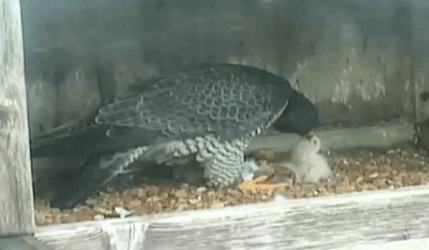
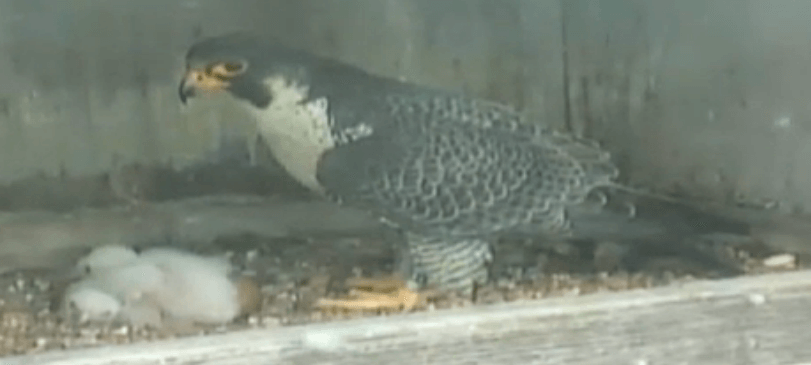
Hello All. The day has come. We have hatching! One of our team members saw the first chick May 1. With the current rainy and somewhat cool weather our female is sitting very tight on her new family, but on the morning of May 3 I finally saw the next generation – we were even able to grab a few photos. When she got up to let the male take over brooding duties, I saw two chicks. For those who watched last year, you may remember we had two then. She had five eggs, and why only two hatched we will never know. However, with her and the male’s old age (13 and 15 years old respectively), it could explain lack of nesting productivity.
When a bird is keeping eggs warm, it’s called incubating. When a bird is keeping chicks warm, it’s called brooding. It’s very important to keep the young chicks warm because birds can’t regulate their own body heat at first. They are much more like their reptilian ancestors (reptiles are cold blooded) until they get to be a certain size and grow their downy feathers to help insulate their small bodies. If you watch the Peregrines on a daily basis, you’ll see mom brooding the chicks a lot over the first 5-10 days. After the 10th or so day, and/or if the temperature warms into the 80’s, mom will start spending less time brooding because the chicks will start to regulate their own 104 degree F body temperature.
Our banding day is scheduled for May 21. We turn the camera off that morning until our activities are done. Then you’ll see the new “jewelry” on the chicks. I like to band the chicks at 20 days because then you can easily tell the difference in size between the males and females. Females are larger than the males, which translates to a different size band for each.
I’m ripe for answering your questions, especially now that the chicks have arrived. Talk to you next week!