Building a Stronger, More Reliable Energy System for You
You rely on safe, reliable power every day. Through Ameren Missouri's Smart Energy Plan, we’re making the energy grid more reliable and better prepared for severe weather. That includes upgrading equipment and power lines, installing stronger poles, and adding technology that helps us detect outages sooner and restore power faster. We’re also investing in new and existing energy centers to help ensure dependable electricity is available when you need it.

What

On June 26, 2026, Ameren Missouri filed a request with the Missouri Public Service Commission (PSC) to adjust base electric rates following recent upgrades to the electric system and construction of new power generation assets that support reliability for Missouri families and businesses.

When

If approved, new rates would begin in mid-2027, following a thorough review by the PSC over the next 11 months.

Why

These investments help deliver the reliable service customers expect, which is especially critical during severe weather, and supporting the energy needs of a growing Missouri economy. We’re focused on keeping service dependable and costs as low as possible.

How Much

If approved by regulators, the typical residential customer would see an increase of about $13 per month, or less than 45 cents a day, based on average usage (about 1,011 kWh).
Key Customer Benefits

Ameren Missouri’s upgrades are strengthening the grid, improving reliability and preparing the system to meet customers’ energy needs for years to come.

Components of the rate review adjustment request include:

  • Strengthening the grid and investing in smart technology through Ameren Missouri's Smart Energy Plan, making the electric system more dependable for families and businesses.
    • Rebuilding electric distribution lines with storm-hardened upgrades throughout north St. Louis and Southeast Missouri after tornadoes and severe weather severely damaged critical infrastructure in spring 2025.
    • Replacing aging infrastructure with new and upgraded power lines with increased capacity.
    • Adding and upgrading substations with smart technology to detect outages faster and restore power more quickly.
    • Upgrading utility poles, many fortified with stronger composite materials, to better withstand severe weather, reduce damage and speed restoration.
    • Utilizing Missouri-based suppliers and contractors to help deliver these projects, supporting local jobs and economic development.
  • Upgrading energy generation sources to keep dependable power available when customers need it through improvements to the Labadie Energy Center and upgrades to the Audrain Energy Center to enable dual-fuel operation.
  • Adding 400 megawatts of new generation to the grid by installing three new energy centers. Once in service by the end of 2026, these diversified power sources will produce enough electricity to power approximately 70,000 homes annually.
  • Establishing a new income-eligible discount rate that offsets the proposed adjustment for our most vulnerable customers without increasing costs for everyone, which helps keep energy costs affordable for seniors and families on fixed incomes.
Working to Keep Rates as Low as Possible

Alongside supporting reliability, we continue to manage costs carefully to help keep rates as low as possible. Today, Ameren Missouri’s residential electric rates are about 27% lower than Midwest and national averages and have remained below those benchmarks for several years. Even with this request, rates are expected to remain below those averages.

This line chart shows rate comparison data for average residential electric prices for 12 months ended June 30 each year from 2018 through 2025. In 2018, Ameren Missouri rates were 10.61 cents per kilowatt hour compared to 12.92 cents for Midwest and 13.24 cents for National averages. In 2019, Ameren Missouri rates were 10.28 cents per kilowatt hour compared to 12.85 cents for Midwest and 13.19 cents for National averages. In 2020, Ameren Missouri rates were 10.02 cents per kilowatt hour compared to 12.84 cents for Midwest and 13.08 cents for National averages. In 2021, Ameren Missouri rates were 9.70 cents per kilowatt hour compared to 12.89 cents for Midwest and 13.08 cents for National averages. In 2022, Ameren Missouri rates were 11.10 cents per kilowatt hour compared to 13.55 cents for Midwest and 14.39 cents for National averages. In 2023, Ameren Missouri rates were 11.28 cents per kilowatt hour compared to 15.44 cents for Midwest and 15.97 cents for National averages. In 2024, Ameren Missouri rates were 11.96 cents per kilowatt hour compared to 16.44 cents for Midwest and 16.50 cents for National averages. In 2025, Ameren Missouri rates were 12.08 cents per kilowatt hour compared to 16.14 cents for Midwest and 16.96 cents for National averages. Ameren Missouri residential rates are 26% below the Midwest average and 28% below U.S. average according to the latest EEI report.
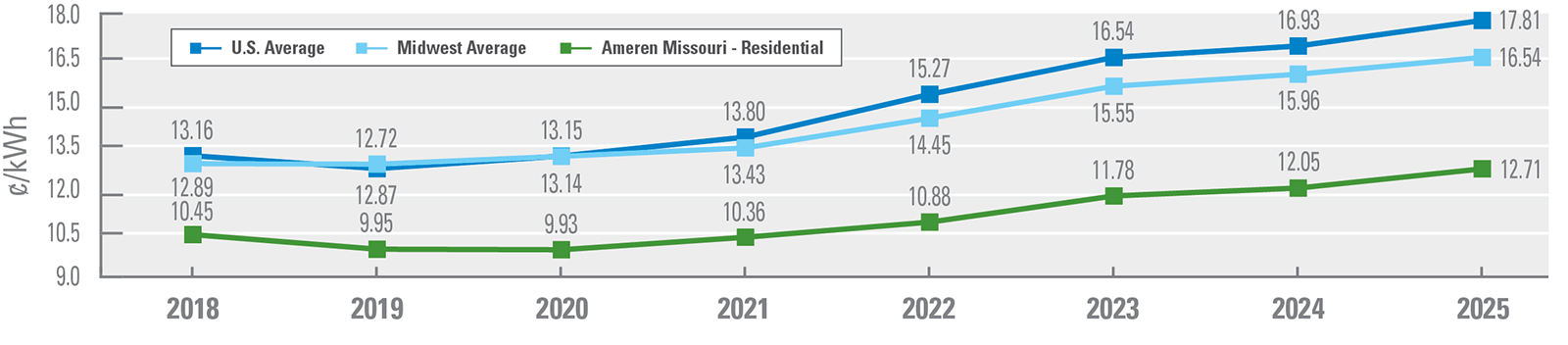
*Source: Average Residential Electric Prices – Edison Electric Institute (EEI), “Typical Bills and Average Rates Report” for 12 months ended June 30 each year through 2025. Ameren Missouri residential rates are 26% below the Midwest average and 28% below the U.S. average according to the latest EEI report.

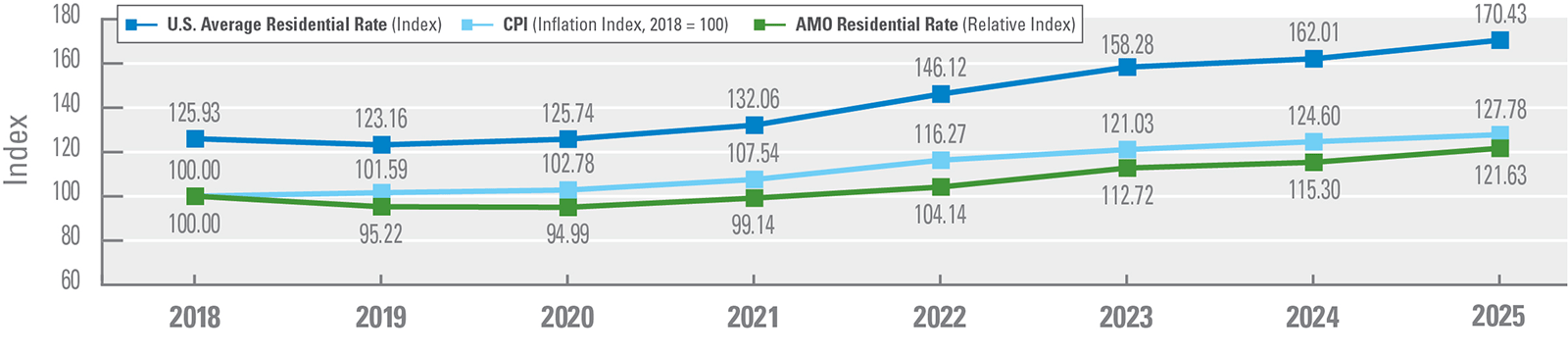
Residential Rates Remain 13%* Below Consumer Price Index

While many everyday household costs have increased over the past decade, we’ve focused on keeping electric rates stable while continuing to invest in reliability and service improvements.

This line chart shows a data comparison of the U.S. average residential rate (index), the Consumer Price Index (CPI), and the average residential electric rates from years 2016 through 2025. In 2016-2017, Ameren Missouri’s residential rate relative index was 100, compared to 100 for CPI and 123.98 for the U.S. average residential rate (index). In 2017-2018, Ameren Missouri’s residential rate relative index was 100.19, compared to 102.86 for CPI and 125.02 for the U.S. average residential rate (index). In 2018-2019, Ameren Missouri’s residential rate relative index was 95.65, compared to 104.49 for CPI and 124.55 for the U.S. average residential rate (index). In 2019-2020, Ameren Missouri’s residential rate relative index was 94.65, compared to 105.31 for CPI and 123.51 for the U.S. average residential rate (index). In 2020-2021, Ameren Missouri’s residential rate relative index was 91.55, compared to 108.16 for CPI and 128.61 for the U.S. average residential rate (index). In 2021-2022, Ameren Missouri’s residential rate relative index was 104.78, compared to 118.37 for CPI and 135.88 for the U.S. average residential rate (index). In 2022-2023, Ameren Missouri’s residential rate relative index was 106.54, compared to 124.49 for CPI and 150.80 for the U.S. average residential rate (index). In 2023-2024, Ameren Missouri’s residential rate relative index was 112.97, compared to 128.57 for CPI and 155.81 for the U.S. average residential rate (index). In 2024-2025, Ameren Missouri’s residential rate relative index was 114.11, compared to 131.43 for CPI and 160.15 for the U.S. average residential rate (index). Ameren Missouri’s residential rates remain 13% below the Consumer Price Index.
*Sources: Year is 12 months ending in October for CPI (Charles River Associates) and ending in June for residential rate data (Average Residential Electric Prices – Edison Electric Institute); residential rate data based on actual revenue and sales.

Powering Growth Responsibly

As Missouri grows, costs to serve new data centers are not causing this request. In fact, Ameren Missouri customers are expected to see projected base rate savings of $21 million over the next two years, driven by committed data center customers.

Our approach to responsibly serving new large load customers is rooted in our Powering Missouri Growth Plan, enabled by Missouri Senate Bill 4. It’s one of the strictest laws in the nation when it comes to supplying power to data centers and providing customer protections by ensuring these new businesses – not other customers – pay the costs to serve them.

Help is Available

If you’re having trouble paying your bill, help is available including financial assistance, flexible payment options and community-based support. Please contact us for information about the following programs:

  • Financial assistance through grants to help customers across a range of income levels.
  • Flexible payment arrangements for those who need more time to pay.
  • Billing Options to help customers manage their energy costs.