

What Are Smart Meters?

What Are Traditional Meters?
Convenience
Choice
Control
Reading your non-standard meter helps ensure your bill is accurate. Most meters have four or five dials that show your energy use. Each dial represents a digit in your total kilowatt-hour (kWh) reading. Your usage is the difference between the current reading and the prior reading.
Tips Before You Get Started:
- Stand directly in front of the meter.
- Make sure you can clearly see each dial.
- Double-check your numbers before recording.
How To Read Each Dial:
- Start with the dial on the far right and record each number as you move across the meter.
- Each dial counts in a different direction than the one next to it:
- On the far-right dial, the numbers increase clockwise (0 → 1 → 2 → 3)
- On the next dial, the numbers increase counterclockwise (0 → 1 → 2 → 3)
- To find the correct reading, follow the order of the numbers (0 → 1 → 2) and when the hand is between two numbers, record the number the hand has already passed.
- If the hand is on a number, record that number.
- If the hand is between 9 and 0, record 9.
- Only use the higher number if the dial to the right has already passed 0.
Example:
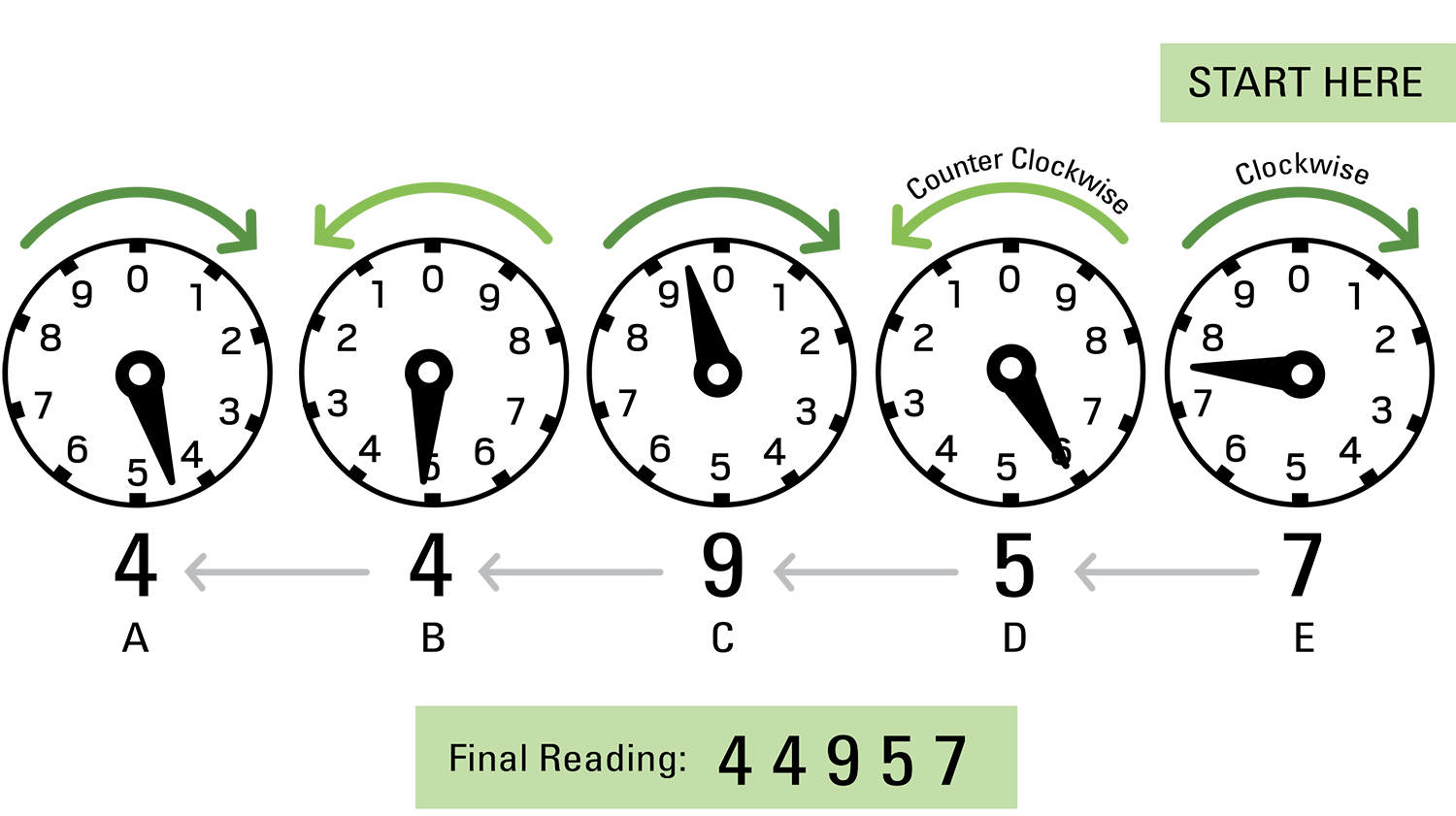
In the pictured example, the dials are labeled A through E:
- Start with Dial E (far right).
- Dial E has not completed a full turn, so Dial D has not moved to the next number.
- Dial E reads 7, and Dial D reads 5.
- Continue this same process across all dials.
Once all dials are read, write the numbers in order from left to right.
Final reading: 44,957 kWh
Reading your non-standard meter helps ensure your bill is accurate. Most meters have four or five dials that show your energy use. Each dial represents a digit in your total kilowatt-hour (kWh) reading. Your usage is the difference between the current reading and the prior reading.

Tips Before You Get Started:
- Stand directly in front of the meter.
- Make sure you can clearly see each dial.
- Double-check your numbers before recording.
How To Read Each Dial:
- Start with the dial on the far right and record each number as you move across the meter.
- Each dial counts in a different direction than the one next to it:
- On the far-right dial, the numbers increase clockwise (0 → 1 → 2 → 3)
- On the next dial, the numbers increase counterclockwise (0 → 1 → 2 → 3)
- To find the correct reading, follow the order of the numbers (0 → 1 → 2) and when the hand is between two numbers, record the number the hand has already passed.
- If the hand is on a number, record that number.
- If the hand is between 9 and 0, record 9.
- Only use the higher number if the dial to the right has already passed 0.
Example:
In the pictured example, the dials are labeled A through E:
- Start with Dial E (far right).
- Dial E has not completed a full turn, so Dial D has not moved to the next number.
- Dial E reads 7, and Dial D reads 5.
- Continue this same process across all dials.
Once all dials are read, write the numbers in order from left to right.
Final reading: 44,957 kWh