
Ameren Missouri filed an application with the Missouri Public Service Commission (PSC) in May 2026 seeking approval to construct a BESS facility at the Millcreek site.
Battery storage facilities store electricity and deliver it back to the grid when it is needed most, including during extreme temperatures. These systems respond almost instantaneously and help support reliable service when conditions change. As part of a broad mix of generation and storage resources, batteries are one of the ways we are working to deliver the energy our customers need while keeping bills as low as possible.
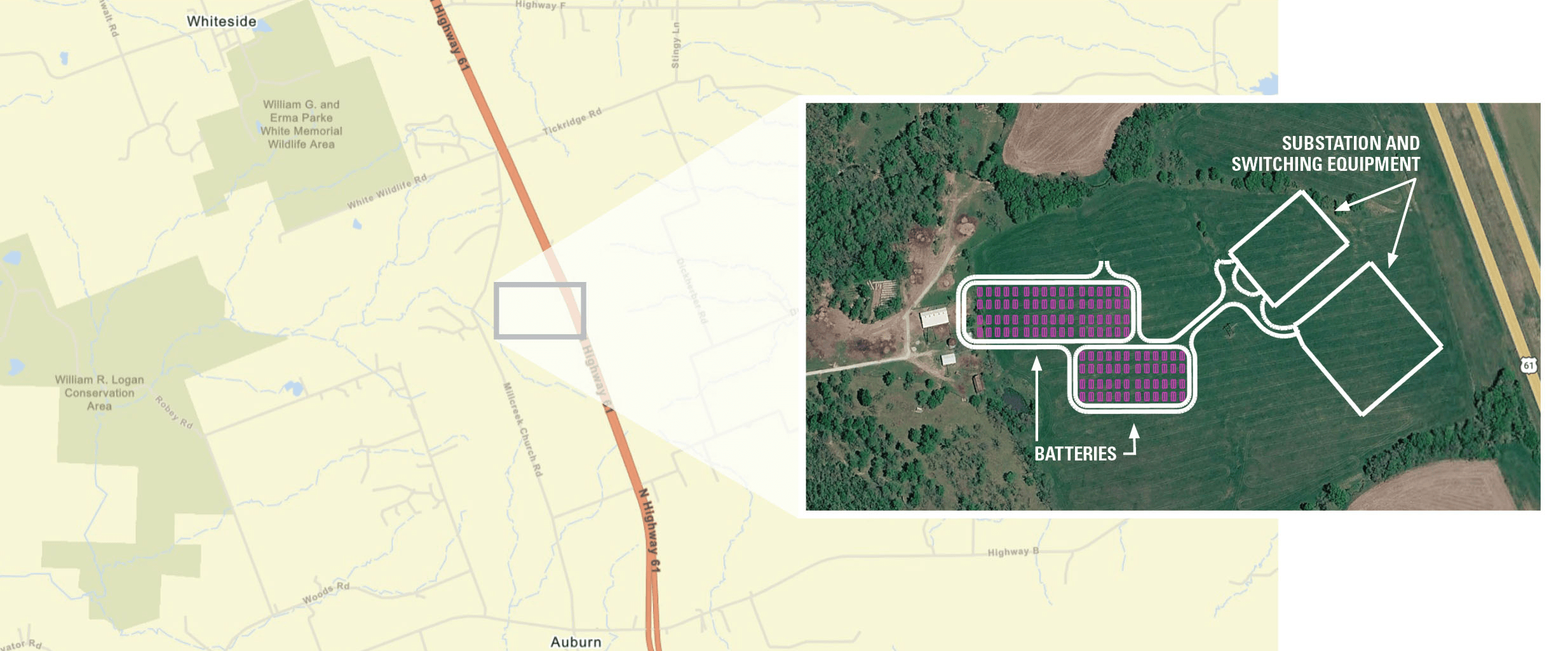
The proposed facility would be located on Ameren Missouri-owned property west of Highway 61 and just south of Tickridge Road. The battery equipment is expected to occupy approximately 12 acres, with an additional 12 acres for substation and switching equipment. More than 200 acres are expected to remain largely undeveloped, providing natural terrain and forested areas to help screen the facility and maintain separation from neighboring land uses. Additional information about battery storage technology, safety, environmental considerations and project development is available on our Battery Storage Information page.
With timely PSC approval, the project will be ready to serve customers in 2028.
Proposed Location
Reliability
Revenue
Jobs
The project schedule will be updated as major milestones are met. The schedule is subject to change.
In addition to the battery project, Ameren Missouri is evaluating a potential solar project in the area. Site studies are underway, and details are still being developed. No application has been filed with the Missouri Public Service Commission. If the project moves forward, it will go through its own community engagement and review process with the commission.
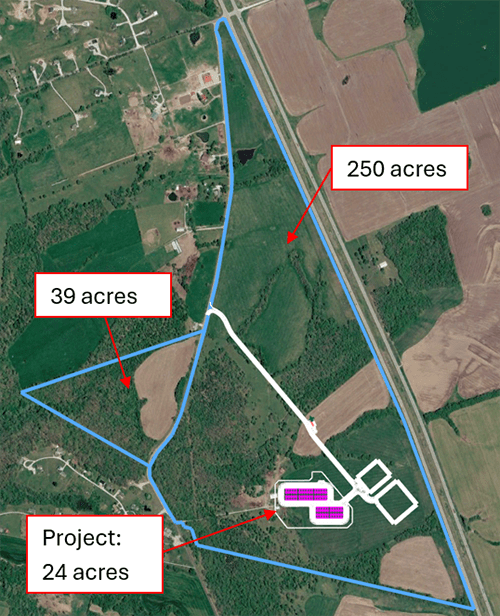
The proposed battery storage facility would use approximately 12 acres of Ameren Missouri-owned land in Lincoln County. The associated switching and substation equipment would use another 12 acres. They would be surrounded by an additional 265 acres that are expected to remain largely undeveloped, providing natural terrain and forested areas to help screen the facility and maintain separation from neighboring land uses.
Ameren Missouri must receive approval from the Missouri Public Service Commission before the Millcreek battery storage project can be built. The Commission's review process includes regulatory filings, data requests by parties to the case and opportunities for public input before a decision is made.
As part of that process, Ameren Missouri provides studies, reports and other supporting information for review. The Commission and other participating parties review that information and request additional details as part of their evaluation. The review process includes opportunities to examine a variety of issues including safety and environmental considerations before any approval is granted.
Like many real estate transactions, the land purchase agreement contains confidential business terms. Those provisions help protect the privacy of the parties involved, including the local landowners.
Confidentiality provisions do not change the approval process for the Millcreek battery storage project. Information about the project itself, including the proposed location, application materials and regulatory filings, is available through the Missouri Public Service Commission and the Millcreek project website. Residents can review those materials, ask questions and provide feedback as part of the public review process.
Property agreements are written to address a broad range of possible scenarios that could arise over the life of a project. References to things like glare, noise or interference are included to clearly define property rights and responsibilities if questions arise in the future.
Energy projects are planned and designed to minimize impacts on neighboring properties. Including these topics in an agreement does not mean Ameren Missouri expects them to become significant issues. Instead, the provisions are intended to address potential questions up front, so expectations and responsibilities are clearly understood by all parties.
Currently, Ameren Missouri has no proposal for solar in Lincoln County before the Missouri Public Service Commission, and it is not a part of this application. While Ameren Missouri is considering a future solar project in the area, such a project would require its own review and approval process before the Missouri Public Service Commission.
Ameren Missouri would own and operate the proposed Millcreek battery facility throughout its life. As a regulated utility, the Company remains responsible for maintaining its facilities, meeting regulatory requirements and serving customers long after construction is complete. The State of Missouri will continue to have oversight of Ameren Missouri and this project.
Ameren Missouri has served customers in Missouri for more than 100 years and expects to continue serving customers in Lincoln County for generations to come. Many Ameren Missouri employees live and work in Lincoln County and nearby communities. The proposed facility would be part of the electric system Ameren Missouri operates every day to help deliver reliable service to homes and businesses across the region, and the company would remain responsible for its operation, maintenance and eventual retirement.
Reliable electric service depends on many types of infrastructure working together. Residents in Lincoln County saw firsthand this spring how important a resilient electric system is when severe weather and an EF1 tornado touched down near Troy. Since 2019, Ameren Missouri has completed approximately 175 reliability projects in the region designed to reduce outages and improve service restoration. Those investments have helped prevent storm-related outages, improve restoration capabilities and strengthen the electric system for customers. The proposed Millcreek battery facility would build on those investments by adding another tool to make energy available when customers need it most.
Ameren Missouri evaluates many factors when considering potential locations, including the ability to deliver the greatest reliability benefits to customers. The proposed site was selected because it offers access to existing transmission infrastructure, land made available by landowners, and the ability to help meet identified energy system needs. Battery storage facilities must be connected to the electric grid and locating projects where transmission infrastructure already exists can reduce the need for additional infrastructure while supporting reliable electric service for customers.
Projects must be built where they can safely connect to the electric grid, operate effectively and support the electric system that serves customers.
Ameren Missouri evaluates potential sites using a range of factors rather than selecting locations based on whether they are rural or urban. The goal is to identify locations that can support the infrastructure needed to provide reliable service to customers while minimizing impacts. Ameren Missouri has never used eminent domain to acquire property for a battery or solar project, and all transactions have been completed with landowners.
Ameren Missouri pursued projects at its retired coal-fired power plants first, Rush Island and Meramec, utilizing land that has been dedicated to energy production for many decades. This resulted in the Big Hollow BESS and Castle Bluff BESS projects. Additionally, the Huck Finn BESS project is being added to the Audrain Energy Center property that is already owned by the company.
The proposed Millcreek battery storage project was identified through that evaluation process. Access to the transmission system, the ability to connect to the electric grid and the needs of the electric system were among the factors considered when evaluating potential locations. The proposed facility would help support the electric infrastructure that delivers energy to customers across the region.
No. The proposed battery storage project and substation would sit on 12 acres each. Lincoln County has a long agricultural tradition, and Ameren Missouri understands why land use is important to many residents. The proposed facility would use a specific site selected through a broader evaluation process that considers many factors, including customer and electric system needs and grid access. The location was selected because it can support infrastructure that helps serve customers while meeting the technical requirements needed to connect to the electric system. The overall property selected for this project is not solely agricultural and contains over 121 acres of wooded area, which will remain undeveloped to create a natural buffer around the project site.
No. The proposed Millcreek battery storage project is being developed to help meet energy system needs and support reliable electric service for customers across Ameren Missouri's service territory.
Like other energy infrastructure projects, battery storage facilities are located based on factors such as access to existing transmission infrastructure, site characteristics and the ability to support the electric grid where it is needed. The presence of a battery storage facility or solar facility does not indicate that a data center is planned for a particular location, nor does it mean that any future development will occur nearby.
Like Ameren Missouri's other retired energy centers, once the facility is retired, battery units and other project equipment would be removed and the site would be restored.
Equipment that remains serviceable may be reused or repurposed, while metals, wiring, transformers, structural steel and other conventional materials can generally enter established recycling streams.
Lithium-ion batteries can also be recycled. Specialized battery recyclers can recover materials such as lithium, copper, aluminum and graphite for reuse in new batteries or other products.
Ameren Missouri used experienced consultants to complete an environmental review for the Millcreek BESS project. This includes a Phase I Environmental Site Assessment, a Waters Delineation Report, and drainage and flood-related studies. These reviews help ensure the project is being designed responsibly, with appropriate consideration for land, water, wildlife, and long-term site conditions.
Findings did not identify significant environmental barriers to development. The Phase I Environmental Site Assessment found no recognized environmental concerns. Water-related impacts are expected to be limited and are primarily associated with the project entrance road, where stream crossings may be needed. Ameren Missouri is coordinating with the U.S. Army Corps of Engineers so those crossings can be designed and permitted to avoid, minimize, or limit environmental impacts.
Overall, the environmental reviews support moving the project forward responsibly, with agency coordination and measures in place to protect environmental resources.
Yes. Ameren Missouri has met with and continues to meet with local fire departments and emergency responders about this project. Emergency response planning and training are developed in coordination with local responders, so they have specific information before the facility begins operation. The company's plans also include safety documentation, training, and visits for local responders. Current industry guidance for responding to a BESS fire is to monitor and contain the incident rather than actively fight the fire directly. This approach reduces the burden on local fire departments with limited resources.
Ameren Missouri continues to develop emergency response plans in coordination with local responders, including training. Preparing for emergencies is one part of a broader safety approach that includes battery technology selection, facility design, monitoring systems and ongoing coordination with local responders.
Today’s utility-scale battery systems incorporate inherently safer lithium iron phosphate (LFP) chemistry, advanced monitoring systems, automatic safety controls, and built-in fire and explosion mitigation features to detect issues early, isolate affected equipment, and help prevent fires from spreading beyond a single battery unit. Ameren also takes a conservative approach to battery container setbacks and unit spacing to reduce the potential for heat from one unit affecting neighboring units or the surrounding area.
Energy storage systems are required to pass rigorous testing demonstrating that they meet nationally recognized safety standards, including Underwriters Laboratories (UL) standard 9540 for the complete system, UL 1973 for battery systems, UL 1642 for individual lithium battery cells, UL 1741 for power conversion equipment, and UL 9540A for fire propagation testing. These standards exist to protect people and property by confirming that the system is properly designed, built, installed, and able to operate safely under normal and abnormal conditions.
The testing to meet those UL standards is rigorous because it evaluates safety at multiple levels: the cell, module, battery unit, and full system. Tests include electrical stress, short circuit and overcharge conditions, grounding and insulation checks, electromagnetic interference, mechanical impact and crush forces, moisture, corrosion, seismic vibration, high temperature exposure, and thermal runaway fire testing. To pass, the product must avoid unacceptable outcomes such as fire spread, explosion, electric shock, hazardous leakage, loss of protective controls, or unsafe operation.
Before an energy storage system can be installed, it must also comply with mandatory safety standards including National Fire Protection Association (NFPA) standard 855, as well as applicable International Fire Code standards which require rigorous testing, design reviews, and performance validation.
Protecting people and the environment is a key part of emergency response planning. Any fire can produce smoke and other byproducts, which is why battery storage projects incorporate multiple layers of monitoring, detection and protection intended to identify issues early and eliminate explosive hazards.
Battery energy storage systems are designed and tested to meet rigorous fire safety standards, including NFPA 855, applicable fire code requirements and UL 9540A-based hazard analysis. Third-party testing shows that, even under severe emergency conditions, fires are expected to remain contained within the affected enclosure, and concentrations are small enough that they are quickly diluted upon contact with the air, meaning there is no negative impact on air quality in the surrounding area. These results support the conclusion that modern battery systems can be operated safely without posing a meaningful risk to air quality.
BESS units are designed to make it difficult for water to come in contact with the enclosed battery cells. Fire water runoff testing has shown no harmful levels of contaminants. The manufacturer's Emergency Response Guide recommends no direct water application to a fire. In addition, the facility design includes containment barriers around the equipment as well as detention basins to capture site runoff, further minimizing impacts to the surrounding environment during an emergency event or normal operations.
Our project design also includes stormwater management and containment measures to manage water and runoff on the property during construction, normal operations and emergencies. Emergency response procedures are developed to help protect county residents, property and environmental resources.
Energy stored at the facility would be delivered to the electric grid, where it would be available to serve customers across Ameren Missouri's service territory. Electricity stored by the project would not be reserved for a single community or county.
The proposed facility would be in Lincoln County and would help support local energy reliability while also contributing to the broader electric grid that serves communities throughout the region. When electricity demand is high, battery storage can discharge energy to help keep power available when customers need it most.
The proposed project would be part of the infrastructure that helps deliver reliable electricity to homes, schools, farms and businesses across the region. Battery storage can store electricity when it is available and deliver it back to the grid when demand is high, helping keep power available when customers need it most.
The project could also generate local economic activity during construction and contribute revenue to support community priorities such as schools, public services and infrastructure.
Customers depend on electricity every hour of every day, including during periods of high demand and extreme weather. Battery storage helps keep power available when customers need it most by storing electricity and delivering it back to the grid when demand is high.
As energy use continues to grow, Ameren Missouri is planning the resources needed to maintain reliable electric service. Battery storage is one tool that can help support reliability by providing additional flexibility to the electric system and making energy available when it is needed most.
Email: connect@millcreekenergycenter.com
Telephone: 877.456.1535